From Kristallnacht to the midterms: Why this November is not the November of yesteryear - opinion

November is a significant month for Israel and the Jewish people. For my late husband, John, November 9, 1938 – commemorated as Kristallnacht – was consequential; the night between November 9 and 10 was when the Germans set aflame Synagogues and Jewish businesses throughout Germany.
John’s father was the rabbi of a synagogue in Bamberg, Germany. As a 10-year-old boy, John remembered, graphically, seeing his father’s synagogue ablaze on that night – a vision that remained with him his entire life.
Ultimately, John became an architect and designed numerous prestigious projects, not only in the UK but in many parts of the world.
However, for him, the most emotionally meaningful buildings he created were two synagogues in London: one for our own community in London’s Mill Hill and the other on the grounds of a Jewish high school.
Later in life, John started painting, proving to be an accomplished artist.
The painting that has center stage in our home is the one where we see Bamberg and the burning synagogue on the left side, together with him standing with his mother and sister as the Germans took his father to Dachau, one of the first concentration camps set up by Adolf Hitler in 1933.
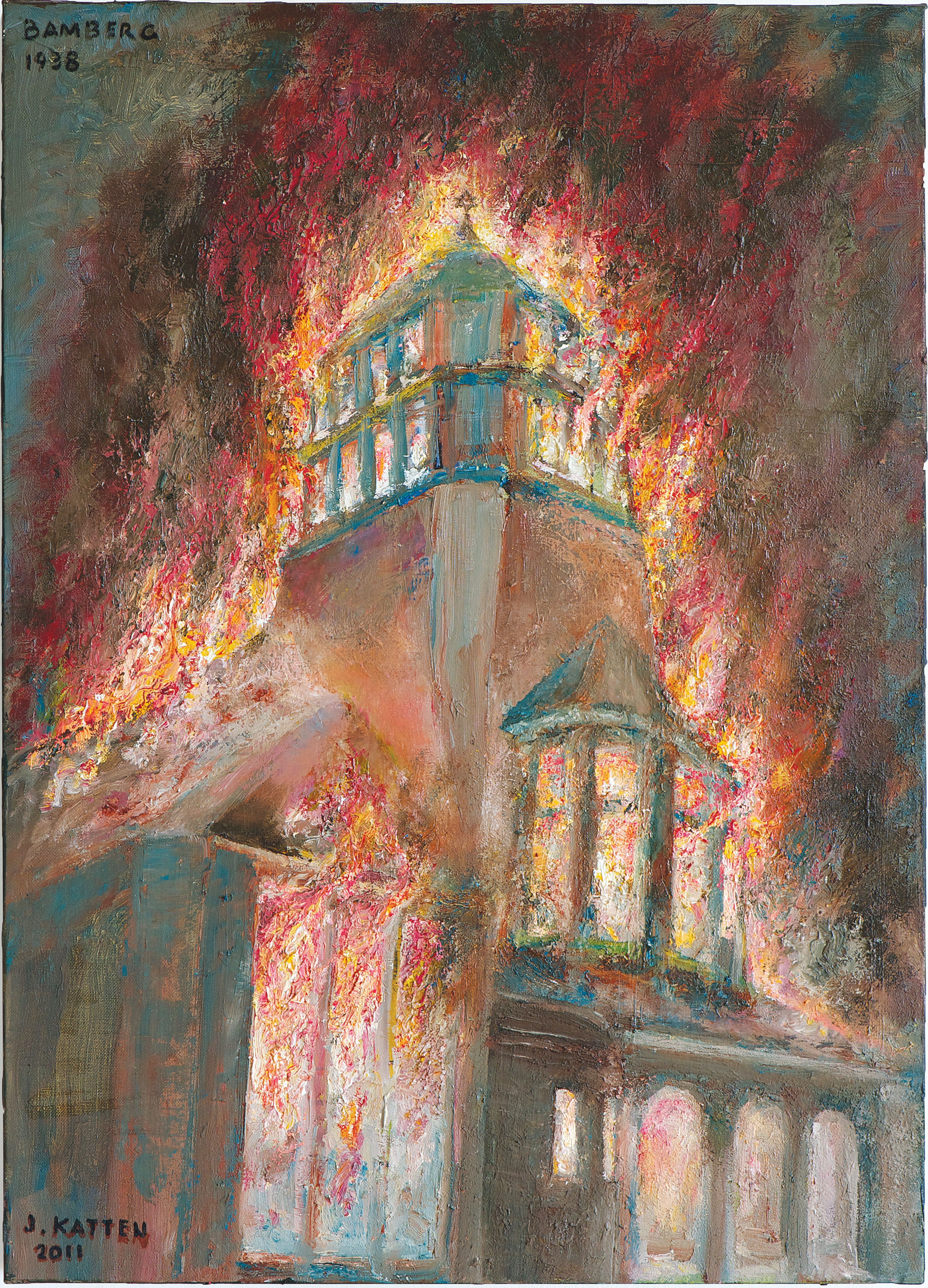
Fortunately, as the Kattens had exit visas for the United States, John’s father, together with other Jewish men who had exit papers, was released after some two months but returned home a shadow of his former self.
On the right side of the painting are the dove of peace, sunshine and light, and grandchildren playing on the beaches of Israel.
JOHN, HIS PARENTS, and his sister found refuge in Britain in 1939.
Although the family had papers to enter the US, the date for entry was November 1940. As the clouds gathered in 1939, his parents realized that waiting until November 1940 would be too late.
John was fortunate that his mother’s father, Rabbi Michael Guttmann, an eminent rabbi in Budapest who headed the Rabbinical Seminary, knew Britain’s chief rabbi at the time, Rabbi Hertz, a fellow Hungarian whose intervention enabled the Katten family to survive.
Hertz used his influence to obtain temporary visas for the family to enter Britain until their American papers became valid.
Sadly, John’s paternal grandmother, who was widowed early in life and lived with John’s parents and family, was unable to leave Germany. She was murdered in Theresienstadt.
His Hungarian grandmother committed suicide in 1944 when the Germans entered Hungary, sending her son, daughter-in-law, and baby grandchild to Auschwitz.
The impact of the Balfour Declaration
November 2, 1917, British foreign secretary Arthur James Balfour wrote to Lord Rothschild – a respected leader of the Jewish community – stating, “His Majesty’s Government view with favour the establishment in Palestine of a national home for the Jewish people...”
This document became known as the Balfour Declaration.
The tragedy for the Jewish people was that the Balfour Declaration took 30 years to come to fruition – as it did on November 29, 1947, when the UN voted for the partition of Palestine into two states: one for the Jews and one for the Arabs, which they declined.
We can but ask ourselves, had the Declaration come to fruition 10 years earlier, in 1937, would the millions of Jews have been saved from the Holocaust? Because they would have had a Jewish state willing to take in those attempting to escape the vile antisemitism of Germany and Austria in 1938.
History recalls that in July 1938, some 32 countries, including Britain, Australia, Canada, and America, came together in Evian, France, specifically to discuss how many Jews each country was prepared to absorb, as Hitler had declared he wished to rid himself of the Jews.
Tragically for the Jewish people, the sole country among the 32 prepared to take in a few Jews was the Dominican Republic.
Israel, Jews face one of the most challenging periods since 1948
THERE ARE times, and there are times, but as I write today, I sense that we are currently facing one of the most challenging periods for Israel and the Jewish people since our homeland’s rebirth in 1948.
For the regular readers of my articles, you will have sensed my fear and apprehension as to what is evolving – both here and there.
In the Diaspora, our brothers and sisters continue to face an unprecedented rise in antisemitism the likes of which has not been experienced since the 1930s. In some ways, it is worse today because antisemitism is prevalent throughout the world rather than solely in Germany and Austria as it was then.
And what of our closest ally, the US?
As if our own election challenges are not enough of a problem, the results of the November midterm elections in the US came, and US President Donald Trump lost his party’s majority in both the House of Representatives and the Senate.
It would appear this was the prime reason Trump chose to announce on November 3, Election Day itself, that the US military assistance package to Israel, amounting to $3.8 billion per year and due to end in 2028, would now end by this year’s conclusion. He hoped this would turn the tide in favor of the Republican Party’s votes.
Of specific concern is the number of members – of both houses – who clearly no longer wish to support the one Jewish state. It was exceedingly disturbing to hear the election campaign speeches of far too many candidates calling for an end to the close relationship that has existed between Israel and the US.
Vice President JD Vance blamed the war with Iran for the loss of the midterm elections. Over the past months, there have been continued insinuations that it was Israel that “dragged” the US into the war.
Perhaps one of the most worrying aspects of these recent mid-term elections is the number of Jews who voted for Democratic Party candidates, including those who are virulently anti-Israel.
Too many American Jews are turning away from Israel. Could those of us in Israel have done anything to prevent this from happening?
We should have strived to remain bipartisan in relation to the Republican and Democratic Parties, which, under Prime Minister Benjamin Netanyahu, we clearly did not.
How well do we remember 2015, when Netanyahu blasted US president Barack Obama in his address to Congress?
Last week, Senator Chris Van Hollen, one of Israel’s most prominent critics in Congress, announced he will challenge Senator Chuck Schumer for the Democratic majority leadership in the Senate.
Van Hollen is among those who have worked to halt arms shipments to Israel, accusing it of committing genocide in Gaza.
However, there is another reason that could explain why so many Jews are turning away from Israel, and that is they are no longer very Jewish.
Bottom line: if you no longer feel being Jewish is OK (and certainly the outside world is making Jews feel anything but OK), then why should you be interested in Israel?
For those of us who grew up knowing the meaning of our prayers understand that Zion means Jerusalem, the direction we turn when praying. Sadly, too many young American Jews are ignorant as to the Jewish historic connection to Israel.
Yes, we Jews are living in challenging times, but let us remind ourselves how fortunate we are to be the generation blessed to have a Jewish state. We, who live here, are privileged to live in a land where it is OK to be Jewish.
For our brothers and sisters living in the Diaspora, they know that the doors of Israel remain ever open – because this is November 2026, and not the November of yesteryear.
Am Yisrael chai!■
The writer is the president of the Israel, Britain and the Commonwealth Association, and has chaired public affairs organizations in Israel and the UK.
KioskNews shows a cleaned-up reading view extracted from the publisher’s page — the original always lives on their site, not ours.