8 Classic Books To Read Before Kicking the Bucket

At any given moment, Scott Simone has at least three books jockeying for his attention. He’ll never turn down a campus novel with a literary bent, nor will he hesitate to add yet another mystery to his Leaning Tower of Pisa-inspired to-be-read pile — which is built upon the bedrocks of too many short story collections, how-are-these-real true crime books, and classics waiting to be cracked open again. Topics that have him ripping through pages the fastest include closed-circle murders, unhappy professors, life-questioning philosophical deep dives, so long as they feature sharp sentences, a dark sense of humor, and at least a little malice.
He’s spent so much time in book shops over the years he is, to his wife’s chagrin, continuing to build a library that doesn’t quite respect the dimensions of the apartment meant to contain it.
Sign in to your Collider account
The classics suffer a strange fate. They have become so celebrated for their literary achievements that people seem to forget what actually happens in them. Ulysses becomes shorthand for an impossibly difficult book. Middlemarch sounds like 900 pages of homework. And Don Quixote gets reduced to an old man attacking windmills. It's an awfully reductive way to treat books that have spent centuries outliving their contemporaries.
But if we're talking about books worth reading before kicking the bucket, there's more to consider than their places in the literary canon. Some do extraordinary things with language and form; others find an entire philosophy in the most ordinary human experiences. A few are just downright strange. All deserve to be read for reasons that have little to do with their reputations.
'The Magus' (1966)

John Fowles doesn't get nearly enough credit as one of the great English novelists of the 20th century. His debut, The Collector, could also take a spot on this list, with its disturbing, point-of-view switching account of a man who treats a kidnapped woman like another specimen in his butterfly collection. But The Magus is a special beast. It's a 600-plus-page account of Nicholas Urfe, an Oxford-educated Englishman, who's thoroughly dissatisfied with his life and so takes a teaching job on a Greek island. It's there he meets the wealthy eccentric, Maurice Conchis, whose favorite pastime is psychological warfare.
Fowles is meticulous as he builds a psychological maze. He takes the reader through endless theatrical performances, contradictory stories, and revolving identities. Those elements all conspire to implicate the reader as well. Nicholas is a bit too confident, thinking himself too intelligent to fall for Conchis' deceptions. But a new chapter unfolds, and yet another explanation is revealed. We buy into it just as much as Nicholas. Fowles, too, is a bit too taken in with his own cleverness, with arguably a few too many twists. Still, The Magus is awfully entertaining — a novel you'll find yourself speeding through, but contemplating far longer than it took to read.
'Middlemarch' (1872)

Dorothea Brooke desperately wants to make something of her life. She believes she can help bring to fruition the supposedly monumental intellectual work of the aging scholar Edward Casaubon. So she marries him. The trouble is that Casaubon has spent so long contemplating his own brilliance that he has little time for anyone else's ambitions. Elsewhere in Middlemarch, the young doctor Tertius Lydgate arrives determined to reform medicine, only to discover his professional aspirations don't necessarily agree with his wife's expensive tastes.
Nearly everyone in George Eliot's Middlemarch thought their life would turn out a little differently. Eliot shines a light on their woes, dissecting their marriages and debts, amplifying the gossip and petty grievances. You watch as each character makes one seemingly reasonable decision after another. But they gradually find themselves trapped within their own ambition. Even the most insufferable among them has easily understandable motives. That's how Middlemarch absorbs the reader: by being so flatly relatable. The reader spends hundreds of pages judging characters for making decisions you know will come back to haunt them. Then you realize you would've likely made exactly the same ones.
'The Master and Margarita' (1967)

The Master and Margarita reads like a bad trip. There's a theater in Moscow where money rains from the ceiling. There are women who receive beautiful but disappearing clothes. There's a giant black cat carrying a pistol. And then, of course, there's the devil himself, masquerading as a mysterious professor named Woland. The city's bureaucrats and literary elites, like the reader, try to make sense of all the strange goings-on. Yet every one of their attempts to restore order has the opposite effect, and they're left looking more and more ridiculous. And that's perhaps Mikhail Bulgakov's nastiest joke: With everyone scrambling to explain away the chaos, the devil somehow comes off as the only one who knows what the hell is going on.
Bulgakov seems to be writing several novels at once. There's the absurdist comedy unfolding in Moscow, a retelling of Pontius Pilate's role in the crucifixion of Jesus, and a love story involving a persecuted writer and a woman prepared to strike a bargain with the devil. It's a strange combination, sure, but it all gradually comes together, circling questions of cowardice, censorship, and the consequences of telling the truth as it does. Bulgakov knew a thing or two about those subjects. He wrote the novel under Stalin's regime and died without ever seeing it published.
'Giovanni's Room' (1956)

David is rather good at convincing himself that the things he wants aren't really what he wants at all. He's an American living in Paris, and his fiancée is traveling through Spain while considering his proposal. While she's out of the picture, he meets Giovanni, an Italian bartender, and the two begin an affair. It doesn't take long for David to move into Giovanni's cramped room, where he briefly allows himself to live a life he refuses to acknowledge as his own. But he knows his girlfriend will return, and David has no intention of letting the affair interfere with the future he's planned.
James Baldwin plays a not-so-subtle trick, revealing early on that Giovanni is awaiting execution. So there's no mystery that tragedy awaits the characters. The suspense instead is in watching David rationalize his increasingly cruel behavior. He spends so much time worrying about what sort of man he ought to be that he hardly notices what he's doing to the man he loves. Baldwin makes his excuses so convincing that the reader occasionally buys into them, too. Giovanni's Room is less about David's inability to understand himself than his determination to avoid doing so, even when somebody else must suffer the consequences.
Collider Exclusive · Middle-earth Quiz
Which Lord of the Rings
Character Are You?
One Quiz · Ten Questions · Your Fate Revealed
The road goes ever on. From the green hills of the Shire to the fires of Mount Doom, every soul in Middle-earth carries a destiny. Ten questions stand between you and the truth of who you are. Answer honestly — the One Ring has a way of revealing what we most want to hide.
💍Frodo
🌿Samwise
👑Aragorn
🔥Gandalf
🏹Legolas
⚒️Gimli
👁️Sauron
🪨Gollum
01
You are handed a responsibility that could destroy you. What do you do? The weight of the world falls on unlikely shoulders.
02
Your closest companion is heading into terrible danger. You: True loyalty is revealed not in comfort, but in crisis.
03
Enormous power is within your reach. Your instinct is: Power corrupts — but only those who reach for it.
04
What does "home" mean to you? Where we long to return reveals who we truly are.
05
When a battle is upon you, your approach is: War reveals what we are made of — whether we like it or not.
06
Someone comes to you for advice in their darkest hour. You: Wisdom is not knowing all the answers — it's knowing which questions to ask.
07
How do you see yourself, honestly? Self-knowledge is the most dangerous kind.
08
Which of these best describes your relationship with the natural world? Middle-earth speaks to those who know how to listen.
09
You encounter a wretched, pitiable creature who has done terrible things. You: How we treat the fallen reveals the height of our character.
10
When the quest is over and the songs are sung, what do you hope they say about you? In the end, we are all just stories.
The Fellowship Has Spoken Your Place in Middle-earth
The scores below reveal your true character. Your highest number is your match. Even a tie tells a story — the Fellowship was never made of simple people.
💍 Frodo
🌿 Samwise
👑 Aragorn
🔥 Gandalf
🏹 Legolas
⚒️ Gimli
👁️ Sauron
🪨 Gollum
You carry something heavy — and you carry it alone, even when you don't have to. You were not born for greatness, and that is precisely why greatness chose you. Your courage is not the roaring, sword-swinging kind; it is quiet, stubborn, and terrifying in its refusal to quit. The Ring weighs on you more than anyone can see, and still you walk toward the fire. That is not weakness. That is the rarest kind of strength there is.
You are, without question, the best of them. Not the most powerful, not the most celebrated — but the most essential. Your loyalty is not a trait; it is a force of nature. You would carry the person you love up the slopes of Mount Doom if it came to that, and we both know you'd do it without being asked. The world needs more people like you, and the world is lucky it has even one.
You were born to lead, and you have spent years running from it. The crown is yours by right, but you know better than anyone that right means nothing without the will and the worthiness to back it up. You are tempered by loss, shaped by long roads, and defined by a code of honour you hold to even when no one is watching. When you finally step forward, the world shifts. Because it was always waiting for you.
You have seen more than you let on, and you say less than you know — which is exactly as it should be. You are a catalyst: you do not fight the battles yourself, you ignite the people who can. Your wisdom comes not from books but from an age of watching what happens when it is ignored. You arrive precisely when you mean to, and your presence alone changes what is possible. A wizard is never late.
Graceful, perceptive, and almost preternaturally calm under pressure — you see things others miss and act before others react. You do not need to make a scene to be remarkable; your presence speaks for itself. You are loyal to those you choose to stand beside, and that choice is not made lightly. You have lived long enough to know that the most beautiful things in this world are also the most fragile, and that is why you fight to protect them.
You are loud, proud, and absolutely formidable — and beneath all of that is one of the most fiercely loyal hearts in Middle-earth. You don't do anything by half measures. Your friendships are forged like iron, your grudges run as deep as mines, and your courage in battle is the kind that makes legends. You came into this fellowship suspicious of everyone and ended it willing to die for an elf. That is not a small thing. That is everything.
You think in centuries and act in absolutes. Order, dominion, control — not because you are cruel by nature, but because you have decided that the world left to itself always falls apart, and you are the only one with the vision and the will to hold it together. You were not always this. Something was lost, or taken, or betrayed, and the version of you that stands now is the answer to that wound. The tragedy is that you're not entirely wrong — just entirely too far gone to course-correct.
You are a study in contradiction — pitiable and dangerous, cunning and broken, capable of both cruelty and something that once resembled love. You are defined by loss: of innocence, of self, of the one thing that gave your existence meaning. Two voices war inside you constantly, and the tragedy is that the better one sometimes wins, just not often enough, and never at the right moment. You are a warning, yes — but also a mirror. We are all a little Gollum, given the right ring and enough time.
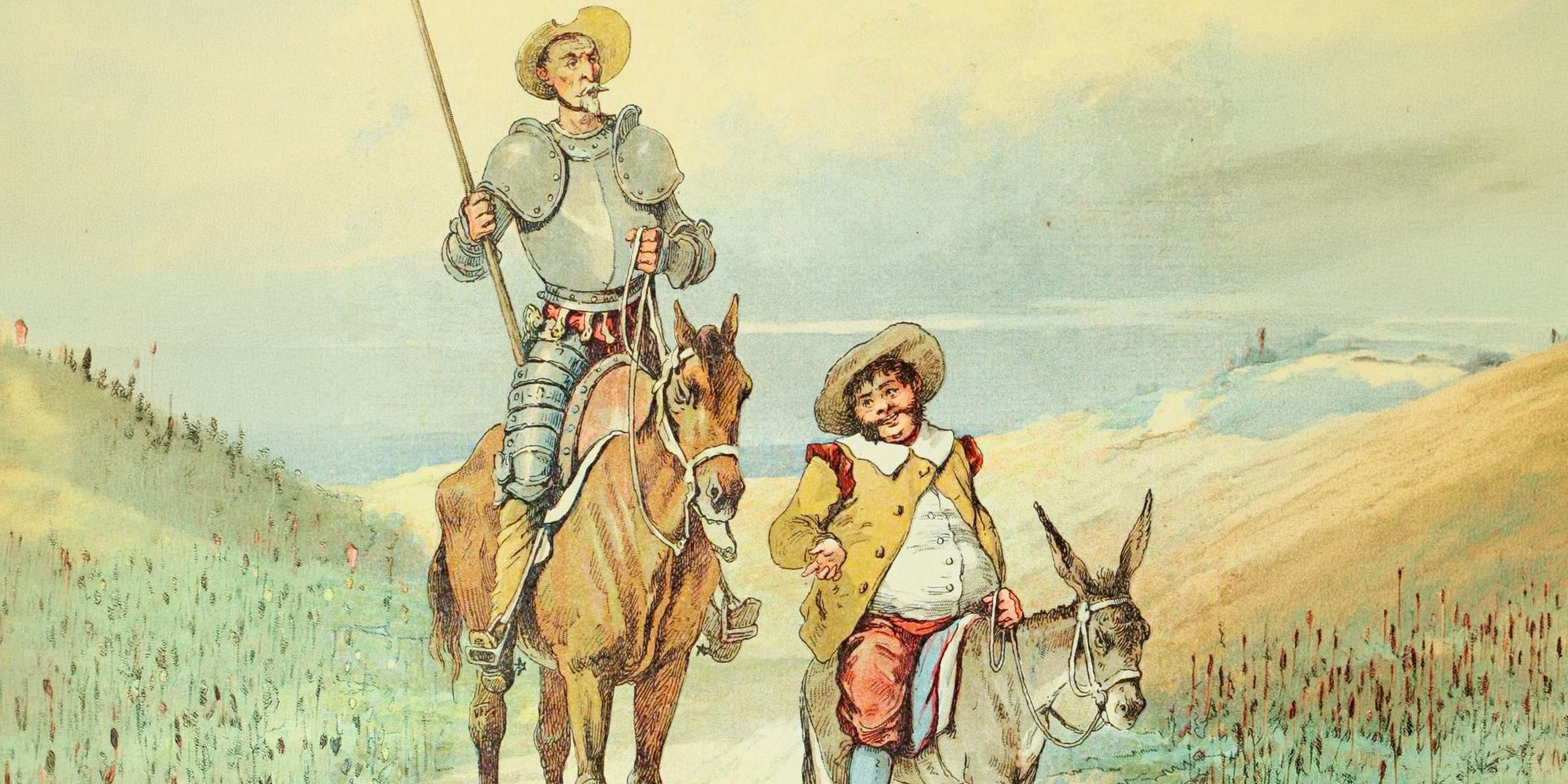
'Don Quixote' (1615)

Alonso Quixano has read far too many books about knights. He's become so taken with their heroic exploits that he decides to become one himself. So he adopts the name Don Quixote, saddles a decrepit horse, and recruits a local farmer named Sancho Panza as his squire. He's read himself out of reality, though, and becomes convinced the world operates like the stories in his books. So he charges at windmills he mistakes for giants, he sees ordinary inns as castles, and he declares a barber's basin a knight's helmet. Sancho knows a windmill when he sees one. He spends much of his journey trying, without much luck, to convince his master of the same.
Miguel de Cervantes has plenty of fun at Quixote's expense. Eventually, though, the joke turns. In the second volume, Quixote meets people who've read about his earlier adventures. While they know he's delusional, they don't talk sense into him; they'd rather play elaborate pranks to make him look the fool. You start to wonder who's really lost their mind. But there's an even greater irony to the whole novel: Cervantes wrote about a man who read so many books he lost his grip on reality, only for Don Quixote to change how novels are written.
'Beloved' (1987)

Sethe has put up with the ghost at 124 Bluestone Road for years. It's a disagreeable housemate, breaking things, moving furniture, and scaring off visitors, but Sethe and her daughter Denver have gotten used to it. And she's survived worse: Sethe escaped slavery in Kentucky and made it to Cincinnati. But the family she hoped to build there has more or less fallen apart. Then Paul D, a man she knew from the plantation, turns up and drives the ghost away. He stays, and for the first time in years, Sethe has reason to believe something good might happen to her. That's roughly when a mysterious young woman arrives, calls herself Beloved, and makes herself at home.
Toni Morrison, of course, hasn't told us the worst of it yet. She keeps returning to Sethe's years in slavery, revealing bits of the story through characters who remember things rather differently. There's plenty that Sethe herself would prefer to leave alone. Gradually, we learn what really happened to her baby daughter. It's horrifying, and Morrison makes no attempt to pretend otherwise. But she also takes us back to the circumstances surrounding Sethe's decision, and suddenly, condemning her doesn't come quite so easily.
'Ulysses' (1922)

Leopold Bloom gets through June 16, 1904, without doing much that would interest a heroic poet. He cooks himself a pork kidney, attends a funeral, runs errands, and wanders around Dublin worrying about his marriage. Stephen Dedalus, meanwhile, spends much of the day drinking, arguing, and thinking rather highly of his own intellect. Eventually, the two meet. James Joyce, with a considerable amount of nerve, decides these small adventures deserve the same treatment Homer gave Odysseus. But there are no sea monsters or angry gods to contend with; Bloom has an ordinary set of problems, most of which he'd probably prefer not to discuss with anyone.
Joyce also seems determined to make this ordinary day as difficult to read about as possible. One episode imitates a newspaper, another unfolds like a theatrical script, and Molly Bloom's closing monologue goes on for pages without much regard for punctuation. It's certainly a lot to ask of a reader. There are moments when you suspect Joyce is having considerably more fun than the rest of us. But then you settle into Bloom's thoughts, which wander from lunch to sex to some half-forgotten memory, often before he's finished thinking about something else. They're petty, affectionate, embarrassing, and occasionally downright stupid. In other words, they're not terribly different from the things going through your own head. Ulysses can be maddening to read. It's also hard to think of another novel that gets quite so much out of a man leaving the house in the morning and coming home again.
'One Hundred Years of Solitude' (1967)
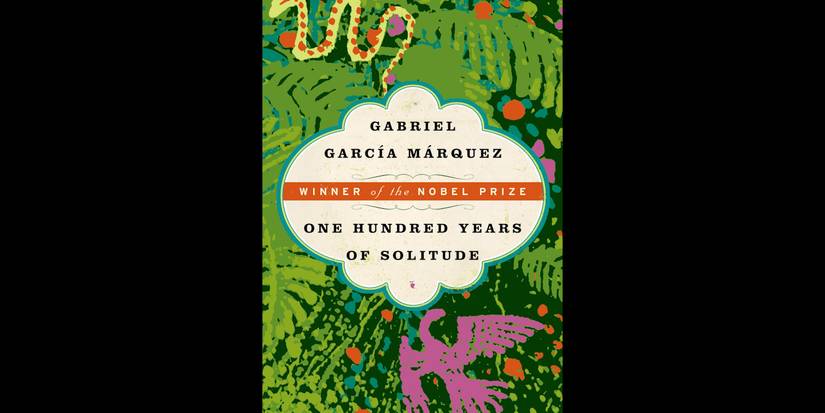
José Arcadio Buendía is the founder of the town of Macondo, but he has much better things to do than run it. He's far more interested in alchemy, magnets, and whatever marvelous invention the passing gypsies bring to town. His wife, Úrsula, is left with the much less exciting business of keeping the family together. Over the following century, their descendants fall in love with people they shouldn't, give their children the same handful of names, and make mistakes their parents already made. A family tree might help as a reading aid, but even that won't explain why the Buendías are seemingly determined to make life difficult for themselves.
Gabriel García Márquez doesn't make their history any easier to follow. Time often repeats itself in Macondo, so much so that no one seems all that bothered when a dead relative turns up for a conversation. There's even an insomnia epidemic that eventually leaves people forgetting the names of everyday objects. But the stranger events in One Hundred Years of Solitude don't necessarily involve magic — civil wars, the arrival of a banana company, and a massacre that may or may not have ever happened. And the townspeople, much like the Buendías themselves, have a remarkable ability to forget things they'd be better off remembering. By the end, you may find it easier to believe in the ghosts than in Macondo's official history.

One Hundred Years of Solitude
10 10
- Release Date
- 2024 - 2026-00-00
- Network
- Netflix
- Directors
- Laura Mora, Alex Garcia Lopez, Carlos Moreno
- Writers
- Jose Rivera
-

Gino Montesinos
Melchiades the Alchemist
-
Claudio Cataño
Colonel Aureliano Buendía
KioskNews shows a cleaned-up reading view extracted from the publisher’s page — the original always lives on their site, not ours.