Ministry promulgates teacher complaint rule changes
By Rachel Lin and Jonathan Chin / Staff reporter, with staff writer


The Ministry of Education yesterday promulgated amendments to regulations governing the handling of complaints against teachers, with the changes designed to protect the rights of educators and reduce administrative workload.
The amendments, which are expected to take effect tomorrow, are centered on simplifying the complaints process, protecting teachers’ ability to teach and discipline students within reasonable limits, as well as students’ right to education, giving due respect for the profession of education, and having distinct types of incidents handled separately, the ministry said in a statement.
The new rules stipulate that schools must close the case without convening a campus incident resolution council if the teacher being reported had clearly acted within the bounds of what is reasonable.
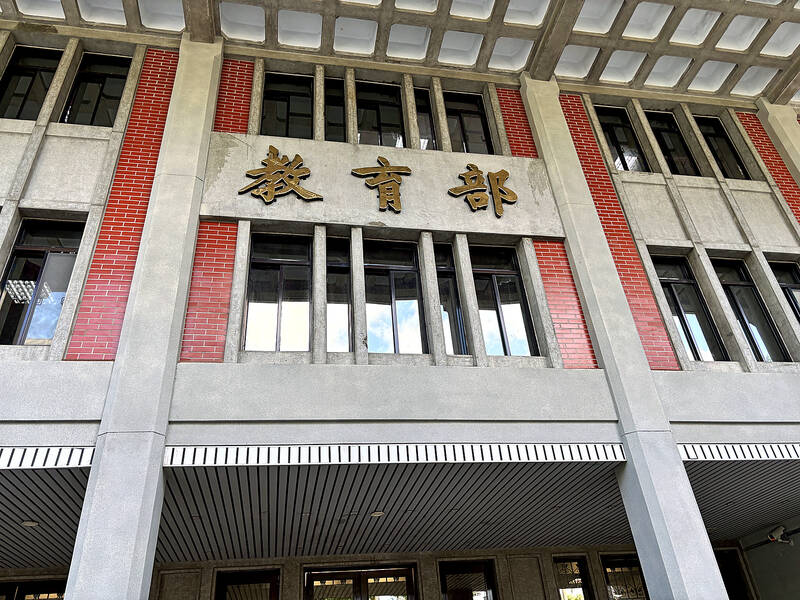
The Ministry of Education is pictured in Taipei yesterday.
Photo: Rachel Lin, Taipei Times
Schools would be required to inform the person who filed the report about the reason for the refusal in writing within 20 days of receiving the complaint, the statement said.
The party filing the report could appeal the school’s decision to a higher educational authority, which would also be authorized to decline taking up the case should it find the complaint to concern conduct clearly exempt from punishment, it said.
The amended regulations would curb the role of independent evaluators, who would be called upon to investigate a teacher’s performance in ordinary performance assessment and disciplinary cases only when the school lacks staff members or under special circumstances, it said.
Planned supplementary measures include guidelines for teachers to call on legal counsel, prevent educational workplace abuse and misconduct, and increase the responsibility of parents to discipline their children, the ministry said.
Parents who fail to cooperate with student guidance could be referred to family education centers or, where appropriate, reported to social welfare authorities for intervention, it said.
The regulatory changes mark the ministry’s second attempt to revise them after the legislature in July returned for correction and resubmission a previous iteration of amendments promulgated in January.
The earlier version did away with the system allowing reports to be filed against teachers anonymously, using different mechanisms to deal with distinct types of incidents and allowing support personnel to assist parties during the proceedings.
The proportion of reports being passed up to campus incident resolution councils had dropped to 22 percent from 82 percent before lawmakers made the ministry rewrite the regulations.
The National Federation of Education Unions in a separate statement said that the current regulations lack enforcement mechanisms and penalties for parents who refuse to cooperate with schools on student guidance and discipline.
The National Federation of Teachers Unions said that reducing the number of accusations being processed by incident resolution councils does not solve core institutional issues.
Teachers need protection against repeated, malicious and unsubstantiated accusations, and incident investigators who do their jobs poorly should be held accountable, it said.
Compensation should be provided to educators for missing out on promotion opportunities and lost income during suspension over unfounded accusations, it added.
The National Substitute Teacher Union said that the amendments promulgated yesterday do not provide enough safeguards to ensure procedural justice or the rights of substitute teachers.
Schools could refuse to renew one-year contracts of substitute teachers if they are reported, regardless of whether the accusations are truthful, it said.
KioskNews shows a cleaned-up reading view extracted from the publisher’s page — the original always lives on their site, not ours.