New $3.3m Dementia Singapore-Lien Foundation initiative offers early palliative care, home support
SINGAPORE - Lyn Leng, 55, has spent the past decade caring for her 56-year-old husband, George, who was diagnosed with young-onset dementia. However, his care needs have intensified as his condition has advanced to the late stage.
In mid-2025, George started attending day care at a New Horizon Centre, which provided him with routine and gave Lyn much-needed respite. That support ended in October when he was discharged following a seizure. The health episode left him unable to stand independently, requiring more care.
At home, the physical toll mounted. Lyn developed knee and lower back issues from constantly transferring her 1.83-metre-tall husband between the bed, sofa, and bathroom, even with aid from her domestic helper.
Relief finally arrived when she met Esther Vanessa Chua, the senior manager of palliative care at Dementia Singapore.
Through Chua, Lyn discovered that George was eligible for a new initiative, called Post Diagnostic Support Plus (PDS+), that offers early palliative care and home support for persons living with dementia and their caregivers.
Launched on Sept 15, PDS+ is developed by Dementia Singapore and Lien Foundation, with a $3.3 million four-year grant from the latter.
The service is currently being piloted at the four New Horizon Centres that provide day care services for people with dementia. These centres, located in Bukit Batok, Jurong Point, Tampines and Toa Payoh, are managed by Dementia Singapore.
“I was very anxious about every blister that he had,” said Lyn, recalling how much it helped when Chua arranged for a physiotherapist to visit her home.
Lyn also hired a second domestic helper to share the load of caring.
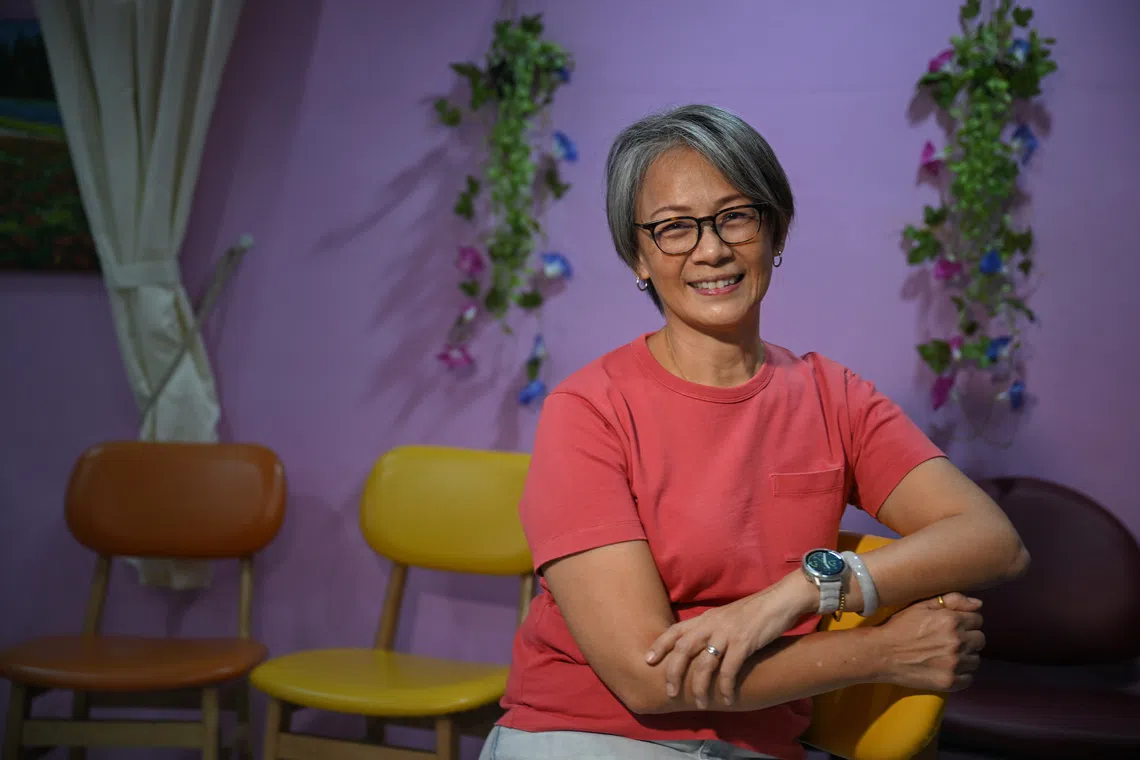
Lyn Leng, 55, has spent the past decade caring for her 56-year-old husband, George, who was diagnosed with young-onset dementia.
ST PHOTO: MARK CHEONG
PDS+ builds on an earlier Post Diagnostic Support (PDS) programme that Dementia Singapore and the Lien Foundation launched in 2020 to address the immediate post-diagnosis adjustment period. The PDS initiative has since been scaled nationally across other care providers, said the programme director at the foundation, Gabriel Lim.
PDS+ will help persons at the late stage of dementia transit from centre-based to home-based care for up to one year. It plugs a gap as traditional palliative care is typically reserved for patients with a prognosis of under one year and is usually introduced near the end of life.
PDS+ has serviced 64 families since late November 2024, when the first advance care planning conversation was done.
At least 80 frontline Dementia Singapore staff are expected to be trained and more than 280 persons living with dementia and their families are expected to benefit directly over the next two years.
“Ultimately, we want to mainstream this programme,” said Dementia Singapore’s chairman Dr Phillip Yap.
Based on the second Well-being of the Singapore Elderly Study by the Institute of Mental Health, there were about 74,000 persons living with dementia in 2023. This number is estimated to grow to 152,000 by 2030.
“When a person has dementia, it often comes with many other chronic, long-term illnesses. So care cannot be focused only on the mental health issues of dementia,” Yap said.
Furthermore, over time, the condition will also affect the person’s physical function and their ability to upkeep daily activities, such as walking, dressing and toileting, he said.
Through an interactive AI tool called ACP GO!, PDS+ hopes to help persons living with dementia indicate their care preferences earlier in the dementia journey, before decision-making capacities decline.
These advance care planning conversations, which start when they are still at the centres, helps to avoid the distressing guesswork and conflict that often arise in families when making difficult decisions as dementia progresses.
Dementia Singapore CEO Bryan Tan said PDS+ provides critical support for families struggling to initiate these conversations. He experienced this firsthand when he tried to speak to his father, who was diagnosed with dementia in 2025.
“Every day he fights to regain his identity, his dignity, and even his independence,” he said. “Every conversation I had with him just ends up really bad because he didn’t want to talk about it.”
Dementia Singapore said it will be scaling its ACP Toolkit training and sharing the ACP GO! tool with other healthcare providers.
While PDS+ officially offers up to one year of support following the transition to home care, Yap said the programme will continue to offer help even after that. With PDS+, one care worker will be the main point of contact.
For Lyn, PDS+ has been a godsend. “I feel very supported,” she said.
KioskNews shows a cleaned-up reading view extracted from the publisher’s page — the original always lives on their site, not ours.