Saigon River pedestrian bridge's 3,400-ton steel arch moves onto barge in 4-hour operation
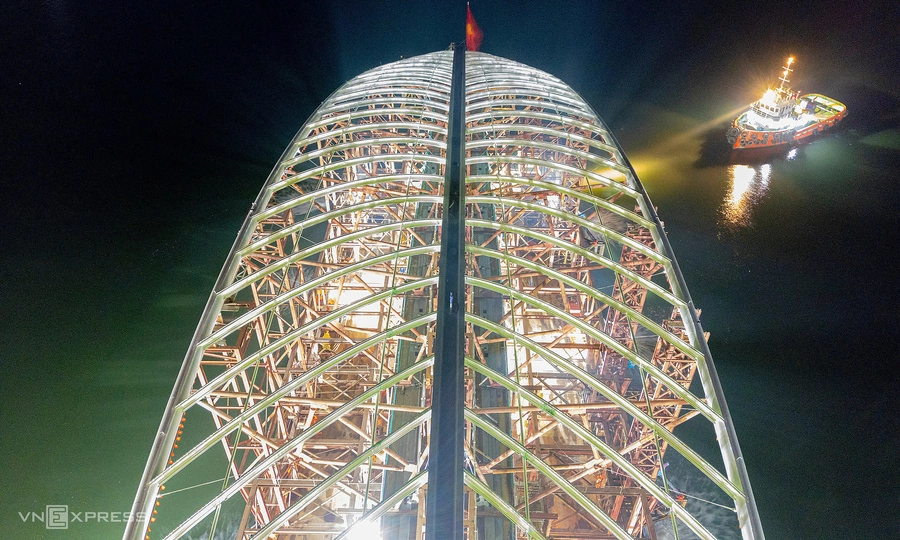
In the early hours of Oct. 16, giant transporters loaded the nipa palm leaf-shaped span of a pedestrian bridge onto a barge twice the size of a mini football pitch, ready to cross the sea from Vung Tau to Bach Dang wharf for installation.

At 2:20 a.m. on Oct. 16, after four hours of work, the entire steel arch sits on the barge at a port in Dong Xuyen Industrial Park, in Rach Dua Ward, formerly in Ba Ria-Vung Tau province and now part of Ho Chi Minh City.
Construction of the pedestrian bridge began in March 2025, with nearly VND1 trillion (US$38.7 million) in funding from Nutifood. The 720 m long, 6-11 m wide structure has a steel arch inspired by the nipa palm leaf and links central Ho Chi Minh City with Thu Thiem peninsula. The bridge opens up more space along the Saigon River and connects with Nguyen Hue walking street.

Earlier, from shortly after 10 p.m. the previous night, 30 self-propelled modular transporter (SPMT) units began moving the bridge's steel arch onto the Trung Nam S05 barge, which is 109 m long and 37 m wide with a load capacity of more than 14,000 metric tons. The specialized transporters can rotate 360 degrees as they move the arch from the shore onto the barge.
The contractor chose to work through the night into the next morning, when the tide was expected to reach 3-3.9 m, to make the move easier.
Bolted connections and welds on the temporary supports were checked before the transporters moved the span. The ground was reinforced and covered with 20 mm-thick steel sheets for added stability.

More than 100 engineers and workers from the Dai Dung plant stay at their posts, following technical procedures and putting safety first. Launching the span at night, on a rising tide and onto a wide barge, requires every team to work in precise coordination.

Teams operating the trailers, the mooring lines, the ballast water and the tugboats move into position for final checks before the span is loaded onto the barge.

Staff cordon off the operating area, keeping out anyone not on duty.

The steel arch assembly, 187 m long, more than 20 m high and weighing 3,400 tons, moves gradually toward the barge on the self-propelled transporters.
The arch is twice the length of the Thu Thiem tunnel segments (each 93 m long, 33 m wide and 9 m high, and weighing 27,000 tons) that were towed and installed on the Saigon River 15 years ago. Its length makes launching, maneuvering and moving it on the river a challenge.

On the barge, technicians continuously run a high-capacity ballast (water pumping) system.
The barge is equipped with 40 pumps with a total capacity of 2,000 cubic meters, which adjust the ballast water so the barge can change its draft as it takes on the arch and stay level with the wharf.

A worker from the self-propelled transporter team keeps a close watch from a position beneath the steel arch. Personnel are required to stay strictly within their work areas and not leave without permission.
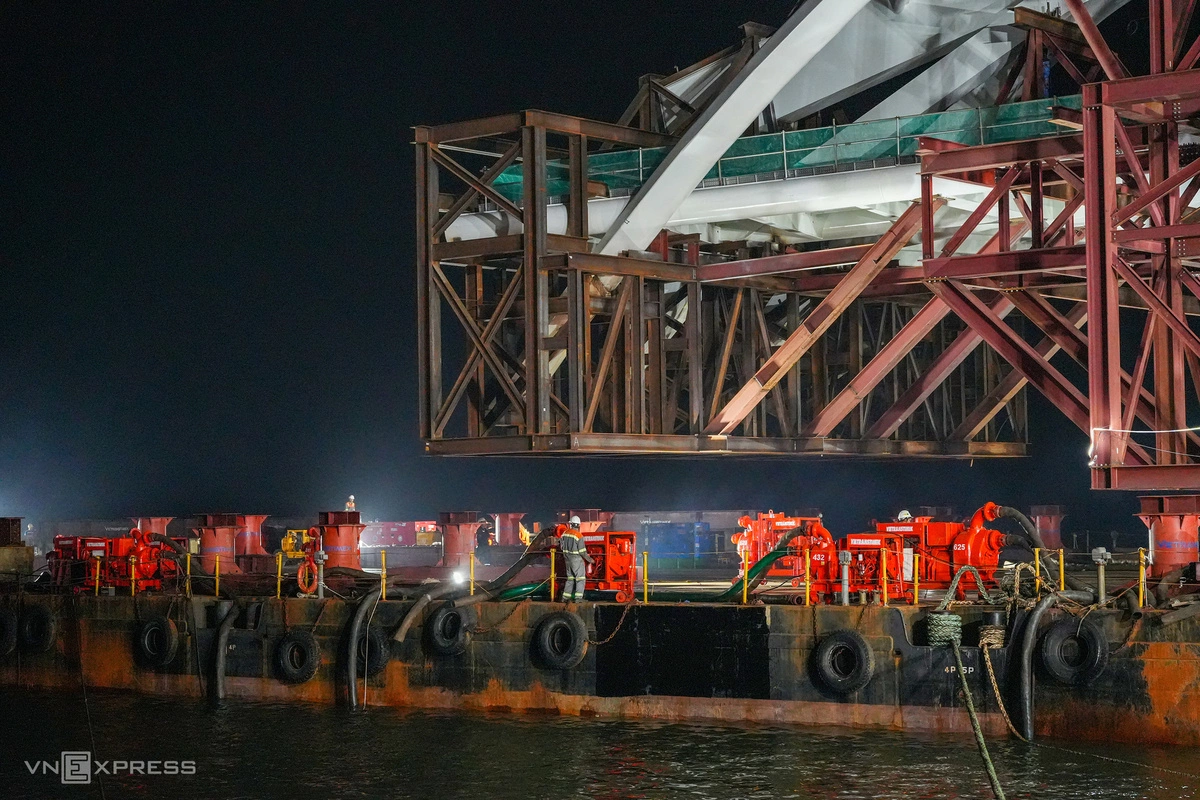

By shortly after 1:30 a.m., most of the span is on the barge.

At the rear of the arch, engineers and workers monitor technical readings before shifting and balancing the assembly.

The entire steel arch rests on the barge as the Dai Dung team and the other units involved break into applause.
The contractor will lash the structure down and check the mooring system to make sure it meets technical requirements before it is towed to Bach Dang wharf on the Saigon River, departing on the morning of Oct. 18.

A worker films the arch on his phone as a keepsake.
Under the plan, the span will be towed to Bach Dang wharf on a journey of nearly 67 nautical miles, or 124 km, lasting almost two days.
Ho Chi Minh City has announced a temporary three-day ban on vessels passing through the construction area to ensure safety while the span is transported and joined.
KioskNews shows a cleaned-up reading view extracted from the publisher’s page — the original always lives on their site, not ours.