YOUTH VOICES: Metro Lives panel explores why Johannesburg’s renewal will fail without its young people
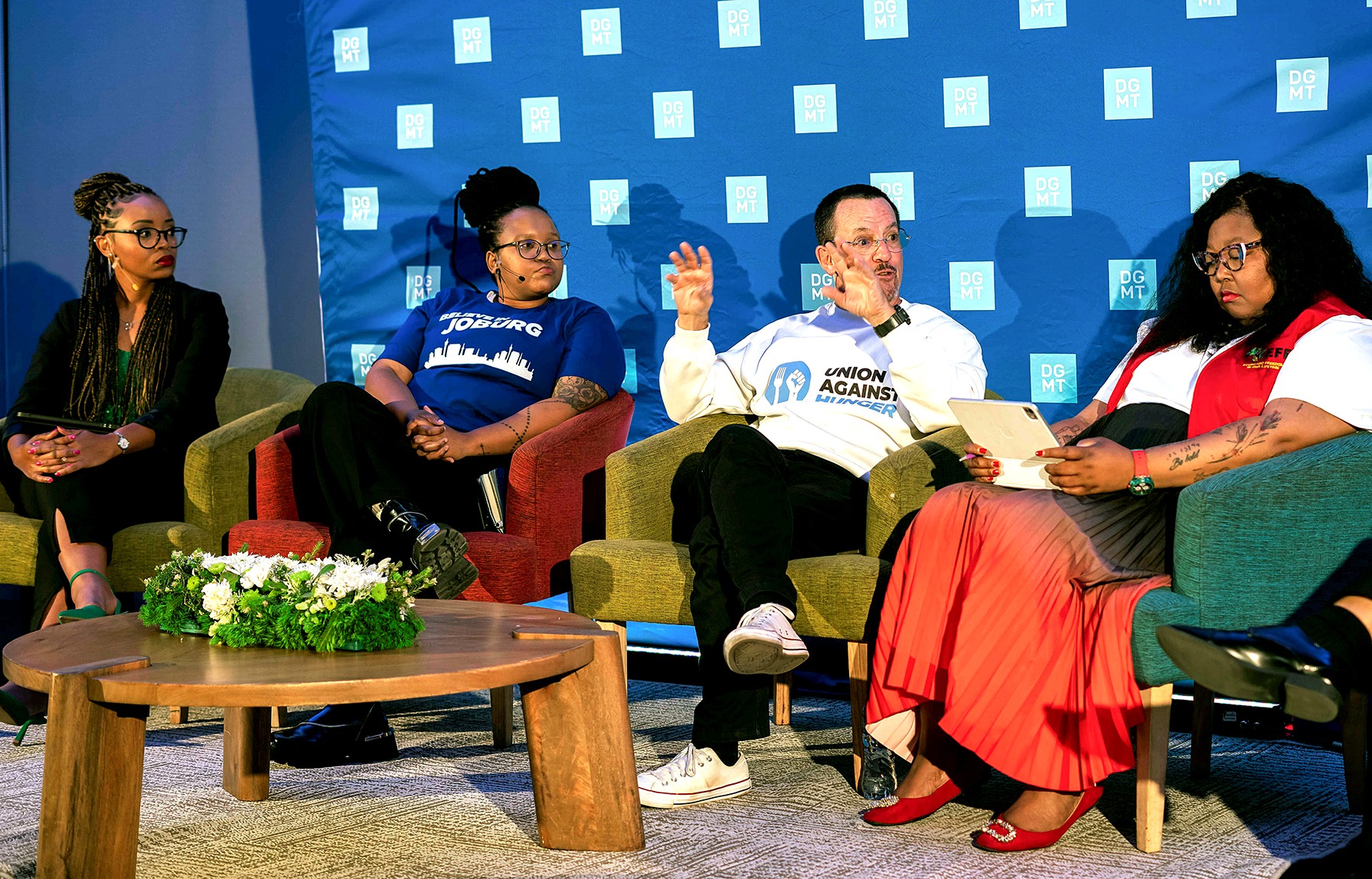
If Johannesburg is to rebuild itself, its young people cannot remain on the sidelines. The city’s renewal depends on treating them not as beneficiaries, but as co-authors of its future, said Matshidiso Lencoasa, a budget analyst at SECTION27.
“Johannesburg has these problems, but we also have ideas, we also have solutions. We just need to be intentional about listening to young people and foregrounding their voices so that we can really build a Johannesburg that works for all,” Lencoasa said.
Lencoasa was speaking at a Metro Lives dialogue hosted by the DG Murray Trust at Constitution Hill in Johannesburg on Monday, 24 August. She was joined by Dr Tlaleng Mofokeng, the EFF mayoral candidate; Nomzekelo Mohamed, Democratic Alliance PR councillor; Mark Heywood, co-founder of Union Against Hunger; and ActionSA MMC candidate Ayanda Allie.
The discussion explored how Johannesburg can put children and young people at the centre of its renewal – and what local governments can do to build safer, healthier and more inclusive communities.
Food security as a City project
For some of the young people in the room, that renewal starts with something as basic as food. A high school learner spoke about going to school hungry in the City of Gold, then returning home to a mother who apologised for not being able to feed her.
Her story captured the human cost behind what Heywood later described as a failing urban food system – and a City that has yet to take its constitutional obligations seriously.
Johannesburg should be taking practical steps such as identifying municipal land where food can be grown, ensuring water, storage and security, and seeing the city itself as a food-producing space. He pointed to an inner-city farm near Johannesburg Stadium where young people learnt about agroecology, about the earth, and about seasons. Yet, instead of nurturing such initiatives, the City demolished the long-standing inner-city farm to build a multi-purpose centre.
Heywood also pushed for supporting the informal food economy rather than criminalising it. Informal traders, he noted, were often cheaper and closer to poorer communities, and could become a backbone of urban food security.
He called for the mapping and funding of the hundreds of community kitchens that are keeping people alive, and questioned why the Department of Social Development with a R1.8-billion budget was not systematically supporting them. He also proposed independent, non-partisan food banks to absorb some of the roughly 10 million tonnes of food wasted annually.
His final proposal was that every school should have a food garden, worked by learners and teachers, to supplement the National School Nutrition Programme and teach children about food systems.
Budgets that work for children
Lencoasa argued that SA’s widely praised laws and programmes – from social grants to the school nutrition scheme – are being set up to fail by the way budgets are made and implemented. On paper, the state commits to children, but in practice, austerity, underspending and opaque decision-making quietly erode those promises.
/file/attachments/orphans/MLJoburg-182_620017.jpg "Matshidiso Lencoasa, budget analyst at Section27 stated that putting children at the heart of Johannesburg’s development priorities includes how it raises, allocates and spends budgets. (Photo: Supplied / The DG Murray Trust)")
She stressed that the money the government invoked when it said “we don’t have funds” was not abstract donor funding, but public revenue raised from ordinary people through income tax, VAT on food and essentials, and levies on transport costs.
“In other words, communities are already paying for a decent state, but are rarely treated as decision-makers in how that collective pot is used,” said Lencoasa.
She said a “budget by the people for the people” meant more than one-off consultations around local government elections, and required real consequence management when money for children and poor households was underspent or diverted. Year after year, she noted, funds went unspent without anyone being held to account, even as schools and clinics limped on without basics like water, electricity, libraries or nutritious food.
Young people demand more than promises
During the discussion, speakers argued that young people must have a stronger voice in determining the City’s priorities, and in holding elected officials accountable for delivering on them.
A young woman in the audience said she had little faith in politicians, adding that young people had heard the same promises repeated for years without seeing them honoured.
She pushed back against the idea of making Johannesburg great again, arguing that for many young people the City was never great to begin with, as its streets were shaped by apartheid and segregation, and that still determined who had access to safety, greenery and leisure. Johannesburg had immaculate sports fields, pools and parks, she noted, but most were locked behind private schools and clubs, effectively out of reach for children whose families could not pay.
/file/attachments/orphans/MLJoburg-156_511534.jpg "Dr Tlaleng Mofokeng, the EFF mayoral candidate, said the right to development from children’s perspective is not getting enough attention. (Photo: Supplied / The DG Murray Trust)")
Mofokeng said it was clear that young people wanted to move from surviving to thriving, and should not be treated as a burden on municipal processes. Instead, children and young people should be recognised as participants whose experiences could help shape solutions to the challenges they faced.
She added that a child-friendly Johannesburg would protect children’s right to participate in civic life, improve safety and invest in the ideas and development of its youngest residents. DM
KioskNews shows a cleaned-up reading view extracted from the publisher’s page — the original always lives on their site, not ours.