Will Sydney’s Victoria barracks become a no man’s land after about-face on sale?
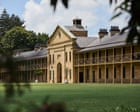
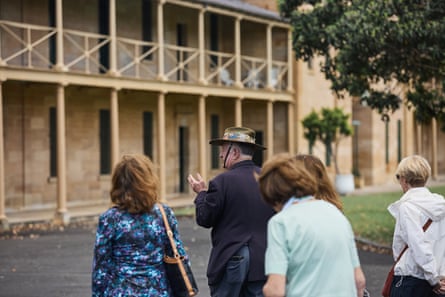
Before February, when the defence department announced its intention to sell Australia’s oldest active military site, only a handful of people would show up for its weekly public tours.
Now more than 100 queue outside the sandstone-ensconced doors of Sydney’s Victoria Barracks every Thursday, with crowds hoping to see the city’s premier military installation before things change for the first time since 1848.
The military is largely vacating Victoria Barracks after the federal government said most of its staff would be transferred to a more secure facility in the CBD. Officials had planned to sell the site – a crown jewel in its trove of assets – as it sought to clear more than $3bn in real estate from the books.
But the prime minister walked back those plans on Sunday amid widespread outcry, saying it would remain in public hands.
All eyes have returned to the barracks, with questions about its future, its upkeep and whether its soldiers shouldn’t be moved at all.
Desktop audit
“We thought it was a victory for common sense,” says Vince Williams, the president of RSL NSW, of the government’s reversal. “Right from the very start when the announcement was made, the position of RSL NSW has not changed: that Victoria Barracks must not be sold.”
Williams says the RSL believes the site should remain an operational facility. Removing the military from the barracks it has called home since long before federation would have a “really negative impact on cadets and reservists”.
“There’s no doubt about that,” he says. “We genuinely believe that this whole defence estate audit was simply a desktop operation of dollars and cents. There hasn’t been a proper analysis of the strategic importance of the bases, that’s the thing that really concerns me.”
Richard Marles, the defence minister, told reporters at a press conference last Sunday that the government had conducted an audit of every facility under its purview and “whether or not it formed a key, relevant part of defending our nation”.
“It was an exhaustive process, and we are following through on that,” Marles told reporters. “And I don’t think there is anyone, actually, who is really seriously suggesting that Victoria Barracks Sydney is central to the defence of Australia.”
He told parliament last month that it would cost $200m over the next 10 years to secure the barracks as an ongoing defence site.
“Given the strategic landscape that we face, we simply cannot afford to be wasting money, and that’s what we’re doing, in this way,” he said.
A ‘sensitive’ transition
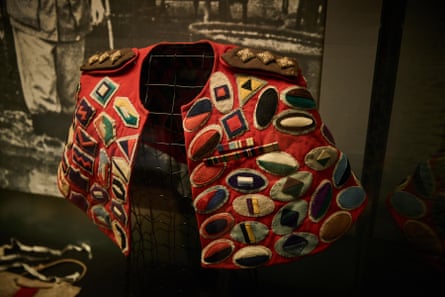
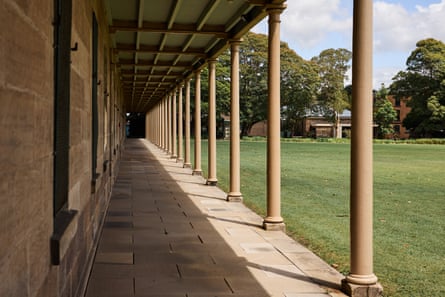
The barracks proudly displays its 150-year history. The 13-hectare site includes a museum that houses three Victoria Cross medalsand the Gallipoli cloth, which features the embroidered names of 3,000 soldiers.
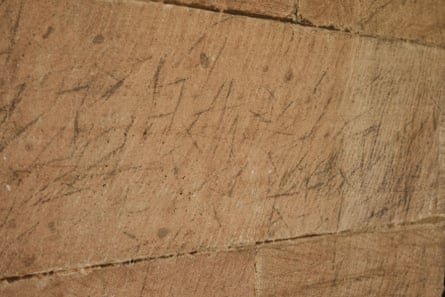
But it’s still an active facility. There’s an officers’ mess hall, providing for the families of a dozen or so high-ranking officers who live onsite and up to 600 people who work here on a daily basis. The main barracks, with its remnants of match-strikes and bayonet-sharpening along the sandstone door frames, now houses office workers.
Those office workers are being moved to a building known as Defence Plaza in Sydney CBD. Most will be at their new desks before Christmas.
“The transition and divestment of Victoria Barracks Sydney will be managed carefully and sensitively, supporting our people, families and the broader Defence community while preserving its heritage, history and legacy,” a Defence spokesperson said.
The prime minister, Anthony Albanese, said this month that the barracks would soon be “free for all Sydneysiders to enjoy” and that its heritage would be “not just maintained, but indeed enhanced”. Ownership of the site will be transferred from Defence to the Department of Finance, which will then determine its future.
after newsletter promotion
“This is an asset for Sydney that should be opened up for Sydneysiders,” Albanese said. “A lot of the facilities that are around here, in what is a pristine location … have been locked out for Sydneysiders.”
But critics of the plan have stressed that Victoria Barracks has – at least in part – been accessible to the public for decades. It’s open for tours every Thursday from 10am to 2pm. There’s an active lawn bowls club that meets twice a week, encouraging new bowlers to join. And music events are held on the lawns a few times a year.
Anthony Roberts, a state Liberal MP who has actively campaigned for Victoria Barracks’ preservation, accused the federal government of planning to commercialise the site. “They’ll transfer this across to the Department of Finance, and then you watch, it might stay in public hands on paper, but effectively they’ll start issuing those 99-year leases,” he says.
“It’s not just a historical place. It’s an operational base that effectively plays an integral role to our counter-terrorism forces. … I think just on a number of levels it is just stupid.”
Who should pay?
Who takes day-to-day control of the barracks if and when it’s transitioned off the Defence budget is another matter.
A Minns government spokesperson says they welcomed the decision to keep the site in public hands, but would not comment on its future management. The site is zoned for military activities, so any development for other purposes would required rezoning.
The city of Sydney, which manages other heritage sites like the Queen Victoria building in the CBD and Paddington town hall, has its own concerns.
“We broadly support the principles of quality open space, well-located among density and firmly believe in the provision of high-quality city infrastructure,” Jess Miller, a councillor and former deputy lord mayor, says. “I think what’s really challenging with this situation is that the federal government doesn’t understand any of those principles … and has largely led to this situation where they see it as less of a community asset or a public good asset and more as a piece of land that they want to divest.”
She says that heritage-listed sites are not cheap to manage.
“There’s probably a reason why the federal government wanted to divest it,” Miller added. “Everyone likes nice things, but they’re not free.”
Fiona Leslie, a heritage consultant who worked on an excavation at Victoria Barracks between 2019 and 2021, said the site was unique in that it had been an active defence site since it was first established.
“Because of that integrity, it’s very nationally significant,” she says. “There are multiple layers of history there. At the barracks itself, there’s so much archaeological potential. You just have to scratch the ground and you’ll find so much.”
KioskNews shows a cleaned-up reading view extracted from the publisher’s page — the original always lives on their site, not ours.