Engadget Indie Pitch: Dressmaker
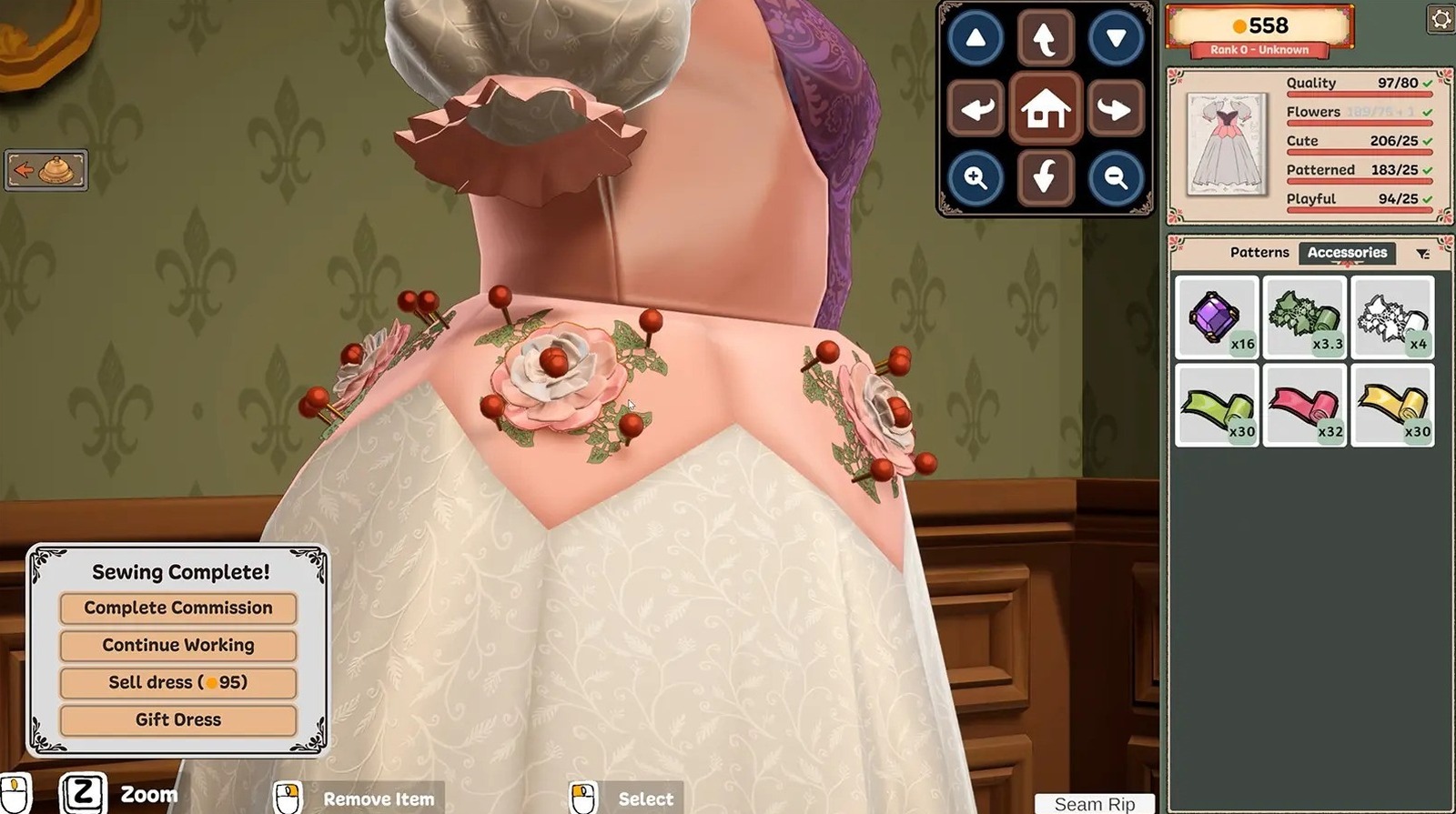
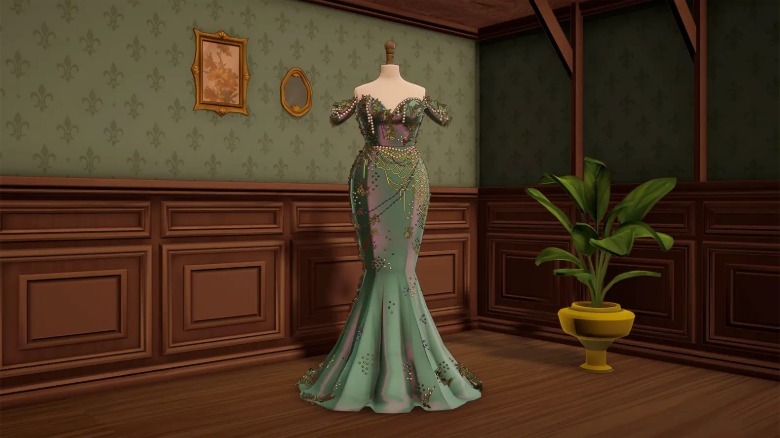
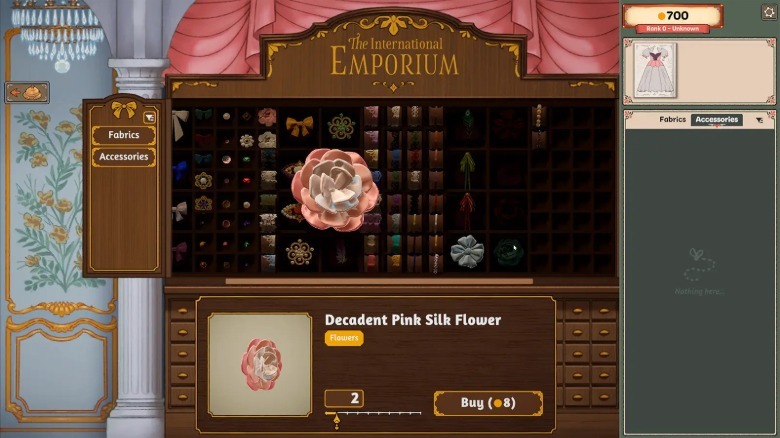
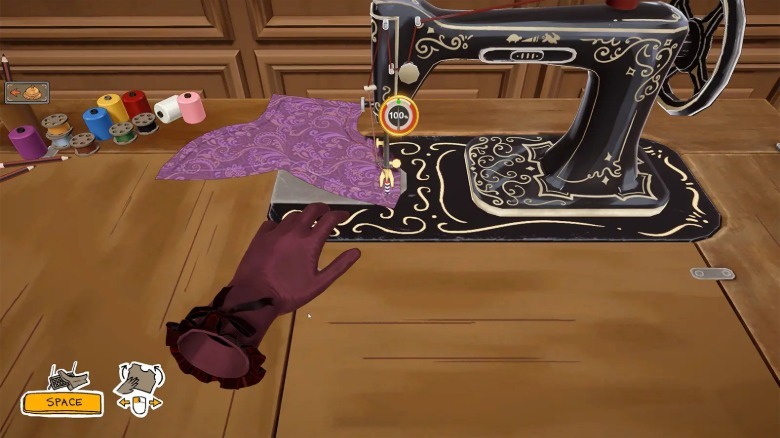
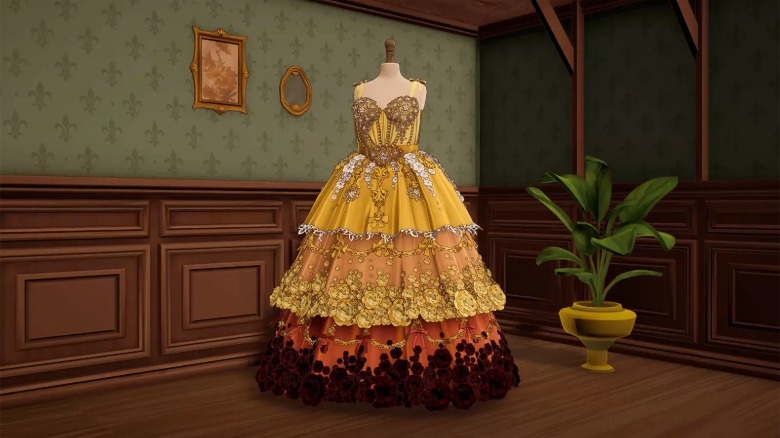
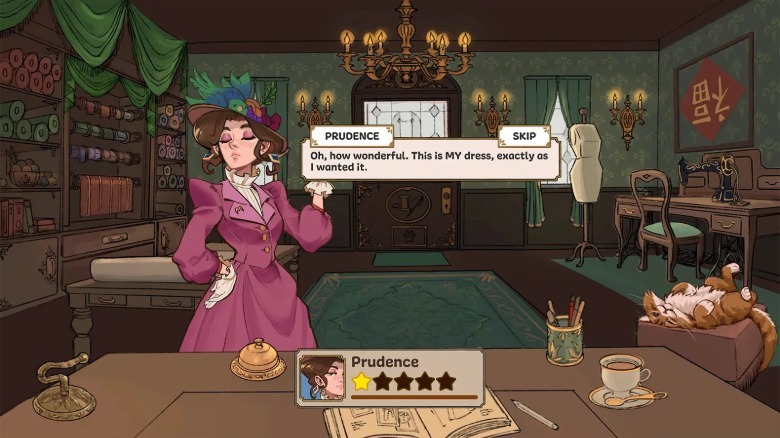
Jonathan: Dressmaker is a game about making dresses, where almost every part of the creative process is under your control: from design, choosing fabrics for each panel, sewing it together and finishing it off with trims, buttons, bows and other accessories. You can make commissioned dresses for a town of women with different tastes and aesthetics, or you can make your own off-rack dresses to sell.
How big is the development team?
Anja: The full-time core development team from Free Lives is only 3 people (Ruan Rothman, Sara Laubscher, Jonathan) alongside our sound designer Jason Sutherland who is currently working on about four projects at the same time. Sabrina has been the vision holder for the project, and has consulted on and quality-assessed all of the game design decisions. External contractors have included Kerstin Hall, our writer, and Meydän, our composer. There has been amazing support from the wider Free Lives machine — additional art and design, production and media/community support. Then there have also been amazing friends that have jumped in to help when things got overwhelming on the footage capture and QA fronts.
How long have you been working on it?
Jonathan: We began the first playable prototype in July 2025, uploading it to itch.io to see if there was an audience for the game. After a month or so of deliberation, it was greenlit by Free Lives in September 2025.
 Cozy Lives
What's the origin story of Dressmaker?
Jonathan: Sabrina and I have been dating for over seven years. When we first met, she was wearing a dress that she'd made herself. Over the years, I've learnt a lot about clothing from her. She points out costume changes in movies and how they support the story, tells me whether they're historically accurate, clever modifications they made to make a historical design work for the world they've created. She'd tell me about the huge environmental impact of fast fashion, of polyester and other synthetic fibers, and lament at the skills that were being lost with the ability to mend and customize clothing becoming less common. She introduced me to a number of YouTube dress historians and dressmakers, and opened my eyes to the enormous community of people who love the craft.
There's this excitement, energy and creativity in that community that I found so beautiful, and I wondered what that would be like in game form, where someone might be able to have some of the creative expression of making custom dresses without having to buy machines and fabrics and be cutting fabric out on their hands and knees on the floor.
So during my vacation after shipping the arid update to Terra Nil, I made a very basic prototype of Dressmaker, where you arrange patterns on fabric, rotate them to the grain line (or not, if you didn't have enough fabric), and cut the pieces out. I added a 3D mannequin that you could drag the pieces onto to see your dress as a 3D model. And then a friend encouraged me to make a Tiktok video about just that, even though I didn't think there was much there yet.
The video itself got some 600,000-plus views across TikTok and Instagram, and was filled with comments of people asking what the name of the game was and where they could play it. But at this point the game barely existed, and didn't even have a name!
I knew that if I continued working on this with Sabrina as a hobby project it would take years to make it anything like the game that we imagined it to be. So I took it to Free Lives, and together with Ruan and Sara, we spent three weeks making a more fleshed-out prototype that was actually a playable game and put that on itch.io. The game got around 30,000 downloads in its first month, which is usually pretty good, but not anywhere close to some of our other successful games' numbers. But the comments were so passionate — players were sharing their dress creations, typing up essays about how much they loved it and making suggestions, and we had a few content creators' videos about the game get over a million views. This was finally enough for Free Lives to give the go-ahead for us to make it into a full game.
 Cozy Lives
Sabrina, how has living with a chronic illness affected your creative process or perspective?
Sabrina: I've had to recognize when I'm in a flare-up, and how I have to take the time off and recover. I've had to accept that work will happen more slowly, and that there are certain things I'm not able to do. I have to work within ever-changing parameters to make sure that I'm listening to my body and taking rest where I need it; because if I don't, it means I won't be able to do any work at all.
It can be really frustrating and really difficult because I can feel like I'm letting people down. But I'm also really fortunate that I work with wonderful people who are understanding and supportive, and are able to catch things that fall through the cracks. I've even had friends come in to help on the project!
Talk about the mechanical and technical depth of Dressmaker — it looks incredibly intricate.
Jonathan: There's the 3D version of a dress that lives on the mannequin, and the 2D version of each of its pieces that is used for cutting out fabric. This is similar to doing UV unwrapping in traditional 3D software: Wherever you place the pattern on the fabric is exactly what appears on the dress. But where UV unwraps are usually done to minimize distortion or for easy packing, these UVs have to be done to look plausibly equivalent to real-world dress patterns, so Sara's had to do a lot of manual unwrapping to get them to look right. The meshes also have to be quite precise, since the game needs to be able to figure out where the seams between panels are for sewing, where seam allowance should be, and where to draw the markings for seam allowance and grain alignment.
Sizing adds an extra layer of complexity. Standardized sizing is a myth, and we try to show a version of this with your taking measurements of each customer and adjusting your mannequin to match. We use a lattice to change the mannequin and dress sizes, but doing this naively without also adjusting the 2D patterns would cause the fabrics to appear stretched. We had to figure out how to make the 2D patterns be able to adapt to the sized dresses to minimize stretching. In some cases this is very difficult (like when the final dress has gathered edges), but we do the best we can.
 Cozy Lives
Why are cozy games so hot right now, do you think?
Jonathan: It's surprisingly hard to define what makes a game "cozy". Even if I think of it as being non-violent, I can still think of very popular cozy examples that have you killing monsters in mines, beating cultists in the woods or raising chickens to feed to slimes. But maybe there are more developers that are more intentionally making games for women.
What's the vibe around the South African indie scene nowadays? The region has produced some big indie hits recently, Free Lives games included.
Anja: I think the South African indie scene is genuinely up-and-coming. A lot of our friends in the international indie communities in Europe and the US have commented that it feels like we're entering something of a golden age here. There are regular meet-ups, jams and community events happening, it's been growing every year, and there's just a massive amount of talent and potential waiting to be unlocked.
At Free Lives, we take a very "ubuntu" approach to the whole thing: You're only as good as your community. The success we've had with games like Broforce and GORN gave us the opportunity to put some money and energy back into the ecosystem that supported us, and we've tried to be pretty intentional about doing that.
Free Lives is the primary funder of the Playtopia Foundation, which runs Playtopia, an annual indie games festival, as well as supporting our local alt-controller community through Super Friendship Arcade. We also fund the Maker's Massive, a Discord and physical community space where developers can meet up, jam and work together for free. We've already spent R3 million on the Jam Dole — a stipend that gives young South African developers the breathing room to prototype without having to sacrifice an income or give away their IP — which has had an unbelievable return on investment in terms of community growth.
We're already seeing some really exciting results. In just the past two years, games like Get Yoked, Detective Turner, Feather's Edge and Fossil Quest have come through that program. And we're actively looking for collaborators to make that program more sustainable.
If anyone is curious about what's happening in South African indie games, come to Playtopia. It's increasingly one of the last stands of a radically open, independent and non-corporatized festival culture — and I think you have to experience that community in person to really understand what's happening here.
Why are video games your chosen form of expression?
Jonathan: I grew up enjoying a lot of different things, from maths and physics to art and music. Video games feel like they can make use of any or all of those things, whatever your interests are — even dressmaking. And there's always so much more to learn, so that I find I'm never bored.
 Cozy Lives
What's the biggest roadblock you've faced as a smaller developer?
Jonathan: I think by far the most important problem to solve is what game to work on: an idea that has appeal, that can be scoped in such a way that it can be executed well enough with the team size and money you have available. Pursuing a project that is too ambitious for the resources available is something that could easily tank a studio. We try to make a lot of small prototypes, and only pursue the ones that show us we could feasibly make the full game in a reasonable timeframe with a hungry audience. But we're also figuring out what other ways we can try to validate ideas, like testing things on social media.
What can larger companies and publishers do to better support developers like yourself?
Jonathan: Anja's mentioned the Jam Dole, which is one of the most practical ways I've seen for helping small developers figure out the right games to pursue. The Jam Dole's model is loosely similar to how we prototype and validate ideas internally. I'd love to see the program expand.
Let's bring it back home. Sell your game in one sentence:
Make the dresses you've always dreamed of — in Dressmaker, coming to PC and Mac on Steam on 21 September!
 Cozy Lives
Check out the Engadget Indie Pitch archive:
KioskNews shows a cleaned-up reading view extracted from the publisher’s page — the original always lives on their site, not ours.