Grab a pencil, find a wall: Bookaroo is back with stories, books and more for Delhi’s children
Imagine a wall slowly filling up with a child’s sketch, a wonky caricature, and then another child adding to it. This is the ‘Doodle Wall’ at Bookaroo Children’s Literature Festival, where Delhi’s children in the 4-14 age group can draw alongside illustrators this weekend.
There is no fixed format or finished picture in mind. A child may sketch, another may attempt a caricature, while an illustrator adds a few strokes beside them. By the end of the festival, the wall is expected to have evolved into a collective mural.
“We give a lot more exposure to illustrators because generally when we talk of children’s literature events, it’s restricted to storytelling, performances and writing. Most times, illustrators get a little short-changed,” says Swati Roy, co-founder and director of Bookaroo.
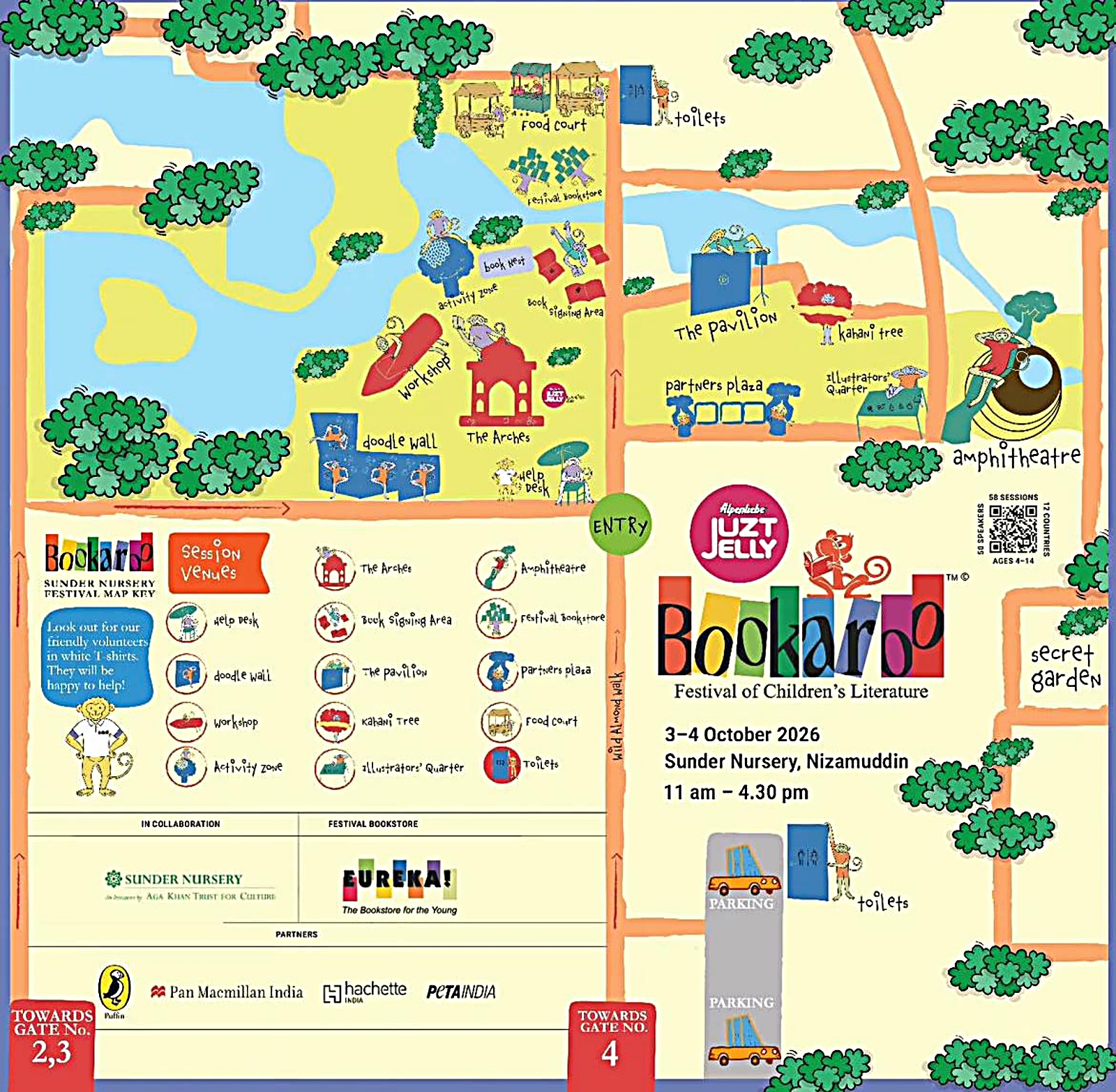
The festival returns to Delhi for its 18th edition and 53rd overall on October 3 and 4 at Sunder Nursery, Nizamuddin. From 11 am to 4.30 pm, 50 writers, illustrators and storytellers from 12 countries will take part in 58 sessions.
It relies on partnerships with publishing houses, art councils, and embassies to bring international and domestic authors, illustrators, and storytellers together for children.
Among the participants this year are Singapore-based writer and educator Laremy Lee, writer and editor Namita Gokhale, author Pradeep Chakravarthy, illustrator Shubhshree Mathur and Dutch illustrator Mark Janssen.
The ‘Illustrators Quarter’, introduced at the last edition as a section where illustrators display and discuss their work, will return. A panel on what goes into illustrating a children’s book will feature Swiss illustrator Carla Haslbauer, Mumbai-based artist and illustrator Kripa Bhatia as well as Delhi-based visual artist and illustrator Pakhi Senshekhar.
Story continues below this ad
According to Roy, for children interested in drawing and illustration, the panel will offer a chance to see the different paths artists have taken to turn their interest into a career. “It’s a good way of saying to them: look at all the people who have pursued their interests in different ways,” she adds.
 Bookaroo fest in Delhi. (Source: Express Photo)
Another panel, ‘Let Them Choose’, featuring author Paro Anand and Roohi Sehgal, managing editor at DK (Dorling Kindersley), will focus on reading choices of parents and children.
Roy calls it “a very non-Bookaroo-ish session”, as the two will speak to parents on why adults need not dictate what children should read. “This is to help parents understand that children should find and pick a book they like and seem interested in, rather than looking at what it’s teaching,” she says.
Co-founder and festival director M Venkatesh says the festival grew out of a children’s bookshop. “We opened a bookshop, Eureka, at Alaknanda in Delhi in 2003. While we held many sessions for children, we could only accommodate 15-20 of them at one go.”
Story continues below this ad
“We moved the sessions to community halls in 2007 but the space still was inadequate,” he adds.
The next year, Bookaroo was launched. “Around 3,000 people attended over two days, much to our surprise,” says Venkatesh.
Bookaroo’s first outstation edition was held in Srinagar. Since then, it has travelled to more than 16 Indian cities, besides editions in Malaysia and Sri Lanka.
“We spend the entire year studying the new books which have been released. Publishers also send in their suggestions. In fact, as soon as the current Bookaroo season ends, we start working for the next one,” Venkatesh says.
Story continues below this ad
Venues are chosen to be centrally located and open. “There is no stage or podium or strobe lights. While interacting with the students, sometimes the speaker even sits on the floor,” Roy says.
Parents are asked to wait outside during sessions. “Without their parents around, children are freer to say what they think, including, ‘I don’t want to’ or ‘I don’t like this’. Authors get direct and non-filtered feedback,” she adds.
 Bookaroo fest. (Source: Express)
There is also no pre-registration, so children may find themselves sitting beside strangers and leave having made new friends.
According to Roy, children’s appetite for books remains strong, particularly in smaller cities. “Children and their parents wait for months for the festival… For them, getting to meet their favourite authors and interact with writers is a very special thing.”
Story continues below this ad
She recalls a young man at last year’s Vadodara edition who brought a book he had bought at an earlier Bookaroo. “He had gone to the author’s session back then but missed the opportunity to get her signature. He returned the following year specifically to have it signed,” she recalls.
The youngest age group is four, though Roy says parents of toddlers are sometimes encouraged to come and “soak in the energy of the festival”.
“At the bookshop, parents often don’t know what to choose and end up discussing what their children are reading,” she adds.
KioskNews shows a cleaned-up reading view extracted from the publisher’s page — the original always lives on their site, not ours.