Leading Chinese mathematicians unite behind use of AI in research
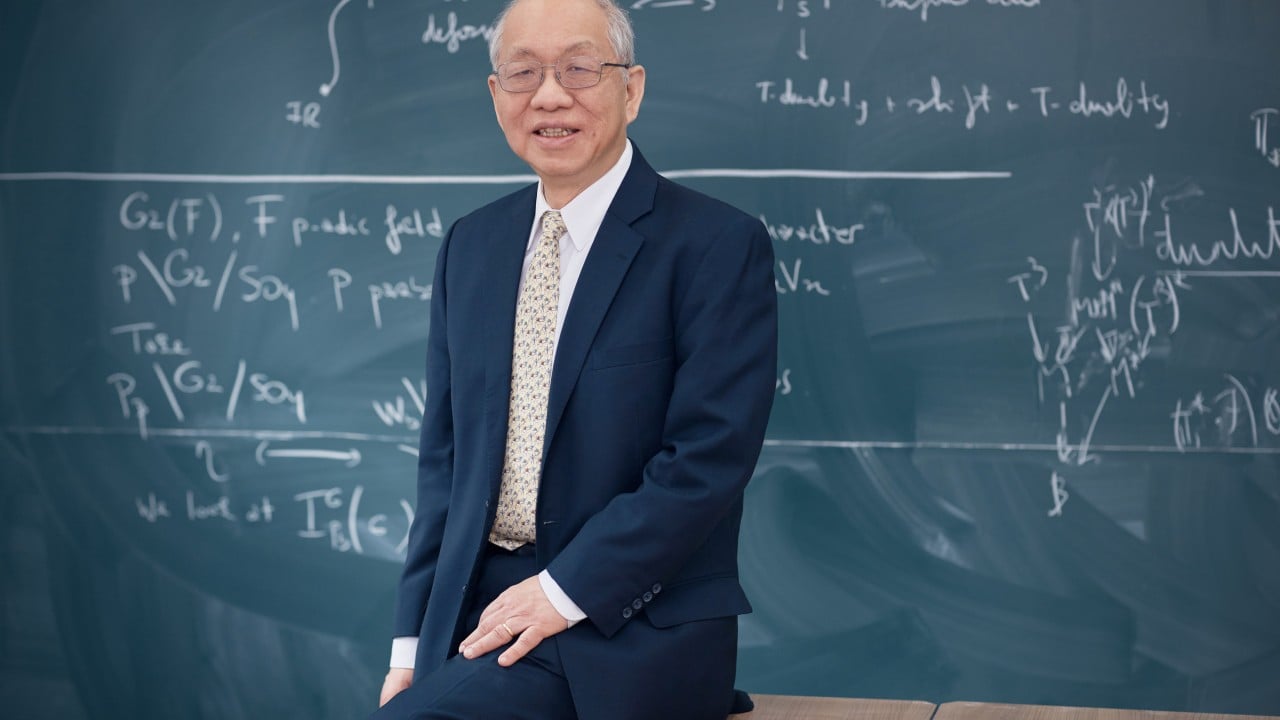
Leading China’s mathematicians joined forces in Beijing on Sunday to launch an alliance aimed at integrating artificial intelligence into mathematical research.
The Yau Laboratory Alliance for Mathematics and Artificial Intelligence is being spearheaded by Fields medallist Shing-Tung Yau, who warned that China was lagging behind the United States in using AI to advance frontier science.
It will bring together eight leading institutions and aims to create a network of more than 1,000 scientists.
The alliance will focus on developing specialised AI models for mathematics, using the technology to generate conjectures and formalise proofs, and building systems whose reasoning could be more easily interpreted.
“A year ago, I did not think AI was this powerful,” Yau, the director of the Yau Mathematical Sciences Centre at Tsinghua University, said.
He added that over the past six to 12 months he had seen AI tackle problems that mathematicians had struggled to solve.
“The development of AI in mathematics is like a tsunami,” he said, arguing that Chinese mathematicians needed to organise themselves and engage with the technology rather than avoid it.
The alliance was launched amid a growing debate over AI’s ability to solve advanced mathematical problems.
Last week, OpenAI released 722 mathematical manuscripts grouped into 372 families of results, claiming progress on hundreds of open problems.
But the company withdrew three manuscripts the following day after identifying an error that invalidated an argument and affected two related papers, while revising 14 others.
Some mathematicians have criticised the speed and scale of the release, arguing that mathematical results needed careful verification, clear explanations and proper acknowledgement of previous work.
02:36
Chinese mathematicians Wang Hong and Deng Yu win prestigious Fields Medal
Another Fields medallist, Terence Tao, has called the use of AI to be slowed down given the concerns about its negative impact, triggering a heated debate with other mathematicians who support the use of the technology.
But when asked about the issue, Yau said: “Tao is a very good mathematician, but that does not mean he represents the mathematical community.”
He added that the dispute should not deter mathematicians from working with AI, instead highlighting the need for closer cooperation between leading mathematicians and AI developers.
He said the gap between China and the United States was particularly pronounced in frontier scientific research, especially when it came to AI systems capable of advancing mathematics and physics.
Chinese models have performed well carrying out tasks for ordinary users, he said, but remained far behind leading US systems in cutting-edge research.
“But if you ask them to do the work OpenAI has done over the past month, the gap is very large.”
Yau said leading US AI companies had mobilised thousands of scholars and substantial industrial investment to tackle difficult scientific problems, with mathematicians helping improve AI systems while using them to investigate new questions.
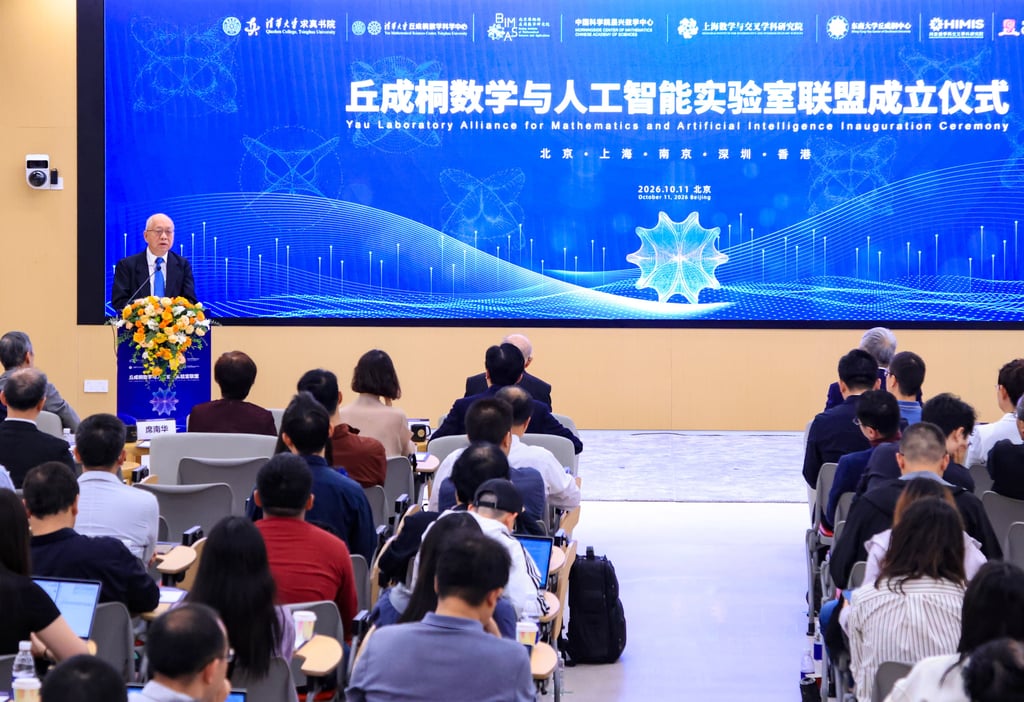
“The United States and the West have brought together their top mathematical experts to work with AI and explore frontier problems,” he said, adding that China’s efforts were fragmented.
Scientists who attended Sunday’s launch included Xi Nanhua, the president of the Chinese Mathematical Society; He Xuhua, vice-president of the International Mathematical Union; and Tian Ye, the deputy director of the Morningside Centre of Mathematics at the Chinese Academy of Sciences.
Besides the Yau Laboratory and Morningside Centre, other institutions involved in the alliance include Tsinghua University’s Qiuzhen College, the Beijing Institute of Mathematical Sciences and Applications, the Shanghai Institute for Mathematics and Interdisciplinary Sciences, Southeast University’s Yau Centre, the Hetao Institute of Mathematics and Interdisciplinary Sciences and the Chinese University of Hong Kong’s Zhizhen School of Interdisciplinary Mathematical Sciences.
KioskNews shows a cleaned-up reading view extracted from the publisher’s page — the original always lives on their site, not ours.