MP Leslyn Lewis sues her alma mater, and professor for ‘traumatizing’ job interview
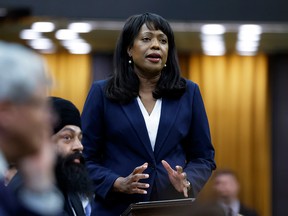
Seeking damages of more than $3 million, Leslyn Lewis, the MP for Haldimand-Norfolk in rural southern Ontario and a former leadership candidate for the Conservative Party of Canada, has brought a defamation claim against her alma mater law school at York University and a professor of refugee law over Lewis’s failed application to a scholar position reserved for a Black person of African descent.
Sign In or Create an Account
Lewis claims Sean Rehaag derailed her short-listed candidacy from the start, by allegedly scheming behind the scenes to alert academic decision makers to his defamatory allegations that Lewis was racist, anti-gay, anti-refugee and opposed women’s reproductive freedom.

Get a dash of perspective along with the trending news of the day in a very readable format.
By signing up you consent to receive the above newsletter from Postmedia Network Inc.
A welcome email is on its way. If you don't see it, please check your junk folder.
The next issue of NP Posted will soon be in your inbox.
We encountered an issue signing you up. Please try again
In her statement of claim filed in Ontario Superior Court, Lewis also alleges the school was negligent in exposing her to a “traumatizing” job interview process by allowing a “toxic culture” of “wokeism” and “groupthink” to develop at Osgoode Hall law school.
She claims Rehaag “blindsided” her with these defamatory allegations about her politics as she gave a presentation about her candidacy, “ganged up” on her with other academic decision makers to verbally abuse her, and that he did this to “embarrass and humiliate” her in public and in front of academic colleagues.
She claims she has been “de facto vetted-out of any future prospect in academia.”
She claims Rehaag told her that people like her had no place at Osgoode and she was not welcome.
In a statement of defence, Rehaag specifically denies this. York denies the environment was “dangerous, hostile, or abusive.” Both deny there was ever any campaign of “vetting out” or “lobbying” against Lewis.
The conflict dates to March of 2021, when Lewis was simultaneously running as a high-profile candidate for the federal Conservatives and applying for this newly created job at York’s Osgoode Hall, where she once took a doctorate.
The job in the Osgoode’s Centre for Refugee Studies “supported York’s Affirmative Action program, in recognition of the underrepresentation of Black faculty,” according to York’s statement of defence. Lewis’s claim says the job “was created in response to the racial awareness that emerged from the George Floyd murder, and the law school sought a faculty member that also shared the lived-experience as a person of Black-African Descent who could continue to advance causes of racial equality.”
Lewis had been involved with the centre as a student in the 1990s, and later worked in refugee law. She says in her statement of claim that she “advocated for members of the LGBTQ+2 community, with a specific focus on Jamaica (the country of her birth). Another area of focus was women fleeing domestic assault.”
Lewis was first elected to Parliament in the September 2021 election. She ran for the federal Conservative leadership in 2020, seeking to replace Andrew Scheer, and in 2022, seeking to replace Erin O’Toole. She lost in 2022 to current leader Pierre Poilievre.
Rehaag, the director of the centre, is a professor who mostly works in immigration and refugee law.
Lewis claims she knew in advance that Rehaag was “hostile” toward her, but that York gave her no forewarning she would be “interrogated” about issues unrelated to the job.
She claims York is liable because it “allowed for Osgoode to develop a toxic culture that discouraged diverse thought, penalized students and professors that do not adhere to wokeism, and used activist professors as gatekeepers to screen out employment candidates that did not adhere to its groupthink culture.”
Lewis also alleges York failed to circulate, as promised, a rebuttal she wrote after the disastrous presentation. She did not get the job.
York says in its statement of defence that the questions Rehaag asked her during a nine-minute exchange in the question and answer segment of her presentation were “relevant, foreseeable, and within the proper scope of a faculty recruitment seminar.”
It says its recruitment procedure involves a recruiting committee of faculty, students and administrators that makes short-listed recommendations to a separate appointment committee, also made up of faculty, students and administrators. Rehaag was on the appointment committee.
The defence claims Rehaag’s emails about Lewis were sent in advance of Lewis’s presentation to a member of the recruitment committee who was also co-chair of the Faculty Council’s Equality Committee “in the context of a confidential process.”
These emails, the defence claims, expressed Rehaag’s view that Lewis has publicly taken anti-gay positions, “including opposing legislation prohibiting so-called ‘gay conversion therapy’ and opposing the inclusion of gender identity and expression in human rights codes.” The emails also expressed Rehaag’s view that many at Osgoode would find Lewis’s public positions “antithetical to the equity and social justice aspirations of the law school.”
The defence further claims he said ideological controversy should not “automatically” mean Osgoode should not consider a candidate, but that efforts should be made to ensure LGBTQ people at the school feel “valued and respected.”
In a later email, Rehaag said Lewis’s invitation to give a presentation as a short-listed candidate “would generate protest and calls for de-platforming,” and he recommended consultation with “students from equity seeking groups whose interests may be impacted by the public positions taken by (Lewis),” such as opposition to Black Lives Matter.
In Lewis’s lawsuit, she claims she was addressed by students at her presentation “who seemed to ask similar questions… premised on the false statements that were advanced by Mr. Rehaag and others.”
York and Rehaag say they will rely primarily on two defences to defamation: qualified privilege, in which Rehaag claims he had a good faith interest or duty in publishing this information for people with a corresponding interest or duty to receive it; and fair comment, in which he claims his comments were on matters of public interest, based in fact, recognizable as comment, not motivated on malice, and reflect an opinion that any person could honestly express on the facts.
Although financial damages specified in statements of claim are often little more than administrative placeholders, to be determined later in court if needed, the damages explicitly sought here are well over $3 million. They include aggravated and punitive damages, to compensate for alleged malice.
No court hearings are yet scheduled.
Our website is the place for the latest breaking news, exclusive scoops, longreads and provocative commentary. Please bookmark nationalpost.com and sign up for our newsletters here.
Join the Conversation
This website uses cookies to personalize your content (including ads), and allows us to analyze our traffic. Read more about cookies here. By continuing to use our site, you agree to our Terms of Use and Privacy Policy.
KioskNews shows a cleaned-up reading view extracted from the publisher’s page — the original always lives on their site, not ours.