These former inmates turn life behind bars into art
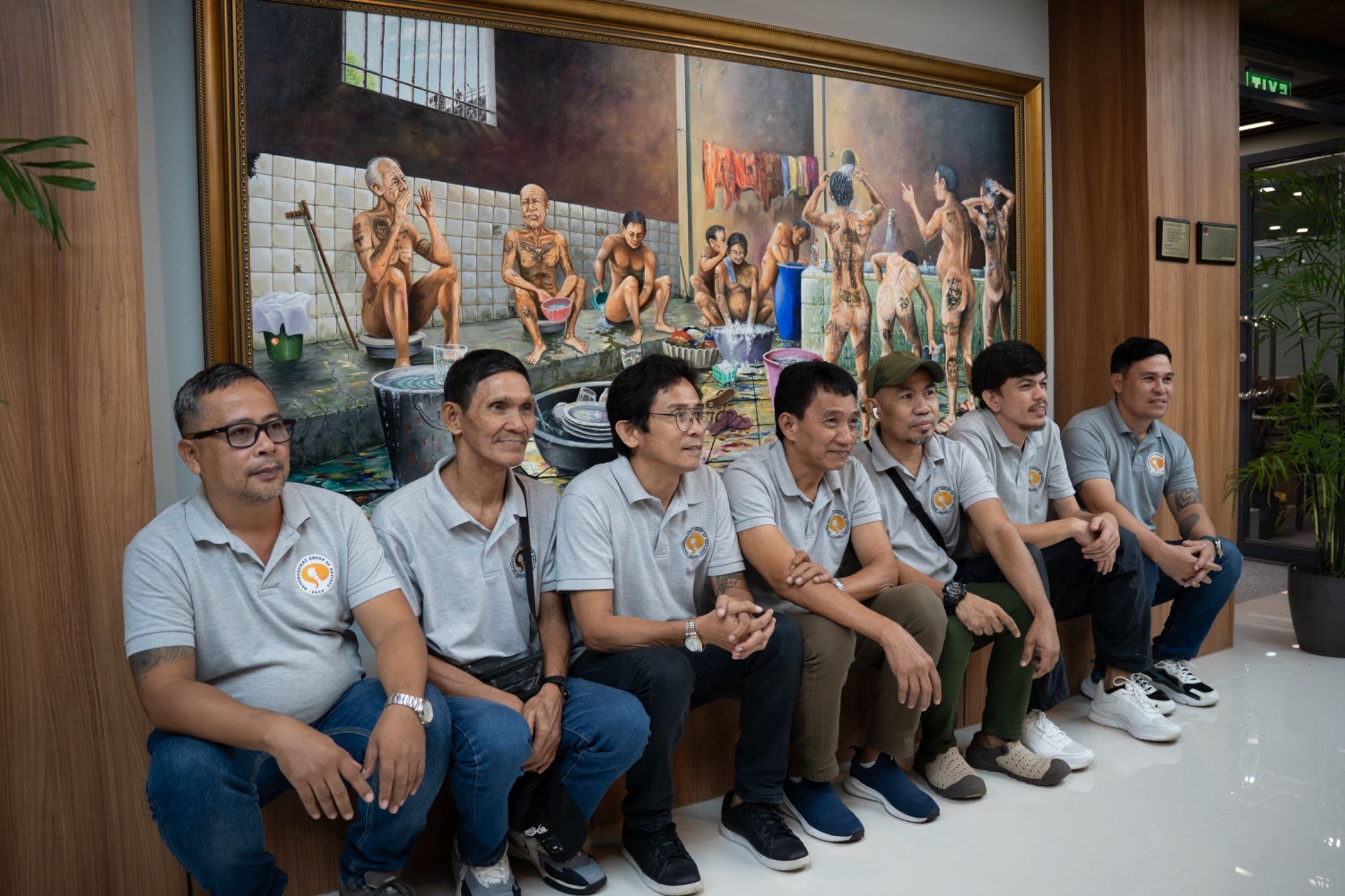
At the UP College of Law, a mural tells a story that cannot be found in a case file.
Painted by members of the Bagongbuhay Group of Artists (BAGA), a collective of former Persons Deprived of Liberty (PDLs), the artwork brings their experiences of detention, change, and life after incarceration into a place where law is taught and practiced.
The painting, Buyon, was formally turned over to the UP College of Law on September 18 as part of the UP Law Class of 2001’s 25th anniversary celebration. It was unveiled alongside a wider exhibit of works by BAGA, a group founded in 2021 that brings together former PDLs and marginalized communities through art.
But before it became a mural hanging inside Bocobo Hall, “buyon” was a word rooted in the everyday reality of life inside detention. It refers to a shared space where PDLs bathe, wash their clothes and dishes, and wait for their turn to use the limited water available.
And behind the painting are the stories of the men who created it — what they remember, what they experienced, and what they are trying to communicate through art.
From jail space to mural
The mural began last year, when Joey de Leon, 57, the founder and president of BAGA, was called to a meeting through Justice Karl Miranda.
Alumni of the UP Law Class of 2001 wanted a large, painting-style mural about the country’s criminal justice system for their legacy project, and they wanted BAGA’s help bringing it to life.
De Leon, who has lived through incarceration himself and would later become one of the five BAGA artists credited on the finished work, proposed starting somewhere the public rarely thinks to look.
“Ang buyon ay isang facility sa loob ng bawat brigada sa kulungan. Doon kayo naliligo, doon rin kayo naglalaba, doon rin dumudumi. Hindi siya katulad ng normal na comfort room o bathroom, pinagsama-sama lahat doon,” De Leon said.
(The buyon is a facility inside every brigada in a detention center. That’s where you bathe, where you wash clothes, and where you relieve yourself. It isn’t like a normal comfort room or bathroom. Everything happens in the same space.)
In the mural, that cramped space is filled with the routines PDLs share. Men bathe and wash clothes beside basins and buckets, against tiled walls and beneath a small barred window. The exhibit’s description also presents the buyon as a place of connection and shared experience among the people who use it. Still, De Leon is careful about what the painting is and is not trying to say.
“Hindi namin sinasabi na, ‘oy, eto kami, bigyan niyo kami,’ kasi may problema ang gobyerno,” he said. “Kami ay pangkaraniwang inmate na naranasan mismo iyon. Pinapakita lang namin, we are humans.”
(We’re not saying, “hey, here we are, give us something,” just because the government has problems. We’re ordinary inmates who lived through it ourselves. We’re just showing that we are humans.)
Making something after detention
For Danilo Faustino, 65, the harder question came after his release. What happens after you have served your sentence?
Faustino spent around two decades in the New Bilibid Prison. For him and other members of BAGA, art became one way of confronting the difficulty of rebuilding life after release. Finding regular work can be difficult for former PDLs, particularly for someone his age, and painting offered another way to earn and help support his family. He wants the same for those still in detention, which is why he encourages them to learn art.
“Para paglaya nila, meron silang, ika nga eh, panghanapbuhay o diskarte,” said Faustino.
(So that when they are released, they will have, so to speak, a livelihood or something they can do.)
Of all the images Faustino could have painted, he chose Lady Justice, a figure closely tied to the justice system he once passed through. His version shows her blindfolded, holding a set of scales in one hand and a sword in the other. After all those years in Bilibid, Faustino has not given up on what she stands for. In his reading of the figure, her balance remains, and justice is still something she is bound to give.
“Katarungan, kailangan niyang ibigay (Justice is something she has to give),” he said.
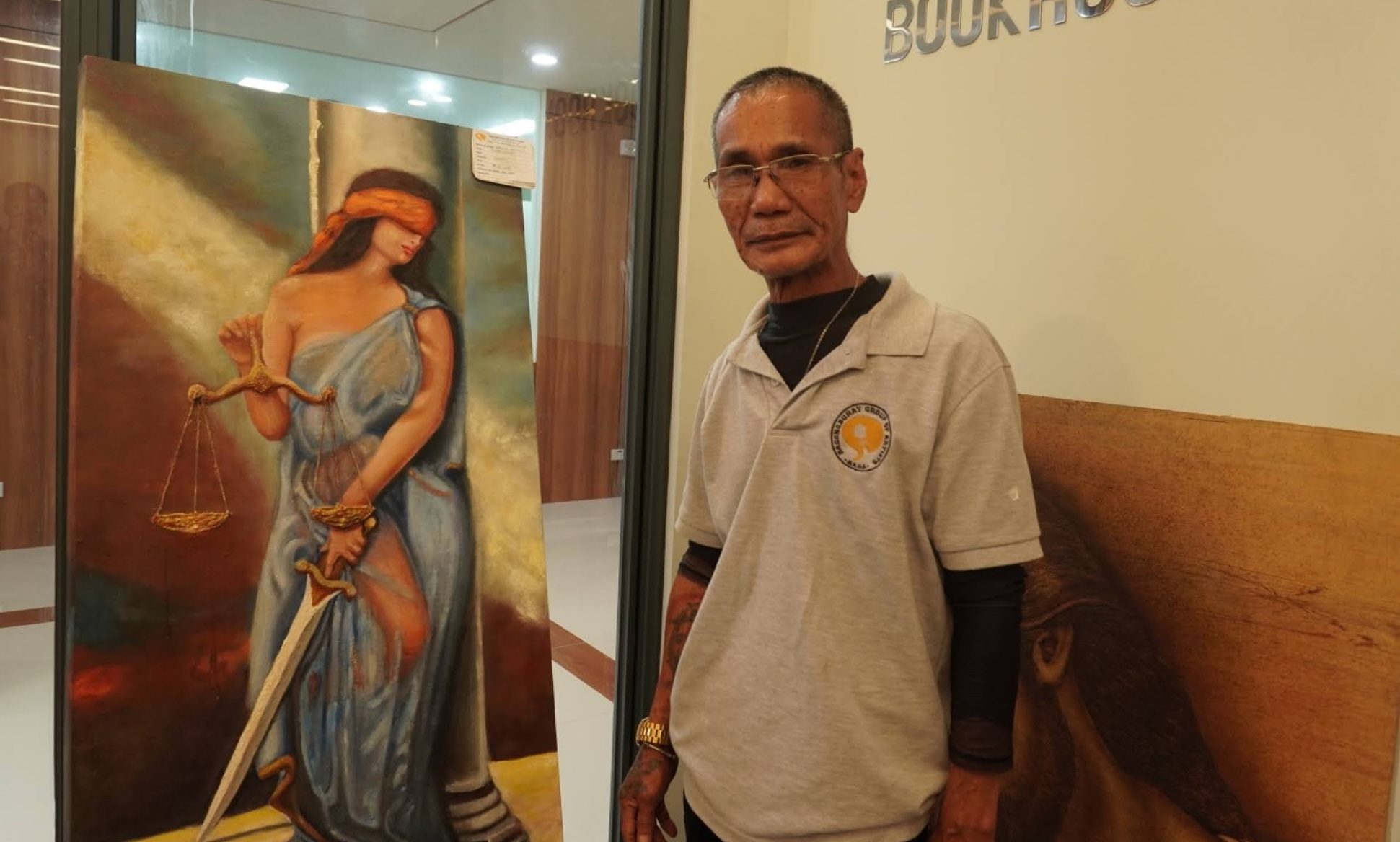
Faustino also sees art as something that helps people get through their time inside. BAGA teaches PDLs so they have something to focus on while serving time.
“Para meron silang mapaglibangan,” he said. “Yung artwork na ’yan, hindi sila ma-homesick sa loob. Hindi sila maburyong.”
(So they have something to keep them occupied. With art, they don’t get homesick inside. They don’t go stir-crazy.)
What people outside do not see
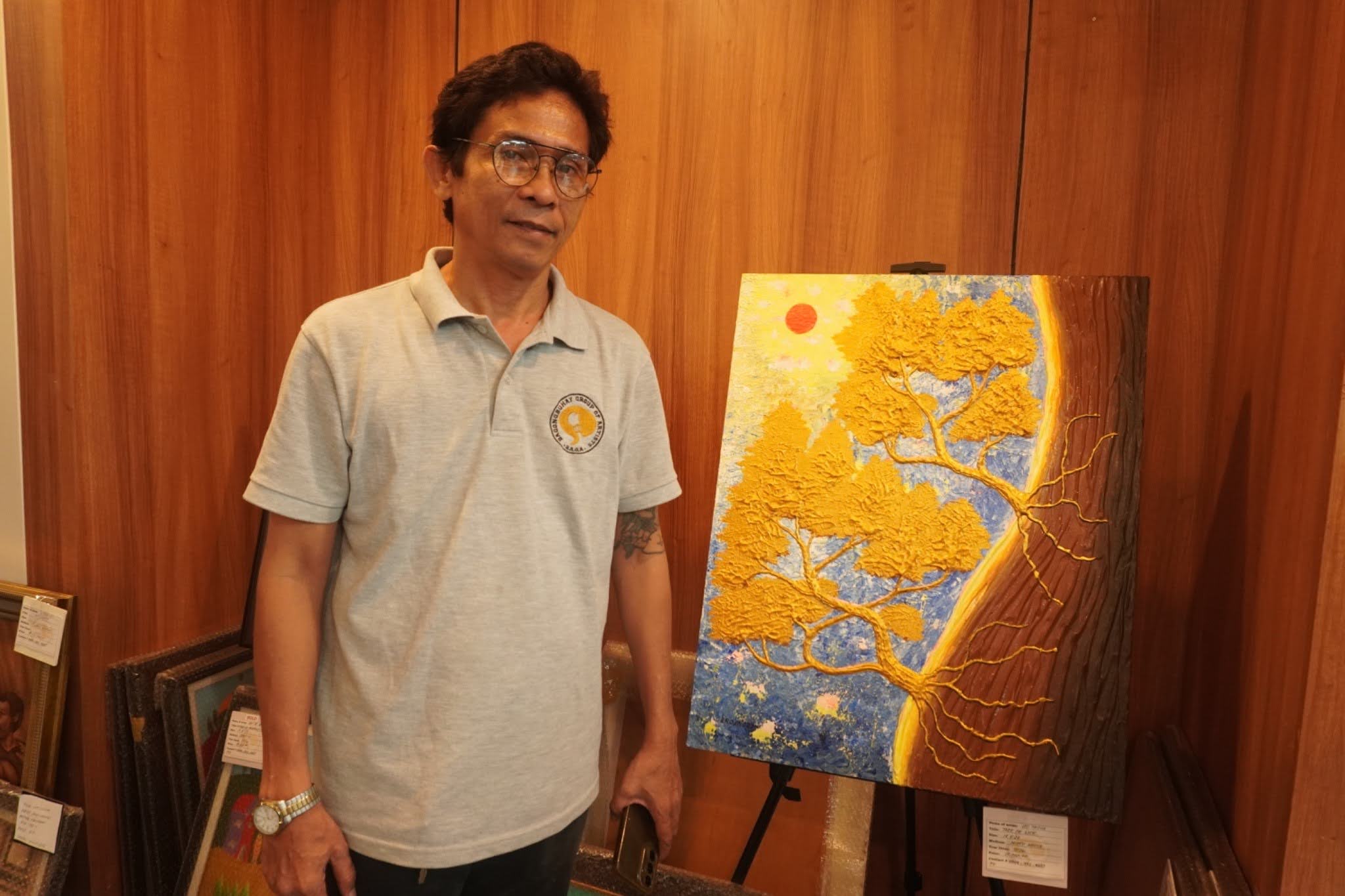
Leo Eroja, 49, is one of the five BAGA artists behind Buyon. He began making art in 1996, the year he was imprisoned, and most of his works are mixed media, often with embossed details. His piece in the exhibit, titled Tree of Life, carries a meaning he explains in simple terms.
“Simbolo siya ng pag-asa at kasaganahan (It’s a symbol of hope and abundance),” he said.
Inside, art also became how he got by. With little else to fill his days, painting gave him something to focus on and something he could sell to support himself.
“Sa loob, matutukan mo talaga ang art. Wala ka namang ibang gagawin. Magpipinta ka para maibenta mo at maka-survive ka sa pang-araw-araw,” Eroja shared.
(Inside, you can really focus on art. There’s nothing else to do. You paint so you can sell your work and survive day to day.)
What Eroja wants people outside to understand is how much of ordinary life continues behind bars. Many do not realize there are schools inside, he said, and apart from limited movement, the main difference is that family cannot always come to visit.
“Hindi nila alam na may school din pala doon. Parang nasa loob ka, parang nasa laya ka rin. Ang kaibahan lang, nakakulong kayo, limited ang galaw mo,” he shared.
(They don’t know there’s a school there, too. Life inside has some of the same routines as life outside. The only difference is that you’re locked up and your movement is limited.)
Not as sterile as the texts we read
For the lawyers behind the mural, Buyon also carries a message for their own school. Professor Oliver Xavier Reyes, a member of the UP Law Class of 2001, admitted during the turnover that he felt some apprehension when a painting was first proposed as the batch’s legacy project, since everything depended on what it would show. Buyon answered that question for him.
“The painting is all about the stakes as we practice law in the grand manner,” he said.
Reyes compared law school life to a cloister, where concerns beyond its walls can sometimes feel like distractions. That distance can be useful, he acknowledged, but it also risks separating legal study from the lives affected by it.
“It is helpful still, for the law student or the lawyer, to be served on occasion the clarifying reminder that the lives embedded in the law are not as sterile as the texts we read,” Reyes said.
One detail in the mural stood out to him, the daylight entering through its barred window, which he called a reflection of “the best of the human spirit.” He also found it fitting that Buyon now hangs in Bocobo Hall, home of the UP Law Center, the government’s legal policy and research arm.
Anyone who walks in, he said, may be reminded that the people lawyers serve include “those who have been rendered least capacitated.”
More than the years they served
Each of the artists asks for something small and concrete. Faustino wants PDLs to leave detention with a skill they can live on. Eroja wants people outside to know that schools and daily routines continue behind bars. For De Leon, what matters most is trust, which he said remains the hardest thing to earn back, even years after release.
He credits organizations and members of the judiciary, like those behind the mural, for giving BAGA’s members another chance, and he hopes the rest of society will follow.
“Ganoon din sana in general, hindi lang itong mga judiciary institution natin. Bigyan niyo kami ng second chance,” De Leon said.
(We hope it’s the same in general, beyond our judiciary institutions. Give us a second chance.) – Rappler.com
Arabella Grace Sta. Ana is a Rappler intern studying BA Philosophy at UP Los Baños.
KioskNews shows a cleaned-up reading view extracted from the publisher’s page — the original always lives on their site, not ours.