Indian protest leader tests government
DETAINED: Abhijit Dipke, who founded the Cockroach Janta Party, was defiant, while police said that he was not being arrested, but his cooperation was sought
Indian police yesterday detained Abhijit Dipke, the political strategist who turned a “cockroach” jibe at unemployed young people into a nationwide protest movement that helped force the resignation of a federal minister.
Police met Dipke’s aircraft as it landed in the capital, New Delhi, ahead of a rally to demand the resignation of the head of elections over accusations of voter list manipulation that critics say dropped about 130 million voters from a draft roll.
“I have come to be arrested, arrest me... I am not afraid of you guys,” Dipke told police officers aboard the aircraft, in television images that showed one of them assuring him he was not being arrested, but rather that his cooperation was sought.
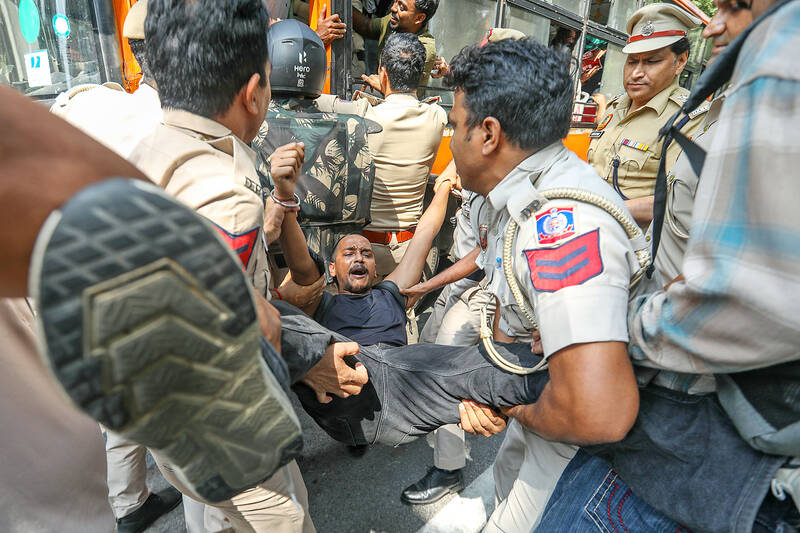
Police detain a man at a Cockroach Janta Party protest in New Delhi yesterday.
Photo: EPA
Dipke, 31, born in a Dalit family on the lower rungs of India’s caste system, shot to fame this year after his six-word response to Indian Supreme Court Chief Justice Surya Kant’s remarks likening unemployed young people to “cockroaches” went viral online.
The post spawned the satirical Cockroach Janta Party, an online movement that rapidly evolved into a political force.
It mobilized mass street protests that culminated in the July resignation of Dharmendra Pradhan as minister of education, a rare exit from Indian Prime Minister Narendra Modi’s Cabinet, following sustained public pressure.
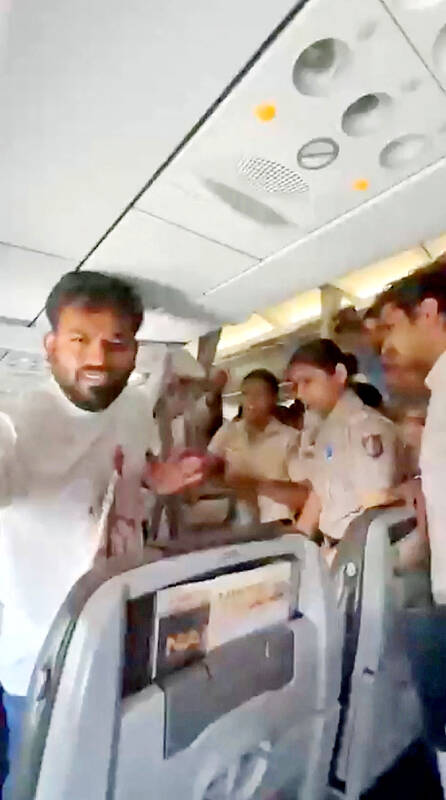
An image taken from video shows Abhijit Dipke, left, who founded the Cockroach Janta Party, being detained by police officers on an aircraft in New Delhi yesterday.
Photo: Reuters / Cockroach Janta Party via X / Handout
Dipke’s detention came after he called for a fresh protest yesterday seeking the resignation of election commission chief Gyanesh Kumar over the changes.
The election panel says the figure comprises entries flagged during draft revision and that voters wrongly removed can enroll again.
Bearded and usually wearing T-shirt and jeans, Dipke had led a protest in the southern tech hub of Bengaluru before traveling via Mumbai to the capital, where police detained him with two senior group leaders, Saurav Das and Ashutosh Ranka.
Despite a police crackdown in Delhi and tight protest restrictions, Dipke urged supporters to demonstrate peacefully, citing the example of Mahatma Gandhi.
“I don’t know what will happen tomorrow, but one thing I am sure of is that I am not going to be afraid,” Dipke said in a video recorded before yesterday’s flight.
“Neither am I going to step back. We have to save our democracy,” he added.
Authorities called in thousands of security forces to fortify Delhi, with travel and telecom links suspended, in a lockdown designed to stop the protest.
“Why is the prime minister so scared of the country’s youth, the country’s people?” Dipke asked before his flight departed.
“What if all cockroaches come together?” was Dipke’s question in a May social media post that almost overnight turned the political communications professional into one of the most recognizable faces of India’s youth protest movement.
He returned to India after completing a master’s degree in public relations in the US, saying his viral success had given him “a chance to do actual, meaningful work,” despite threats he and his family received.
The Cockroach Janta Party amassed millions of followers online and helped drive protests over leaks of a medical entrance examination paper affecting about 2 million candidates.
The movement eventually focused its anger on Pradhan, who resigned on July 25.
Since then, Dipke and his supporters, who see the group as a political pressure movement rather than a party, have campaigned on issues ranging from government school infrastructure to jobs for young people.
It returned to the streets after a report last month in the Indian Express newspaper.
The paper said two of election chief Kumar’s deputies had repeatedly raised concerns about voter-roll revisions, registration procedures and the commission’s digital systems.
The poll body has said that differing views are normal during internal deliberations.
KioskNews shows a cleaned-up reading view extracted from the publisher’s page — the original always lives on their site, not ours.