MND Local CDMX: Pilgrimage preparations, ancient remains and delivery protests
From preparations for one of Mexico’s largest annual religious gatherings to archaeological discoveries and transportation projects, Mexico City has plenty happening this November.
Authorities are gearing up to welcome millions of pilgrims to the Basilica of Guadalupe, while construction of a major passenger rail connection revealed an unexpected discovery. Meanwhile, a proposed licensing overhaul for motorcycle delivery workers hit a roadblock following protests.
Let’s get into it.

Authorities outline priorities for ‘Operation Basílica 2026’
Mexico City authorities have begun organizing a major security and public services operation ahead of Día de la Virgen de Guadalupe, the annual December celebrations honoring the Virgin of Guadalupe. Approximately 13 million pilgrims are expected to visit the Basilica of Guadalupe this year, which is on par with last year’s figures.
The Gustavo A. Madero borough, home to the religious complex, held its first interagency planning meeting earlier this month to coordinate the “2026 Operativo Basílica.” More than 30 federal and local government institutions are expected to participate in the effort.
The operation will cover public security, traffic management, emergency medical assistance, civil protection, sanitation and more. Participating agencies include the National Guard, Mexico City’s Citizen Security Ministry, the Navy, the National Defense Ministry, the Red Cross, the fire department and the city’s Metro and Metrobús systems.
Planning and coordination
Gustavo A. Madero Mayor Janecarlo Lozano said early coordination is necessary to manage crowds and ensure authorities can respond quickly to emergencies.

“Our responsibility begins with the planning stage and continues until the pilgrims begin their journey home,” Lozano said, according to Excelsior. “We want them to find guidance when they need it, assistance when they require it, and dignified treatment at all times.”
The holiday and pilgrimage honor an event in 1531, when an apparition of the Virgin of Guadalupe is said to have appeared to an Indigenous peasant named Juan Diego on a mountain above the holy site.
Last year’s operation provides a starting point for this year’s preparations. In 2025, the borough deployed 10,600 city workers, 250 law enforcement officers and 110 law enforcement vehicles. Authorities also installed 450 portable toilets, 26 hydration stations and two bike parking structures capable of housing 12,000 bicycles.
“We have years of experience and the opportunity to improve,” Lozano said, according to Milenio. “Let’s make each meeting a source of clear agreements and use all our institutional capacity to provide a timely response to the people. Because governing is about caring, we work together to live up to the trust of millions of people.”
INAH discovers possible pre-Hispanic ossuary during Mexico-Querétaro train works
Meanwhile, archaeologists have uncovered what may be an ancient ossuary containing human remains and artifacts at Mexico City’s Buenavista railway terminal, according to a news release from Mexico’s National Institute of Anthropology and History (INAH). The discovery was made Sept. 17 during construction work on the Mexico City-Querétaro train line.
Researchers have so far identified nine human skeletons, five mandibles and several other bones, including ribs, femurs and pelvic fragments.
According to Secretary of Culture Claudia Curiel de Icaza, the discovery reveals new dimensions to the region’s pre-Hispanic funerary practices and how they honored their dead.
1 of 3
“A possible ossuary speaks not only of death: it raises questions about how the ancient communities of this territory treated and remembered their dead during a time of profound change,” Icaza said in a statement.
The burial deposit may date to the Late Postclassic period (1200-1519) or the early years of Spanish contact (1519-1535). Associated artifacts include domestic pottery, miniature spindle whorls, figurines and stone tools. Several obsidian blades may have originated in Hidalgo’s Sierra de las Navajas region.
“Taken together — bone fragments and ceramics — they could correspond to the final years of the pre-Hispanic period and the colonial era (1535-1821),” said José Manuel Cervantes Pérez, head of the Physical Anthropology Laboratory.
The recovered materials have been transferred to laboratories in Hidalgo for cleaning, restoration and further study.
“The associated materials offer clues to this encounter between different historical moments; it will be up to the INAH to study them rigorously and explain what they reveal,” Icaza said. “In this way, a history that lay hidden beneath the city can be incorporated into the knowledge of everyone.”
Mexico City-Querétaro train line construction is now 32% complete
Speaking of the Mexico City-Querétaro train line, construction has reached 32% completion, President Claudia Sheinbaum announced Oct. 31 during a visit to a portion of the project in Polotitlán, State of Mexico.
Additionally, Sheinbaum said 90% of the land rights needed for the project have been secured and that construction is progressing according to schedule.
At a cost of roughly 700 billion pesos, the approximately 230-kilometer railway will connect Mexico City with Querétaro, passing through the State of Mexico and Hidalgo. The journey is expected to take approximately two hours, with trains averaging 130 kilometers per hour.
The route will feature six stations: Buenavista in Mexico City, Huehuetoca and Teoloyucan in the State of Mexico, Tula de Allende in Hidalgo, and two stops in Querétaro.
Sheinbaum described the project as part of a broader effort to revive passenger rail services across the country, which in turn would offer an alternative to increasingly congested highways.
According to officials, 47 trains have been contracted and are currently being manufactured.
Mexico City suspends special license and commercial plate plan for delivery drivers
And now a win for the thousands of men and women who keep this city humming via Rappi, Uber Eats and countless other delivery services …
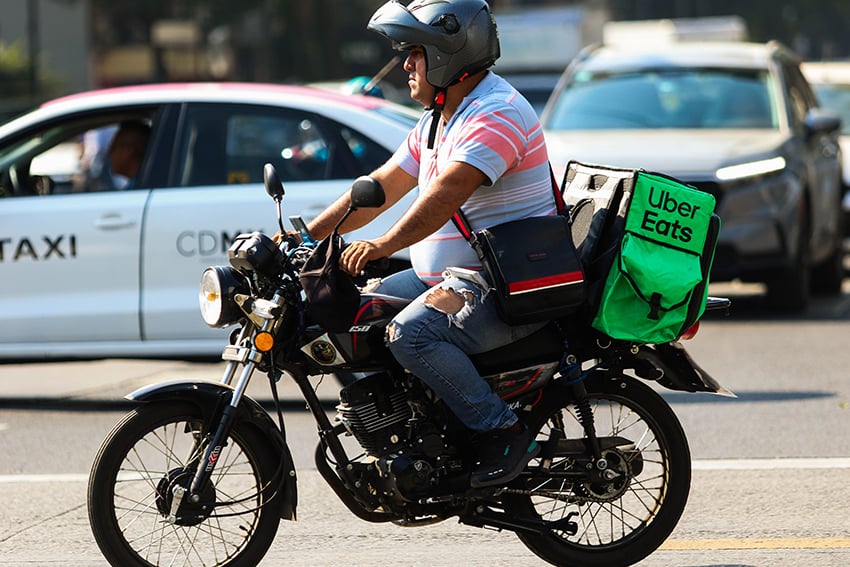
Mexico City authorities have suspended a pilot program that would have required motorcycle delivery workers operating through digital platforms to obtain special licenses and commercial plates, following protests over the proposed regulations.
The city’s Mobility Ministry (Semovi) reached the agreement Nov. 9 after Secretary Héctor Ulises García Nieto met with representatives of several groups to discuss their concerns. Both sides also agreed to establish additional working groups to review any revised proposals and develop an alternative regulatory framework.
The announcement followed several hours of demonstrations in western Mexico City, where app-based delivery workers blocked major roads in the Santa Fe area, causing traffic delays.
MND Local CDMX: A nighttime race, queer musical and medieval masquerade
‘Unnecessary administrative hurdles’
Protesters argued that the proposed requirements would impose unnecessary administrative hurdles and additional expenses on workers who already hold motorcycle licenses. Some also complained about frequent police enforcement operations targeting delivery riders during their shifts, as well as unsafe working conditions.
“I mean, we already had a license, first the regular one, then they made us get another one for a motorcycle, and now a special one. It’s tough,” a delivery driver who did not give their name told La Gazzetta DF. “Besides, the police are around all the time on this side; there are operations, they keep driving their trucks around us, and now the National Guard is involved, they show up and everything. It’s like we’re criminals, and we’re not.”
Semovi said the initiative was intended to organize motorcycle-based delivery services and improve protections for workers in a sector that has historically faced precarious working conditions.
The program’s suspension leaves the proposed licensing and registration requirements under review, with further discussions expected between authorities and motorcycle delivery groups.
Drew Pittock serves as Mexico News Daily’s features director. He is based in Mexico City. Have an idea for a feature story or unique event in CDMX? Send an email to drew.pittock@mexiconewsdaily.com.
KioskNews shows a cleaned-up reading view extracted from the publisher’s page — the original always lives on their site, not ours.