RTS Link’s Bukit Chagar station to connect directly to KTM trains, buses and taxis: Malaysia Transport Minister
A proposed public train-bus hybrid system to absorb an expected increase in commuters will however not be ready by Jan 2027, with Malaysia’s Transport Minister Anthony Loke saying that the government is still working out details.
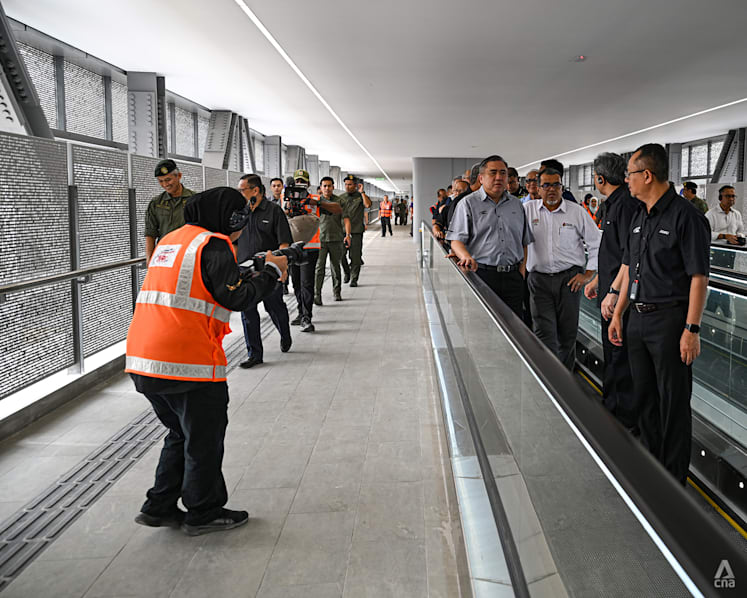
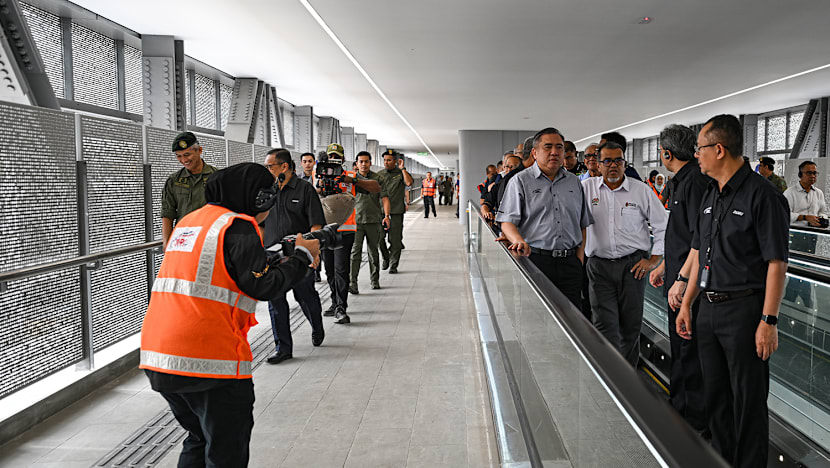
Malaysia’s Transport Minister Anthony Loke visits the pedestrian overhead bridge connecting the RTS Link Bukit Chagar station to KOMTAR JBCC on Aug 18, 2026. (Photo: CNA/Zamzahuri Abas)
New: You can now listen to articles.

This audio is generated by an AI tool.

18 Aug 2026 03:37PM (Updated: 18 Aug 2026 03:43PM)
JOHOR BAHRU: Passengers using the Johor Bahru-Singapore Rapid Transit System (RTS) Link will have more direct access to other forms of public transport, as Malaysian authorities seek to improve traffic dispersal around the Bukit Chagar terminus ahead of the cross-border service's opening.
An anticipated public train-bus system to absorb an expected increase in commuters will, however, not be ready as the government is still working on the details, said Malaysia Transport Minister Anthony Loke on Tuesday (Aug 18).
Connections from the Bukit Chagar RTS station in Johor Bahru will include a new pedestrian link to the Keretapi Tanah Melayu (KTM) station near JB Sentral, said Loke.
It will allow passengers to transfer more easily to KTM Komuter services to other parts of Johor, as well as the Electric Train Service (ETS) to major Malaysian cities including Kuala Lumpur and Ipoh.
“Once this is completed, passengers travelling on KTM Komuter will be able to alight at the KTM Komuter station and connect directly to the RTS Bukit Chagar station,” said Loke.
“This will make the journey much more convenient for passengers.”
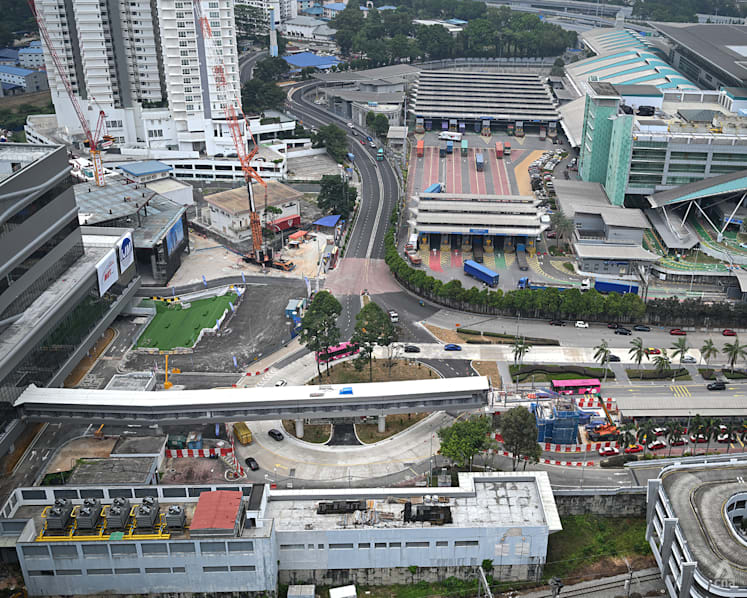
The new connection will branch off from a 450m covered pedestrian bridge linking the Bukit Chagar RTS station with JB Sentral. The wide walkway, which is equipped with travellators, is designed to accommodate thousands of people at a time.
Currently, KTM passengers would have to walk through JB Sentral before doubling back towards the RTS connection. The new link will allow them to join the pedestrian bridge closer to the KTM station, cutting the walking distance.
It will be in addition to planned connections giving RTS passengers access to bus services at a designated roundabout along Jalan Jim Quee and a taxi bay further down the same road.
Loke said the new KTM link will cost the Malaysian government RM60 million (US$14.8 million) and take about 12 months to construct.
Other connections to the taxi bay, bus services, Komtar JBCC mall and JB Sentral will be ready when the RTS Link begins operations, expected in early 2027.
“What we want the public to know is that the RTS system at Bukit Chagar will be integrated with multiple modes of public transport in Johor Bahru,” said Loke.
“This is one of our solutions to ensure that traffic dispersal can be managed effectively,” he added.
NO CONSTRUCTION LAUNCH DATE FOR E-ART SYSTEM
Meanwhile, there is uncertainty over plans for Johor's elevated Autonomous Rapid Transit (e-ART) project, a proposed public transport system intended to help absorb an expected surge in passenger movements in Johor Bahru once the RTS Link opens.
Johor Chief Minister Onn Hafiz Ghazi has repeatedly appealed to the federal government to expedite the e-ART project.
He has said that current measures including park-and-ride facilities, and the reorganisation of buses, taxis and e-hailing vehicles around JB Sentral, are only interim solutions.
Asked by CNA on Tuesday for an update on the e-ART, Loke said the system would eventually be integrated with the RTS Link, but details would only be announced once the government was ready.
“We are currently working out the concession agreement,” he said, referring to a legal contract for a private company to construct the project.
An ART system is typically an autonomous train-bus hybrid that runs on roads. Its rubber-wheeled carriages use sensors to follow a route defined by a virtual track.
CNA previously reported that uncertainty over Johor Bahru's rail plans had heightened concerns over worsening congestion in the state capital ahead of the RTS Link's opening.
RTS FARE, OPENING DATE TO BE ANNOUNCED JOINTLY
Loke was also asked about fares for the RTS Link. He said ticket prices and the date for the start of operations would be announced jointly by Malaysia and Singapore at a later date.
“At this point, we cannot make any announcement. I can assure you that discussions are ongoing and they are very positive,” said Loke.
On his last visit to the site in April, Loke said RTS Operations Pte Ltd (RTSO), the rail operator, is expected to submit its pricing proposal in the third quarter to Malaysia’s Land Public Transport Agency and Singapore’s Land Transport Authority.
The fare package will be considered by both governments before prices are announced by year-end, he had said.
RTSO is a joint venture between Malaysia’s state-owned transport operator Prasarana Malaysia Bhd and Singapore’s SMRT Corporation.
In February, Loke said one-way fares were expected to be around S$5 to S$7. He added then that fares for the cross-border rail service were unlikely to be as cheap as public transport in Kuala Lumpur, though they would still be more cost-effective than travelling to Singapore by car.
He also said in February that Singapore would not provide subsidies, meaning the operating model would have to be commercially sustainable.
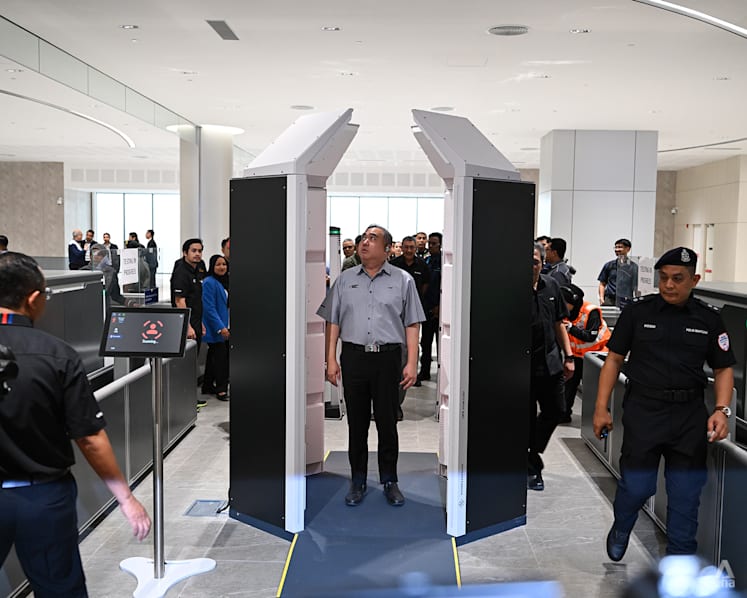
On Tuesday, Loke surveyed the Bukit Chagar station and took a return train journey from Bukit Chagar to Woodlands North with local officials and journalists.
“As we saw earlier, in terms of physical readiness, the (customs, immigration and quarantine) building and the RTS station are essentially complete. We are now in the final phase of testing,” said Loke.
“This is the most important phase before operations begin. The testing and commissioning phase is critical to ensure that all systems function properly and perform as expected before the RTS is opened to the public,” he said.
Malaysia authorities have set a target of 25 minutes for passengers to board the train after they enter Bukit Chagar station.
The station is billed as one of Malaysia’s most modern. It will feature spacious air-conditioned concourses, high-tech security screening and immigration systems, as well as amenities such as large toilets and a nursery for travellers with young children.
The RTS Link completed its first test run in December 2025. Experts say it is expected to reduce traffic congestion at the checkpoints by up to 25 per cent.
The 4km rail link will connect Bukit Chagar in Johor Bahru with Woodlands North in Singapore. It will carry up to 10,000 passengers an hour in each direction, with projected daily ridership of about 40,000 when operations begin.
KioskNews shows a cleaned-up reading view extracted from the publisher’s page — the original always lives on their site, not ours.