Myanmar leader in Russia on diplomatic push, even as legal risks complicate travel elsewhere
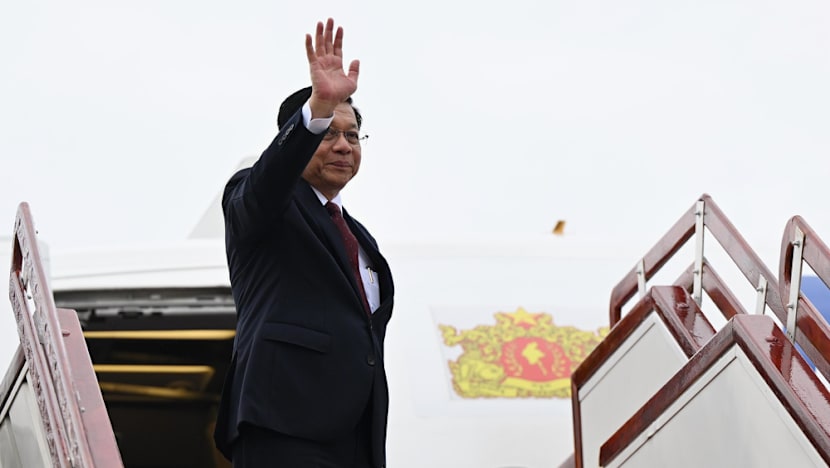
Since assuming a civilian role in April, Min Aung Hlaing has embarked on a charm offensive across at least five countries. But analysts say legal risks limit where he can travel.
New: You can now listen to articles.

This audio is generated by an AI tool.
18 Aug 2026 04:59PM
Myanmar leader Min Aung Hlaing is stepping up a diplomatic blitz abroad, seeking to expand his administration’s international ties and bolster its legitimacy.
He is due to meet Russian President Vladimir Putin in Moscow on Tuesday (Aug 18) and attend a business forum, with economic cooperation expected to feature on the agenda.
The former general arrived in the Russian capital the day before, the latest stop in a series of overseas visits that have also taken him to India, China, Laos and Thailand, since he assumed a civilian government role in April.
The two leaders will discuss strengthening cooperation as well as regional and international issues, with several agreements expected to be signed, according to a Kremlin statement. Myanmar’s President Office said the talks will span areas including the economy, security and social affairs.
The trip marks Min Aung Hlaing’s first visit to Russia since winning a parliamentary vote to lead Myanmar, following an election dominated by a military-backed party.
But it is his seventh trip there since the 2021 military coup that ousted the elected government of Aung San Suu Kyi. He last met Putin in Moscow in September last year.
The frequent high-level meetings reflect increasingly close ties between Myanmar and Russia. Both countries are under Western sanctions – Myanmar over the coup and subsequent crackdown, and Russia over its invasion of Ukraine.
Hunter Marston, director of the Southeast Asia Program at Sydney-based think-tank the Lowy Institute, expects defence cooperation to feature prominently in the talks.
With Myanmar’s military seeking to regain territory lost to resistance forces, Russia remains a key arms supplier, although its war in Ukraine has constrained its ability to export more weapons.
“I think Min Aung Hlaing will be seeing what is available to acquire from Russia to keep up the Myanmar military and air forces' advantage over the resistance at home,” Marston told CNA’s Asia Now programme.
Energy cooperation is another area likely to feature in the talks as Myanmar looks for ways to shore up its struggling economy.
Beyond defence and energy, Russia also offers Myanmar an important diplomatic relationship as Naypyidaw seeks to broaden and diversify its network of international partners.
“Russia plays an important role in Myanmar's wider diplomatic networking to offset its reliance on China, and also to shore up its network of partners in light of international isolation and targeted economic sanctions,” Marston said.
In Min Aung Hlaing's recent charm offensive abroad, he has emphasised that Myanmar is open for business and portrayed the country as being on a path towards progress, stability and democracy.
He has also pledged to restore ties with the Association of Southeast Asian Nations (ASEAN), although he has pushed back on the regional bloc’s Five-Point Consensus peace plan, saying it discriminates against Myanmar.
Analysts say his diplomatic push has several objectives, including securing economic deals and gaining greater international recognition for an administration that remains isolated, particularly in much of the West.
But his choice of destinations is shaped by another consideration: the risks of arrest over allegations of international crimes.
LEGAL RISKS ABROAD
In November 2024, the International Criminal Court (ICC) prosecutor sought an arrest warrant for Min Aung Hlaing over alleged crimes against humanity involving the Rohingya ethnic minority.
International human rights lawyer Chris Sidoti said travelling overseas therefore carries some degree of risk for the Myanmar leader.
“(Min Aung Hlaing) is taking a risk when he travels,” he said. “But he certainly can be confident when he travels to his close friends (such as) China, a country that has a very close association historically to the Myanmar military.”
Russia is also considered a relatively safe destination for Min Aung Hlaing, Sidoti added. Putin himself is subject to an ICC arrest warrant over the alleged war crime of deporting Ukrainian children to Russia.
But it remains unclear if the court has since issued an arrest warrant for Min Aung Hlaing, as the ICC does not always immediately make such warrants public.
If one has been issued, the court can rely on its member states to carry out an arrest. Within ASEAN, only Cambodia and Timor-Leste are parties to the Rome Statute, the treaty that established the ICC.
But Sidoti said this does not necessarily mean Min Aung Hlaing can travel freely elsewhere in the region.
“Universal jurisdiction still applies for all states,” he said. “There are expectations that they would take seriously various responsibilities under international law to prosecute persons suspected of those most serious international crimes.”
Universal jurisdiction is a fundamental principle of international accountability. It allows nations’ courts to investigate and prosecute serious international crimes such as war crimes, crimes against humanity and genocide.
Under this principle, a state may exercise jurisdiction through its national courts over these crimes even when they were committed abroad.
“In some instances, some countries consider that they have an obligation to prosecute a person who falls into these categories,” said Sidoti.
“If Min Aung Hlaing (travels) to some countries, he would be almost certain to be arrested and investigated. In other countries, it's a discretionary jurisdiction.”
In 2019, a Rohingya rights group filed a universal jurisdiction case in Argentina over allegations of genocide and crimes against humanity in Myanmar.
An Argentine court subsequently issued international arrest warrants for more than 20 Myanmar officials, including Min Aung Hlaing.
The rights group urged Thai authorities to arrest Min Aung Hlaing during his recent visit to Thailand, but Bangkok did not do so.
For now, that leaves Min Aung Hlaing able to travel to countries prepared to receive him and where the prospect of arrest is limited.
The larger question is how far he can expand that diplomatic circle while he remains widely blamed for Myanmar’s ongoing crisis.
NUG’S OWN DIPLOMATIC PUSH
Myanmar’s opposition National Unity Government (NUG), meanwhile, is pursuing its own campaign for international support.
Over the past five years, NUG Foreign Minister Zin Mar Aung has travelled to the United States, Canada, Japan, South Korea and Timor-Leste, meeting officials and representing Myanmar’s opposition government.
Within ASEAN, however, the NUG’s engagements have been more limited, including online meetings that have often taken place away from the international spotlight.
The NUG argues that this reflects an imbalance in how regional governments engage with Myanmar’s rival camps.
“For example, during the recent meetings in Thailand, the ASEAN Envoy and the ASEAN Chair engaged with us separately,” Zin Mar Aung said. “But the host country did not accept us being there in person. So it was not equally treated.”
As Min Aung Hlaing’s administration and the NUG compete for diplomatic attention, ASEAN remains at the centre of efforts to address the crisis in Myanmar.
The regional grouping has maintained its stance since the 2021 coup of barring Myanmar’s military leadership from high-level ASEAN meetings, while keeping channels open with stakeholders across the conflict.
ASEAN has also stressed that engagement with Myanmar’s military authorities does not amount to recognition.
That distinction is becoming increasingly significant as Min Aung Hlaing expands his overseas outreach. His administration can point to meetings with foreign leaders and a growing number of diplomatic engagements as signs that Myanmar is breaking out of its isolation.
The NUG, meanwhile, is trying to ensure those engagements do not translate into broader international acceptance of Min Aung Hlaing’s administration, while pressing governments to give the opposition greater access of its own.
KioskNews shows a cleaned-up reading view extracted from the publisher’s page — the original always lives on their site, not ours.