Alibaba’s Joe Tsai champions open-source AI at Wuzhen Summit amid US pushback
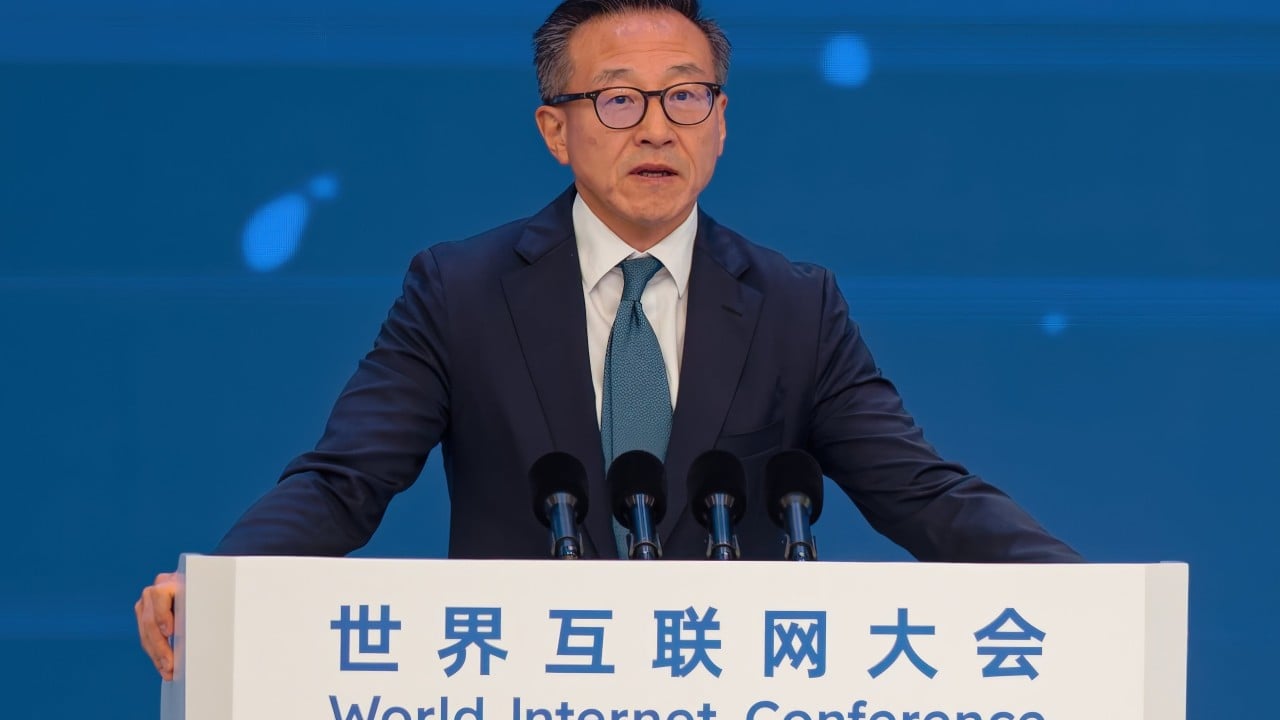
Open source is the only viable path to creating a sustainable artificial intelligence industry, Alibaba Group Holding chairman Joe Tsai said on Tuesday, as the Chinese technology giant doubles down on its open-source AI strategy.
Speaking at the opening ceremony of the annual World Internet Conference Wuzhen Summit in eastern China’s Zhejiang province, Tsai pointed to a growing convergence around open ecosystems among domestic tech companies, as surging AI demand rubs up against persistent shortages of computing power.
“Only through open source can AI become popularised, and only through popularisation can we create a sustainable, inclusive intelligent era,” the Alibaba co-founder told attendees at the event backed by the Cyberspace Administration of China and the Zhejiang provincial government.
Tsai framed China’s leading role in the global open-source landscape around what he called the “spiritual core of Chinese innovation”. This philosophy, he said, focused on “transcending self-interest to enhance the common well-being, elevating collective wisdom through sharing, and creating greater value by helping each other succeed”.
His remarks aligned with the summit’s broader political tone. In a keynote address on Tuesday, Premier Li Qiang advocated for “inclusive balance” and “open dialogue” in the development of AI and the internet, while warning against “overstretching national security concepts” and erecting a “digital iron curtain”.
Late last month, prominent Chinese AI firms DeepSeek and MiniMax secured regulatory approval to release and license open-source systems overseas, according to state media reports.
Granted days after authorities proposed new export restrictions on AI-related technologies, the clearances ensure that domestic champions can continue distributing model weights internationally.
While leading US companies such as OpenAI and Anthropic have argued that powerful open-weight models pose safety risks, an increasing number of developers globally are turning to open alternatives.
Andrew Ng, the former head of Google Brain and chief scientist at Baidu, said in August that open-weight systems “seem safer to me than closed-weight models”. Ng noted that he had used two Chinese models – Moonshot AI’s Kimi K3 and Z.ai’s GLM-5.2 – to conduct security reviews on a new AI agent tool.
Within China, Alibaba has emerged as one of the most active promoters of open-source AI. Its flagship model family, Qwen, now has more than 470 open-source variants, with total downloads exceeding 4 billion and more than 330,000 derivative models created to date, according to company figures.
Tsai said open weights significantly lowered research and development costs for smaller businesses and developing nations. He cited the example of a non-profit group in Uganda that had used Qwen to build a localised AI model supporting 68 African languages, allowing local engineers to bypass foundational hurdles without building models from scratch.
Tsai’s pitch in Wuzhen follows similar remarks he delivered last month at the Wave tech conference in Italy, where he said embracing the open-source approach was the only way for Europe to achieve tech independence.
“You don’t want to feed it into some closed-source API,” Tsai said at the time. “You want to maintain those data and be able to take open-source models and then further train your model, and improve it for your use.”
Alibaba was using the US$25 billion in free cash flow generated by its core e-commerce business to fund its AI infrastructure and model development, Tsai said, adding that the Hangzhou-based company had doubled its computing capital expenditure every year for the past three years.
KioskNews shows a cleaned-up reading view extracted from the publisher’s page — the original always lives on their site, not ours.