Tim had never been on a jury. This TV experiment left him ‘gobsmacked’
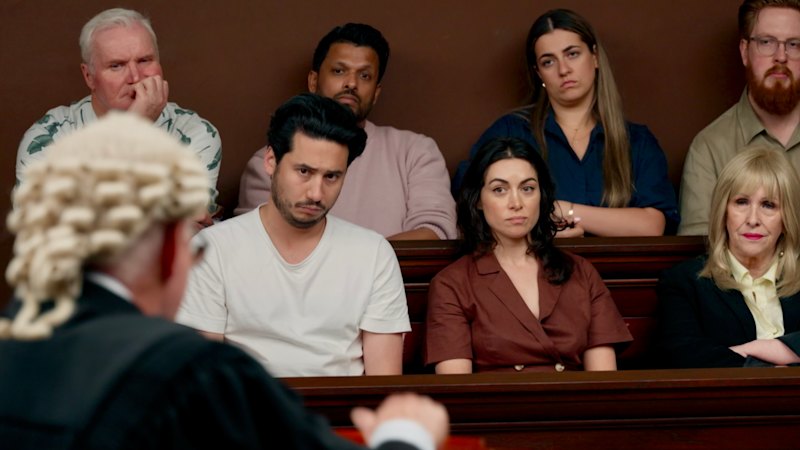
Tim had been called up for jury duty four times, but the 29-year-old musician had always been unavailable due to his former career in the busy advertising industry. However, when a friend who worked at SBS suggested he apply to be part of TV experiment The Jury, his interest was piqued.
“God, I had nothing better to do,” he says. “I’d gotten out of rehab a couple of months before that, so I was just chilling, and I was like, ‘Why not? Let’s do some reality TV.’” The experience ended up significantly changing his perceptions of the justice system.
Tim is one of the 12 everyday Australians taking part in season two of The Jury, where viewers are taken inside the usually off-limits world of the jury room. As in the first season, which came out in 2024, the series follows a real case, the details of which have been anonymised. The 1700-page transcript of the real criminal trial is condensed to a 500-page script (created to very closely reflect the original testimony) and the new jurors are left to find their own verdict.
For the show’s legal consultant Simone Quinn, a solicitor who has been practising law for nearly 30 years, it’s a unique insight for audiences. “[The jury room] is completely secret and closeted,” she says. “It is an extremely sacred space and the confidentiality of those deliberations and the jurors is critical to ensuring that justice is dispensed properly.”
The trial this season covers the disappearance of a woman whose remains are found when the defendant’s former backyard is dug up for construction a decade later. Quinn says it’s a trial that would have been particularly challenging for jurors to navigate.
“I thought it was a really tricky case to put in front of a jury,” she says. “Having a woman’s remains dug up in a residential backyard points to something very sinister, yet the case or the evidence before them really was circumstantial. There was no direct evidence of a killing.”
This season was a massive undertaking, with 16 actors and dozens of crew working together for a two-week shoot at the 172-year-old Justice and Police Museum in Sydney.
“There was a court officer who took you in, every detail was as it would be if you were experiencing it in real life,” Tim says. “So it wasn’t hard to pretend. Everything felt completely real.”
As in an actual jury, the 12 participants also brought a range of life experiences to the table. Throughout the episodes, they candidly shared their own personal histories of crime, tragedy and hardship. For Tim, who has experienced substance addiction, he felt reasonably able to park his biases and aim for objectivity on the case, though he admits that was not always 100 per cent possible.
“Having experienced drug addiction and seeking treatment with other people who are drug addicts, I think you really sharpen this sense of empathy for people that you did not have,” Tim says. “My sense of empathy is almost the biggest bias that I brought into it. Some of the people in this case acted very irrationally, but I can understand why.”
He says his experience on the show has completely flipped his thoughts on juries. Tim now believes the system used in most of Europe, where a judge or panel of judges determines guilt or innocence, seems the best option.
“This is like the digestive part of our legal system that you don’t see. It’s kind of gross,” he says. “Everyone knows it’s a jury of your peers. In a criminal trial, they need to prove beyond reasonable doubt. You hear those as sound bites. But when you’re really there, to me, it didn’t make a damn bit of sense to have 12 people plucked off the street who have no legal experience actually having to grapple with some pretty serious legal concepts.
“I thought everything would be explained, but they just plonk you in a room and say, ‘Figure it out for yourself.’ I was gobsmacked at how much faith they put into 12 random people that may or may not have any experience with the legal system. I think it’s to its detriment, honestly.”
The Jury: Skeleton in the Garden premieres at 7.30pm on Monday October 5 on SBS and SBS On Demand.
Want more TV? We’ve got you.
- Newsletter: Find out the next TV, streaming series and movies to add to your must-sees. Get The Watchlist delivered every Thursday.
- Movie guide: More than 200 handpicked hits from all the major streamers.
- What’s Julia Morris doing after I’m a Celebrity? Whatever she wants.
- Last Meals: Why TV is full of celebrities eating chicken and doing Tim Tam slams.
- On set with Sharon Horgan: Inside the Irish star’s hilarious new show Youth.
- Watch: Binged The Airport Chaplain? Meet the man who inspired the show.
More:
KioskNews shows a cleaned-up reading view extracted from the publisher’s page — the original always lives on their site, not ours.