UPSC Issue at a Glance | Nobel Prize 2026: Key discoveries, winners and their significance
UPSC Issue at a Glance is an initiative by UPSC Essentials aimed at streamlining your UPSC Current Affairs preparation for the Prelims and Mains examinations by focusing on issues making headlines. This time, we look at the Nobel Prize 2026 from a broader perspective. Let’s get started.
Early October 2026, like every year, marked Nobel Prize season. The announcement of six prizes to new faces from around the globe, consisting of the world’s most elite roster of scientists, writers, economists, and human rights leaders, does not just mean facts to remember.
With the changing nature of UPSC Examinations, aspirants must prepare themselves for analytical questions and make the best use of news and editorials around Nobel Prizes, directly or indirectly, in essays, ethics, personality tests, and other GS Papers. In this context, let’s take an overview of the Nobel Prize 2026.
Understanding the Nobel Prize: Essential facts
Before diving into the list of winners of the Nobel Prize this year and their discovery, let’s take a brief look at what the Nobel Prize is and some important facts associated with it.
Alfred Nobel, a Swedish chemist, engineer, industrialist, and the inventor of dynamite, in his last will and testament in 1895, gave the largest share of his fortune to a series of prizes in Physics, Chemistry, Physiology/Medicine, Literature, and Peace, to be called the “Nobel Prizes”.
In 1968, the sixth award, the Prize in Economic Sciences, was started by Sweden’s central bank, the Sveriges Riksbank.
Story continues below this ad
The Nobel Prize comprises a Nobel Medal, a diploma, and a document confirming the prize money. The monetary award varies depending on the income of the Nobel Foundation’s investment fund. In 2026, each Nobel Prize carried a monetary award of 12 million Swedish kronor (SEK).
When the first Nobel Prizes were awarded in 1901, the prize money stood at SEK 150,782 per category. Notably, it is not necessary that the award amount will increase every year. For instance, in 2012, the Nobel Foundation reduced the prize money from SEK 10 million to SEK 8 million.
The Nobel Peace Prize is presented in Norway while the other awards are handed out in Sweden. That’s how Alfred Nobel wanted it. The Nobel Committees of the prize-awarding institutions are responsible for the selection of the candidates. The institutions are:
| Nobel Prize in Physics | The Royal Swedish Academy of Sciences |
| Nobel Prize in Chemistry | The Royal Swedish Academy of Sciences |
| Prize in Economic Sciences | The Royal Swedish Academy of Sciences |
| Nobel Prize in Physiology or Medicine | The Karolinska Institute |
| Nobel Prize in Literature | The Swedish Academy |
| Nobel Peace Prize | A five-member Committee elected by the Norwegian Parliament |
Notably, the names of nominees and other details of the selection process are kept confidential for 50 years, ensuring the integrity and privacy of the process.
Story continues below this ad
Question 1: What have the 2026 Nobel Prize in Medicine winners discovered, and why does their work matter?
The Nobel Prize in Physiology and Medicine for 2026 was jointly awarded to Karl Deisseroth, Peter Hegemann and Georg Nagel for their discovery of an algae protein that reacts to light and its use as a switch to study the functions of nerve cells.
Their explorations led to the creation of a new field of study called optogenetics, which may finally help scientists understand how the brain forms memories, feelings and behaviours.
In simple terms, they found a way to control cells with light. Imagine that the brain is a vast electrical network containing billions of tiny cells called neurons. These neurons communicate by sending electrical signals, allowing us to move, see, remember, feel pain and experience emotions.
Karl Deisseroth, Peter Hegemann and Georg Nagel helped scientists develop a remarkable way of controlling these electrical signals: using light. Their research led to the discovery and development of light-sensitive proteins, called opsins, that can be placed in specific cells. When light is shone on those cells, the proteins act like tiny switches, turning the cells’ activity on or off. This technology is known as optogenetics — essentially, using light to control genetically modified cells.
Story continues below this ad
What they discovered?
The Francis Crick, the molecular biologist who was behind the discovery of and was awarded the Nobel prize for the double helix structure of DNA, envisioned activating individual nerve cells in a brain to investigate the mechanisms that underlie human consciousness. With nerve signals being extremely rapid, he realised it would only be possible if scientists were somehow able to manipulate the nerve cells with light. He himself admitted that the idea sounded far-fetched.
But it was made possible by the work of Peter Hegemann and Georg Nagel on the alga Chlamydomonas. These are famous for their ability to quickly swim towards a light. Hegemann found that it reacted extremely quickly, within half a millisecond after the light reached a tiny orange dot called eyespot that the alga used to detect light. To compare, it takes 10 milliseconds for the human eye to react to light. Hegemann wondered how could the response to light be more than twenty times faster in Chlamydomonas?
He hypothesised that a single protein complex both captured light and acted on it in the alga as opposed to the multi-step process in the human eye. Yet, finding this protein was a challenge because when the proteins in the algal eyespot were removed from their natural setting, they became unstable and easily damaged. This is when he discovered that Japanese researchers had mapped the DNA of Chlamydomonas, among which were the codes for two genes that had similarities to light-capturing proteins.
Story continues below this ad
Nagel used egg cells of frogs to express the two proteins and confirm that Hegemann’s hypothesis was actually correct. The alga detected and reacted to light using the protein channelrhodopsin-2 (ChR-2). They then introduced the cells in different types of cells and found that they all became light sensitive.
Karl Deisseroth found that ChR-2 could control the activity of specific nerve cells in the manner proposed by Francis Crick. He used it to control rat nerve cells in a petri dish and later in the rats. With Deisseroth’s lab at the forefront, researchers soon found more proteins that can turn nerve cells on and off, and which are activated by different wavelengths of light.
Why this matters?
Optogenetics has deepened understanding of depression, anxiety, schizophrenia, Alzheimer’s and Parkinson’s disease. In ongoing clinical trials for retinitis pigmentosa, a channelrhodopsin-like protein placed in a blind person’s retina restored some vision. With light-emitting glasses, the person could discern and grasp objects on a table. Researchers also hope optogenetics could make cochlear implants more precise.
As the Nobel Prize website’s official press release says, “Across cognition, emotion, and movement, these discoveries and applications illustrate a profound shift. Behaviors previously understood as unified phenomena can now be experimentally deconstructed into discrete computational streams. By enabling temporally precise, pathway-specific interventions in intact brains, optogenetics has transformed neuroscience by revealing the causal logic of brain function.”
Question 2: What has the 2026 Physics Nobel winner done, and how is it significant?
Francis Halzen has been awarded the Nobel Prize in Physics 2026 “for decisive contributions to the IceCube Neutrino Observatory and the discovery of high-energy neutrinos of astrophysical origin”.
What exactly are neutrinos?
Story continues below this ad
A neutrino is a subatomic particle with no electric charge and almost no mass. The Nobel Prize official release calls it “the shyest particle in the universe”, because it passes through matter almost without a trace. Every second, 65 billion neutrinos from the Sun pass through our human finger nails, and we do not notice.
Neutrinos are produced in enormous numbers by the Sun, exploding stars, nuclear reactions and radioactive decay. The same processes also produce protons, but because protons carry electric charge, their paths change by the time scientists can study them. Neutrinos interact so little with the world around them that studying the particles can give scientists a window into the processes that created them.
“Neutrinos also come from other regions of space, carrying clues to some of the mysteries of the cosmos. Researchers that succeed in capturing these rarer cosmic neutrinos can then extract information about the extreme environments in the universe where they originated,” as the Nobel release says. However, the same reason that makes neutrinos important to study also makes them difficult to detect — they pass through matter leaving almost no trace.
What has Francis Halzen done?
The quest to detect neutrinos, and attempts to study them, have already led to several Nobel Prize wins. Another one was added with the 2026 Nobel Prize in Physics being awarded to Francis Halzen, a Belgian-American scientist who designed an elaborate set-up under ice sheets in Antarctica to detect these elusive particles.
Story continues below this ad
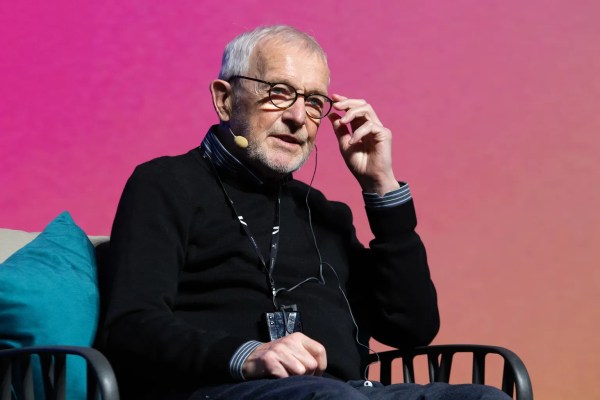 Francis Halzen, the Belgian-American scientist who designed the elaborate IceCube facility in Antarctica to detect neutrinos. (AP)
The 82-year-old Halzen, who had been studying cosmic rays since the 1960s, came to know of the attempts of Soviet researchers to build a neutrino detector in Antarctica, a press release from the Nobel Prize committee said. When a neutrino collides with an atomic nucleus in the ice, it creates an electric spark. This produces radio waves which could be detected using radio antennas.
Halzen thought of a slightly different idea. He realised that light sensors could be installed in glacier ice. These sensors could produce flashes of light from collisions of neutrinos with the nucleus of ice atoms. The area around the South Pole was a favourable location. It was isolated and, at significant depths, there was a lot of darkness with no disturbance from other radiations or signals.
He discussed his ideas with some of his colleagues and did most of the theoretical work on designing an observatory deep below the ice-sheets. IceCube is one cubic kilometer of ice equipped with over 5,000 light sensors on long cables, along with an overground facility where signals are collected. On the rare occasion when the neutrino interacts with an atomic nucleus of ice, a charged particle is produced. If that charged particle travels faster than the speed of light in ice, it produces a faint glow. From the characteristics of this glow, scientists are able to reconstruct the energy and direction of the neutrino involved in the collision.
This exquisite set-up became operational in 2011. By that time, it had already recorded a couple of events that suggested the involvement of extra-galactic neutrinos. In 2013, the observatory presented the first evidence of having detected very high-energy neutrinos. Since then several such incidents have been recorded and verified.
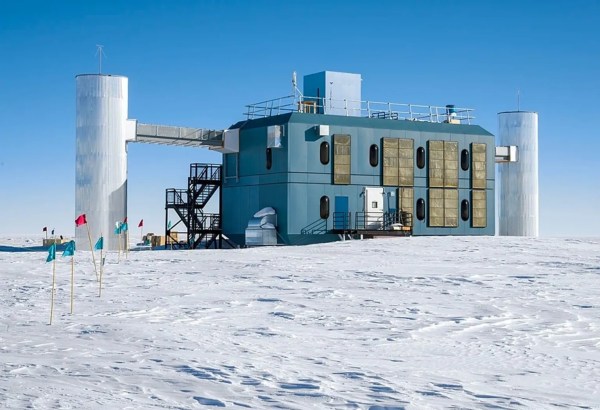 The IceCube Neutrino Observatory at the South Pole. (Photo: Wikimedia Commons)
“The neutrino has thus helped physicists confirm their models of the processes inside the Sun and what happens inside a supernova. The idea behind IceCube is to take neutrino astronomy to a new level, the hope being that neutrinos will provide information about phenomena that are hidden behind dust clouds, or objects that are so distant that other forms of radiation have disappeared along the way. The aim is to gain knowledge that cannot be obtained in any other way,” the Nobel release says.
Question 3: What have this year’s winners of the Nobel Prize in Chemistry 2026 done, and why does it matter?
The Nobel Prize in Chemistry 2026 has been awarded to Henri B Kagan and Kenso Soai “for the discovery of non-linear effects and autocatalysis in asymmetric organic synthesis”.
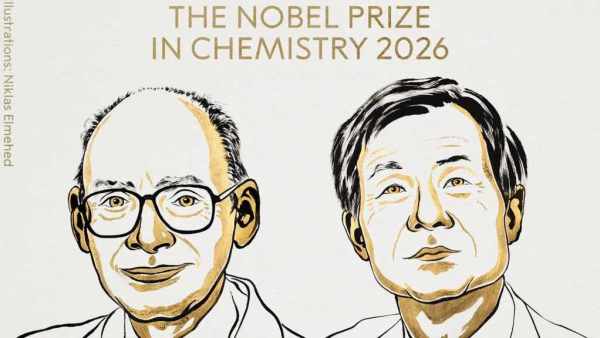 The Royal Swedish Academy of Sciences has decided to award the 2026 #NobelPrize in Chemistry to Henri B. Kagan and Kenso Soai. (Photo: X/ @NobelPrize)
In simpler words, the scientists’ work led to the creation of a way to produce more of one type of molecule and less of its mirror image in chemical reactions where the product was the same as the catalysis, the agent causing the reaction.
What have the winners done?
Certain molecules exist in two forms, each a non-superimposable mirror image of the other — like the left and right hands of human beings. Chemically, the two forms are the same in the sense that they are composed of the same set of atoms, connected in the same order. The difference is only in the relative three-dimensional arrangement of those atoms, such that one happens to be the mirror image of the other.
This structural asymmetry, called chirality, becomes particularly interesting in biology. Many of the fundamental molecules in biology, like the amino acids that make up proteins or the sugars in DNA, appear in only one form. The mirror image versions of these amino acids or the sugars do exist, but they are rarely used in these biological settings. This preference for homochirality in life forms has intrigued scientists for long.
This year’s Nobel Prize in Chemistry was awarded to Henry Kagan and Kenso Soai for demonstrating how this homochirality can emerge.
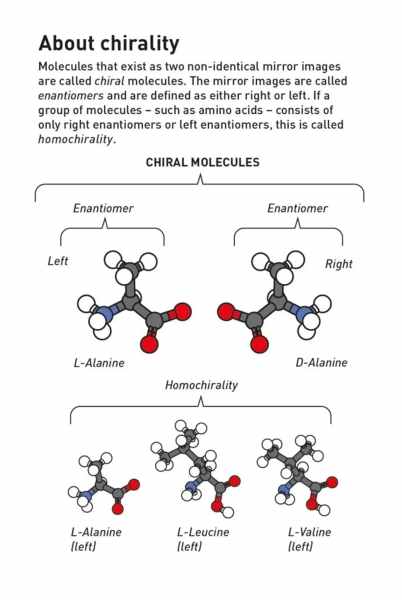 © Johan Jarnestad/The Royal Swedish Academy of Sciences
The normal chemical processes used to produce a chiral molecule results in the production of both forms, called enantiomers. Kagan developed a way of manipulating these processes in such a manner that one form was produced in much greater proportion than the other. Soai took a step further and designed the first chemical reaction in which only one of the enantiomers was produced. Outside of biological processes, such a result had never been achieved.
Why does this matter?
As the Nobel press release says, “The non-linear effects that Kagan discovered have become an important tool for chemists when they design new reactions. The fact that a reaction is non-linear provides chemists with information about how it occurs. This information can be used to optimise the reaction, so they can obtain the purest possible enantiomers of the product. This is vital for every company that manufactures substances that are intended to interact with living beings, such as pharmaceuticals, flavours, scents and agricultural chemicals.”
Question 4: Who won the 2026 Nobel Prizes in Literature and Peace, and what were the main reasons for their recognition?
The 2026 Nobel Peace Prize was awarded to South African jurist Navanethem “Navi” Pillay, 85, whose work — from the apartheid regime in her home country to the ongoing humanitarian crisis in Gaza — has helped shape legal precedents on key global issues.
 United Nations High Commissioner for Human Rights Navanethem Pillay, center, visits Al- Daraj Elementary Co-ed UNRWA school in Gaza City in 2011. (AP Photo/Adel Hana, File)
In its official citation, the Norwegian Nobel Committee spoke of her “exceptional courage and integrity”, stating that she led the way “towards a more comprehensive global legal order.”
It is not often that the committee rewards jurists. But the citation stated that through this award, it wanted to “remind the world that the rule of law – national and international – underpins the system we have set up to ensure peace and resolve conflicts non-violently. Peace requires justice.”
The committee noted that Pillay “has been instrumental in ensuring that war crimes, crimes against humanity and genocide are prosecuted.”
Nobel Prize in Literature 2026
The Canadian classicist Anne Carson has won the 2026 Nobel Prize in Literature. The Swedish Academy praised “her bold and inventive oeuvre that, in playful dialogue with the classical tradition, has created new forms for contemporary literature.” She is the 19th woman to win since 1901, and the second Canadian, after Alice Munro.
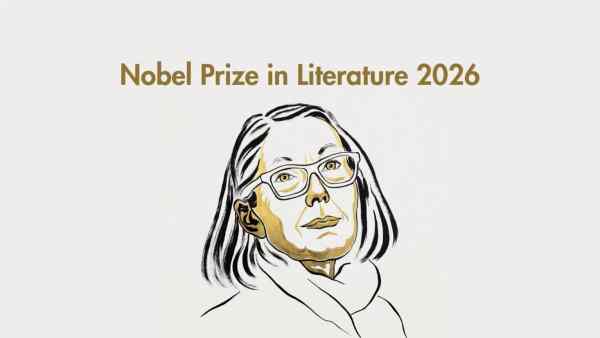 Canadian poet Anne Carson is the winner of the 2026 Nobel Prize in Literature. (Sketches via nobelprize-org)
Carson’s most important book is her 2002 translation of Sappho, the ancient Greek poet who wrote nine books of lyrics. Almost all of Sappho’s poetry survives only in fragments, and only a handful of complete poems remain. While most translators would try to “repair” those fragments into readable, finished poems, Carson prints the gaps, which allows readers feel the shape of what is lost. Her most famous books are- Autobiography of Red (1998), Eros the Bittersweet, Men in the Off Hours, Nox, etc.
THE CITATION
"For her bold and inventive oeuvre that, in playful dialogue with the classical tradition, has created new forms for contemporary literature."
The Swedish Academy announced the prize on October 8, 2026. Carson, born in Toronto in 1950, is a classicist who wrote her doctorate on Sappho and taught ancient Greek for more than three decades, at Princeton, McGill and the University of Michigan.
12m
Swedish kronor in prize money (about ₹11.5 crore)
19th
Woman to win the literature prize since 1901
2nd
Canadian literature laureate, after Alice Munro
CANADA AND THE NOBEL
Two Canadians in 13 years
Until 2013, no Canadian citizen had won the Nobel Prize in Literature. Carson's win means two of the last 13 literature prizes have gone to Canadian women, and both are celebrated for reinventing a form: Munro the short story, Carson the poem.
2013 — ALICE MUNRO
"Master of the contemporary short story"
First Canadian winner. Short-story writer from small-town Ontario.
2026 — ANNE CARSON
Poet, essayist, classicist
Second Canadian winner. Born in Toronto, 1950.
★
The Saul Bellow footnote
Saul Bellow, the 1976 laureate, was born in Lachine, Quebec, but won as an American writer. He is usually not counted as a Canadian winner.
THE WORKS
Four decades, one shelf, many forms
Carson's books mix poetry, essays, translation and drama. Many of them retell or translate ancient Greek texts. Highlighted books are the best places to start.
1986
Eros the Bittersweet
Her first book, grown from her Sappho doctorate: an essay arguing that desire lives in the gap between lover and beloved.
1992
Short Talks
Her first book of poems, published by a small Canadian press when she was 42.
1995
Glass, Irony and God
Contains "The Glass Essay": a heartbroken woman, her sharp-tongued mother and Emily Brontë.
1995
Plainwater
A collection of essays and poetry that blurs the line between the two.
1998
Autobiography of Red
A novel in verse in which the red-winged monster Geryon becomes a teenage photographer in love with Herakles. Her breakthrough.
1999
Economy of the Unlost
Reads the ancient Greek poet Simonides alongside Paul Celan, asking what money did to poetry.
2000
Men in the Off Hours
A poetry collection that won her first Griffin Poetry Prize.
2001
The Beauty of the Husband
"A Fictional Essay in 29 Tangos" about a marriage. It made her the first woman to win the T.S. Eliot Prize.
2002
If Not, Winter
Translations of Sappho's fragments, with brackets marking where the ancient papyrus is torn.
2005
Decreation
Subtitled "Poetry, Essays, Opera". Its title comes from the philosopher Simone Weil.
2006
Grief Lessons
Her translations of four plays by Euripides.
2010
Nox
An elegy for her brother, published as a folding book in a box.
2012
Antigonick
A free, playful version of Sophocles' Antigone.
2013
Red Doc>
A sequel to Autobiography of Red, named after its computer file. It won her second Griffin Prize.
2016
Float
A collection of separate booklets that readers can take in any order.
2019
Norma Jeane Baker of Troy
A play that recasts Helen of Troy through Marilyn Monroe. It won the Governor General's Award in 2020.
2021
H of H Playbook
A collage retelling of Euripides' Herakles.
2024
Wrong Norma
Her latest book: playful prose poems and collages mixing myth, pop culture and memory.
THE BETTING
From outsider to joint favourite in a week
There is no official shortlist. The Academy keeps nominations secret for 50 years, so bookmakers' odds are the only public race. Carson's price fell sharply in the final days.
SEP 29, 2026 — LADBROKES
33/1. Carson is a long shot. Can Xue leads at 10/1, followed by Haruki Murakami at 14/1.
OCT 3, 2026 — LADBROKES
10/1, joint favourite. Carson draws level with China's Can Xue at the top of the market.
OCT 6, 2026 — BETSSON
7.00, second favourite. She sits behind Can Xue (5.00) and ahead of Gerald Murnane (8.00).
OCT 8, 2026 — STOCKHOLM
Carson wins. The bookies' late surge proved right.
LADBROKES — FINAL WEEK
10/1, joint favourite
BETSSON — OCT 6
7.00, second favourite
2
Griffin Poetry Prizes
1st
Woman to win the T.S. Eliot Prize
42
Her age when her first poetry book came out
✓
Fellowships
Lannan Literary Award (1996), Guggenheim Fellowship (1998) and MacArthur Fellowship (2000).
✓
National honour
Appointed a Member of the Order of Canada in 2005.
✓
International prizes
Spain's Princess of Asturias Award for Literature (2020) and the PEN/Nabokov Award (2021).
✓
Lifetime achievement
The Paris Review's Hadada award, presented in 2025.
"Anne Carson is, for me, the most exciting poet writing in English today."
— Michael Ondaatje, on the cover of Autobiography of Red
Question 5: How have the winners of the 2026 Sveriges Riksbank Prize in Economic Sciences in Memory of Alfred Nobel (Nobel Prize in Economics) reshaped modern economic policy?
The Royal Swedish Academy of Sciences has awarded the Sveriges Riksbank Prize in Economic Sciences in Memory of Alfred Nobel 2026 — commonly called the Economics Nobel — to two American economists: Robert E Hall of Stanford University and Michael Woodford of Columbia University.
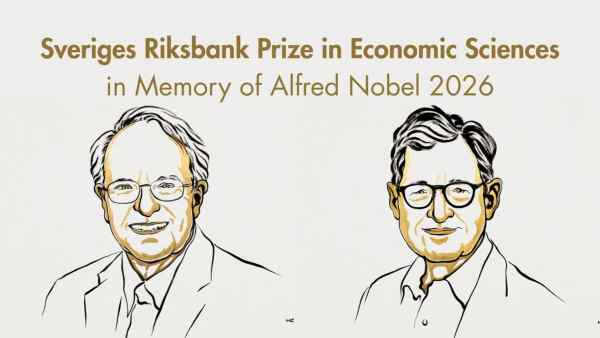 Robert E Hall and Michael Woodford announced as winners of the Sveriges Riksbank Prize in Economic Sciences in Memory of Alfred Nobel in Stockholm. (Sketches via nobelprize-org)
The official citation states they have received the award “for microeconomic foundations of macroeconomic stabilisation”. Macroeconomic stabilisation refers to policies that governments and central banks use to “stabilise” an economy.
What is their contribution?
A crash in the stock markets in October 1929 marked the start of the Great Depression in the US. As the days and months rolled by, the US gross domestic product — the value of annual output — fell by 30% and the unemployment rate soared to 25%.
Thousands of banks and businesses went under. The crisis reverberated through the world, especially affecting Europe. The dominant policy paradigm leading up to the Great Depression was that governments should not intervene, letting markets resolve through forces of demand and supply instead. But the widespread devastation made everyone rethink.
British economist John Maynard Keynes provided a solution that seemed to work: Governments and central banks should “stabilise” the economy through policy interventions. When growth is slow (and unemployment high), policymakers should cut interest rates and taxes, and the governments should spend more even at the cost of borrowing money itself and having a budget deficit, thus incentivising economic activity.
When the economy starts overheating and the inflation rate starts rising fast, the policymakers should slow down the economy by policies like raising interest rates. Thus, government intervention could save economies from suffering from wild fluctuations.
This broad policy formula worked until the experience of the 1970s. This was a decade when economies faced high inflation and high unemployment both at the same time, thanks to repeated oil price shocks. Efforts to boost a slowing economy only spiked inflation. Efforts to contain inflation further worsened unemployment.
The situation became so bad that the Keynesian recipe of government intervention was seen as the problem, not the solution.
Through their work from the late 1970s onward, Hall and Woodford revitalised the Keynesian approach by making it grounded in research. Keynes had assumed a linear or straight relationship between variables such as inflation and unemployment, and consumption and production. Hall and Woodford started studying the ground-level data.
Hall focussed on the demand side of the economy: questions such as, how do people decide how much they would consume, and when and how do they choose to raise or cut consumption. A better understanding of these, based on household data, has informed policy choices.
Woodford’s work focussed on the supply side: how firms behaved and took decisions such as changing prices. The assumption is that markets find the ideal price based on supply and demand, but businesses don’t change prices everyday. He found that businesses look to the future when fixing prices. This means that expectations about future interest rates are important for inflation. In turn, this had a tremendous policy implication: Central banks must clearly convey what they intend to do, which is important for firms when they fix prices.
Why this matters enough to have won the prize?
The work of Hall and Woodford has helped transform how central banks understand and manage economic fluctuations. By accounting for how households and businesses form expectations and respond to policy decisions, their research has helped policymakers better anticipate the effects of interest-rate changes, communicate policy intentions and stabilise economies. According to the Nobel Committee, this framework has also helped central banks navigate crises, with inflationary episodes becoming less prolonged.
Post Read Questions
(1) With reference to the neutrino, consider the following statements:
1. It is a subatomic particle with no electric charge and almost no mass.
2. Exploding stars can produce enormous numbers of neutrinos.
Which of the statements given above is/are correct?
(a) 1 only
(b) 2 only
(c) Both 1 and 2
(d) Neither 1 nor 2
(2) The Nobel Prize in Chemistry 2026 has been awarded for:
(a) the discovery of non-linear effects and autocatalysis in asymmetric organic synthesis.
(b) the development of metal–organic frameworks.
(c) the discovery and synthesis of quantum dots.
(d) the development of asymmetric organocatalysis.
(3) The Royal Swedish Academy of Sciences has awarded the Sveriges Riksbank Prize in Economic Sciences 2026 to two American economists: Robert E Hall and Michael Woodford for:
(a) having identified the prerequisites for sustained growth through technological progress
(b) studies of how institutions are formed and affect prosperity
(c) having advanced our understanding of women’s labour market outcomes
(d) microeconomic foundations of macroeconomic stabilisation
Prelims Answer Key
1. (c) 2. (a) 3. (d)
(Sources: The science of ‘neutrinos’, What the 2026 Physics Nobel winner has done: Capturing messengers from space in ice, Nobel Medicine Prize 2026, 2026 Chemistry Nobel: Mirror-image molecules and the chemistry of life, Nobel Peace Prize 2026, What makes Anne Carson, the 2026 Nobel Prize winner, so different?, 2026 Economics Nobel: How to keep an economy stable using policy tools)
Click here to read the UPSC Essentials magazine for October 2026. Share your views and suggestions in the comment box or write to us at manas.srivastava@indianexpress.com.🚨
Subscribe to our UPSC newsletter. Stay updated with the latest UPSC articles by joining our Telegram channel – Indian Express UPSC Hub, and follow us on Instagram and X
KioskNews shows a cleaned-up reading view extracted from the publisher’s page — the original always lives on their site, not ours.