Youngest Canadians more accepting of collective blame against religious, ethnic groups: poll

While most Canadians reject collective blame and sweeping claims about religious and ethnic groups, younger Canadians are substantially more likely to accept them, according to a new poll.
Sign In or Create an Account
Data collected by the Association for Canadian Studies (ACS) found that more 57 per cent of Canadians find it unacceptable — not very or not at all — to suggest that a particular religion has harmful beliefs. The only outlier among the age groups was 18-24-year-olds, 56 per cent of whom felt it was somewhat or very acceptable to say that.
Nearly seven in ten respondents (69 per cent) think it’s either degree of unacceptable to say that members of a specific ethnic or religious group cannot be trusted. The youngest cohort was the only one with observable conflict, with 42 per cent of on the accepting side.

Get a dash of perspective along with the trending news of the day in a very readable format.
By signing up you consent to receive the above newsletter from Postmedia Network Inc.
A welcome email is on its way. If you don't see it, please check your junk folder.
The next issue of NP Posted will soon be in your inbox.
We encountered an issue signing you up. Please try again
When it comes to holding members of a religious group collectively responsible for the actions of a foreign government, three quarters (75 per cent) deemed it unacceptable, but, again, nearly a third (32 per cent) under 25 were more accepting.
People in the 25-34 age group (30 per cent) and the 45-55 demographic (31 per cent) also registered above the overall net acceptable number (25 per cent).
“There needs to be some increasing thought and sensitivity about the extent to which people make those connections,” ACS president Jack Jedwab told National Post in an interview, noting that none of that should ever be acceptable “in democracies like ours.”
Without ascribing any symmetry to the subjects, the poll sought to understand which religious or ethnic groups Canadians feel should be apologizing for the one they are perceived to be affiliated with outside of Canada.
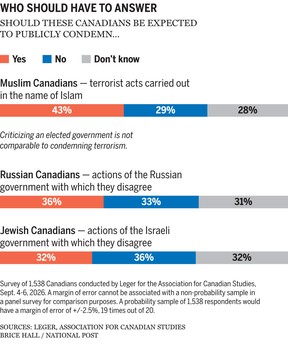
It found that 43 per cent of respondents are most likely to think that Muslims should be expected to publicly condemn terrorist acts carried out in the name of Islam. Meanwhile, 36 per cent suggested Russian Canadians should be expected to publicly condemn actions of the Russian government with which they disagree, and 32 per cent felt the same about Jewish Canadians and the Israeli government.
“I’m not comparing the acts of the Israeli government to the actions of terrorism in the name of Islam,” said Jedwab.
“But what is common about it is the accusation of responsibility for such actions, because I sometimes get the impression that some people feel that some of this is okay, but the other sort of expression of it isn’t.”
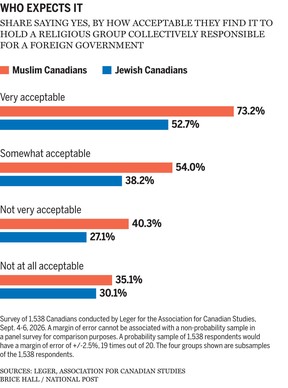
ACS’s data also showed that the people most likely to say that members of a specific ethnic or religious group are responsible for the actions of a foreign government are the ones who expected to publicly condemn acts “over which they have no individual control or responsibility.”
A plurality of people who feel that’s very (73.2 per cent) or somewhat acceptable (54 per cent) who feel that way said Muslim Canadians should be expected to publicly condemn terrorist acts carried out in the name of Islam.
Asked if Jewish Canadians should be expected to publicly condemn actions of the Israeli government with which they disagree, the majority (52.7 per cent) from the very acceptable ranks agreed, as did 38.2% among those on the somewhat acceptable side.
“People who make that statement, who support those views, think that it’s okay for Muslim Canadians to publicly condemn terrorist acts carried out in the name of Islam — it’s not okay,” Jedwab said, noting the same holds for Jewish and Russian Canadians.
“These aren’t free expression issues. They’re a threat to free expression.”
The poll of 1,538 respondents, conducted by Leger on behalf of the Association for Canadian Studies, was conducted Sept. 4-6. A margin of error cannot be associated with a non-probability sample in a panel survey for comparison purposes. However, a probability sample of this size would have a margin of error of 2.5 per cent, 19 times out of 20.
Our website is the place for the latest breaking news, exclusive scoops, longreads and provocative commentary. Please bookmark nationalpost.com and sign up for our daily newsletter, Posted, here.
Join the Conversation
This website uses cookies to personalize your content (including ads), and allows us to analyze our traffic. Read more about cookies here. By continuing to use our site, you agree to our Terms of Use and Privacy Policy.
KioskNews shows a cleaned-up reading view extracted from the publisher’s page — the original always lives on their site, not ours.