Lai pushes for NT$1tn output in tourism industry
AIMING HIGH: The government would help the tourism industry adopt artificial intelligence and big-data analysis to better understand travelers’ preferences, Lai said
President William Lai (賴清德) yesterday reiterated Taiwan’s goal of generating more than NT$1 trillion (US$30.5 billion) in annual tourism output and attracting 10 million annual international visitors by 2030.
Speaking at the opening of the Taiwan International Travel Fair (ITF), Lai said the targets would be supported by improved services, stronger branding and digital transformation.
Lai previously outlined the NT$1 trillion target at last year’s fair and reiterated both goals at the Taiwan Culinary Exhibition in July.

President William Lai, third left, and other event guests hold placards at the opening of the Taiwan International Travel Fair in Taipei yesterday.
Photo: Tien Yu-hua, Taipei Times
“Tourism not only drives overall economic development, but is also one of the best ways to strengthen Taiwan’s ties with the rest of the world,” Lai said.
He said the Taiwan Tourism Institute, established this year, would help bring together government and private-sector resources to improve tourism services and help Taiwan compete for international visitors.
Lai also highlighted the T-WALK program, which links six major trails to encourage international visitors to explore Taiwan’s mountain landscapes.
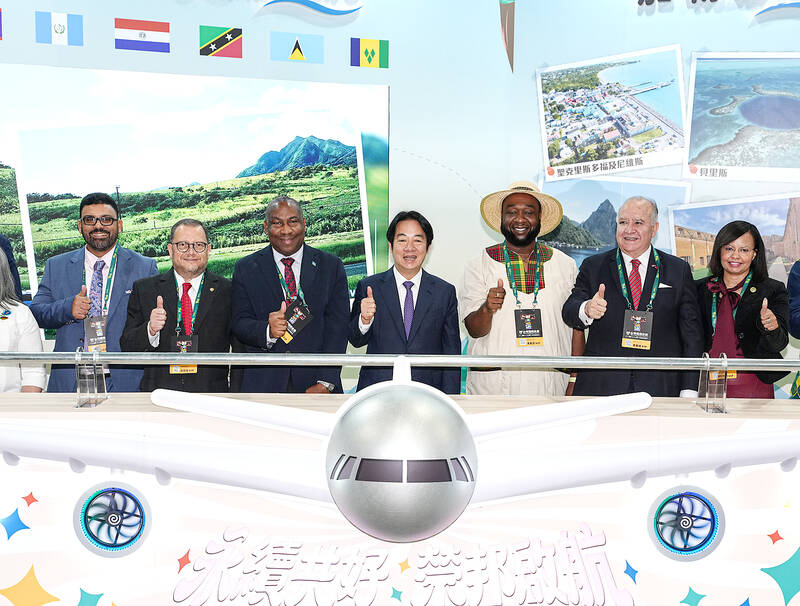
President William Lai, center, gestures alongside envoys and exhibitors at the Latin America and Caribbean Pavilion during the opening of the Taiwan International Travel Fair in Taipei yesterday. The Latin American and the Caribbean Trade Office joined forces with six of Taiwan’s diplomatic allies in the region to set up a joint pavilion for the first time, showcasing their countries’ tourism attractions.
Photo: CNA
They include the Tamsui-Kavalan Trails (淡蘭古道), linking New Taipei and Taipei City with Yilan in northeastern Taiwan, and the Raknus Selu Trail (樟之細路), extending from Taoyuan through Hsinchu and Miaoli to Taichung.
The government would also help tourism businesses use artificial intelligence and big-data analysis to better understand travelers’ preferences, improve efficiency and develop tourism offerings that appeal to travelers, Lai said.
Minister of Transportation and Communications Chen Shih-kai (陳世凱) said domestic tourism generated NT$564.3 billion last year, up 9 percent from 2024.
The number of domestic trips reached 248 million, compared with 168 million before the COVID-19 pandemic, Chen added.
The fair, celebrating its 40th anniversary, replaced “Taipei” with “Taiwan” in its name this year.
It runs through Monday at Taipei Nangang Exhibition Center, Hall 1, with 1,600 booths representing 123 countries and cities.
Taiwan Visitors Association chairwoman Chien Yu-yen (簡余晏) said the name change reflected the fair’s changing focus as the fair placed greater emphasis on distinctive experiences and quality products rather than discounts.
“Today’s ITF has moved from being discount-oriented toward competition between brands,” she said.
Taiwan’s appeal extended beyond its internationally recognized technology industries to its mountains, diverse cultures, open society and hospitality, Chien added.
KioskNews shows a cleaned-up reading view extracted from the publisher’s page — the original always lives on their site, not ours.