Half of Canadians have avoided hospitals because of wait times: poll
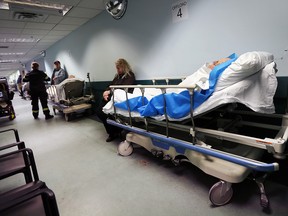
Half of Canadians have avoided hospitals because of long waits and more than 25 per cent said they have turned to the private system for care, according to a new poll.
Sign In or Create an Account
Most Canadians say health services where they live need to change — 58 per cent believe the system needs to change in a major way — and 61 per cent are open to allowing people to pay for surgery at private clinics if the public system can’t deliver timely care, the survey found.
“Canadians are very OK with the idea of more private health services being used,” said Renaud Brossard, vice-president of communications at the Montreal Economic Institute, or MEI.

Get a dash of perspective along with the trending news of the day in a very readable format.
By signing up you consent to receive the above newsletter from Postmedia Network Inc.
A welcome email is on its way. If you don't see it, please check your junk folder.
The next issue of NP Posted will soon be in your inbox.
We encountered an issue signing you up. Please try again
“They see it as a safety valve” rather than simply being added to months-long waiting lists for publicly funded care, he said.
The new Leger poll, jointly commissioned by the MEI, SecondStreet.org and the Canadian Constitution Foundation, found many Canadians are avoiding seeking medical attention because of wait times.
“When people avoid seeking medical attention for a health issue, it doesn’t just magically go away,” SecondStreet.org president Colin Craig said in a news release.
Only 10 per cent of those polled believe the health-care system doesn’t need to change and “just needs more public funding.”
By contrast, 84 per cent said health services where they live require some degree of change: 58 per cent said major change and 26 per cent said minor.
The poll didn’t ask what people specifically believed needed changing. However, “people recognize it’s not just a matter of funding,” Brossard said.
“What we typically hear is, ‘If we were just able to properly fund the health system, everything would be OK.’ It’s what we’ve been hearing for 40, 50 years,” he said.
“The result has still been very long wait times to get surgery, long wait times at the emergency room and patients without family doctors. That has remained a constant for the past 40 or 50 years.
“People recognize that something is not working. It’s not just a lack of money,” Brossard said.
When asked, “Do you ever avoid going to a hospital or a doctor because you don’t believe you will receive timely treatment,” 50 per cent of those polled responded yes; 47 per cent said they haven’t avoided hospitals or doctors. The remainder were unsure.
Women (59 per cent), the under-55s (55 per cent) and people living in Quebec (56 per cent) were more likely to have avoided visiting a hospital or doctor.
Some six million Canadians don’t have a family doctor and even many of those who do face long waits to be seen. Untreated problems can grow worse, ultimately requiring a higher, and more expensive level of care than what they would have needed otherwise, Brossard said.
But surveys have found only 36.9 per cent of adults with a family doctor or clinic can get same- or next-day urgent care. Meanwhile, emergency departments are reporting historic wait times, with one in 10 people spending 14 hours or more in emergency in 2024-25, the Canadian Institute for Health Information reported this summer.
“There are a lot of people who might have an ailment that actually needs (medical attention), but they ask themselves, ‘Can I afford to wait four hours, six hours, eight hours until I see a doctor?’” Brossard said.
In 2024-25, 1.2 million emergency visits — about eight per cent of all emergency visits — involved someone leaving the emergency room before being assessed by a doctor, according to CIHI. Pre-pandemic, it was 5.4 per cent, or roughly 800,000 visits.
People who leave emergency without being seen have a 14 per cent higher risk of death or hospitalization within seven days, Canadian researchers have reported.
According to the Leger poll, 27 per cent of Canadians have paid for private health care to avoid long wait times and “unsatisfactory services in the public system.” Most sought it within their own province, while some (four per cent) went outside their province, or outside the country (four per cent). Nearly half of Quebec residents (46 per cent) said they’ve used their own money or extended health insurance to pay for private care.
“Canadians recognize that our ‘everything-by-the state’ approach just isn’t working in getting everybody the treatment they need,” Brossard said.
“Universal access is something we can do with a mixture of both public and private facilities.”
Many health agencies disagree, worrying that wait times in the public system will worsen with more private care and create a two-tier system that will give people access to care based on their ability to pay, not medical need.
The Canadian Medical Association has called for a federal review of Alberta’s “dual-practice” model that allows some doctors working in public hospitals to also offer private care.
The poll’s results suggest “there is a lag in terms of where Canadians are, and where the public debate needs to be,” Brossard said.
The new Leger poll surveyed 1,510 Canadians aged 18 and older between Oct. 16 and 18.
For comparison purposes, a probability sample of this size yields a margin of error no greater than plus or minus 2.5 per cent, 19 times out of 20.
National Post
Our website is the place for the latest breaking news, exclusive scoops, longreads and provocative commentary. Please bookmark nationalpost.com and sign up for our newsletters here.
Join the Conversation
This website uses cookies to personalize your content (including ads), and allows us to analyze our traffic. Read more about cookies here. By continuing to use our site, you agree to our Terms of Use and Privacy Policy.
KioskNews shows a cleaned-up reading view extracted from the publisher’s page — the original always lives on their site, not ours.