Rare hug and roaring flyover set stage for historic firsts at Apec in Shenzhen
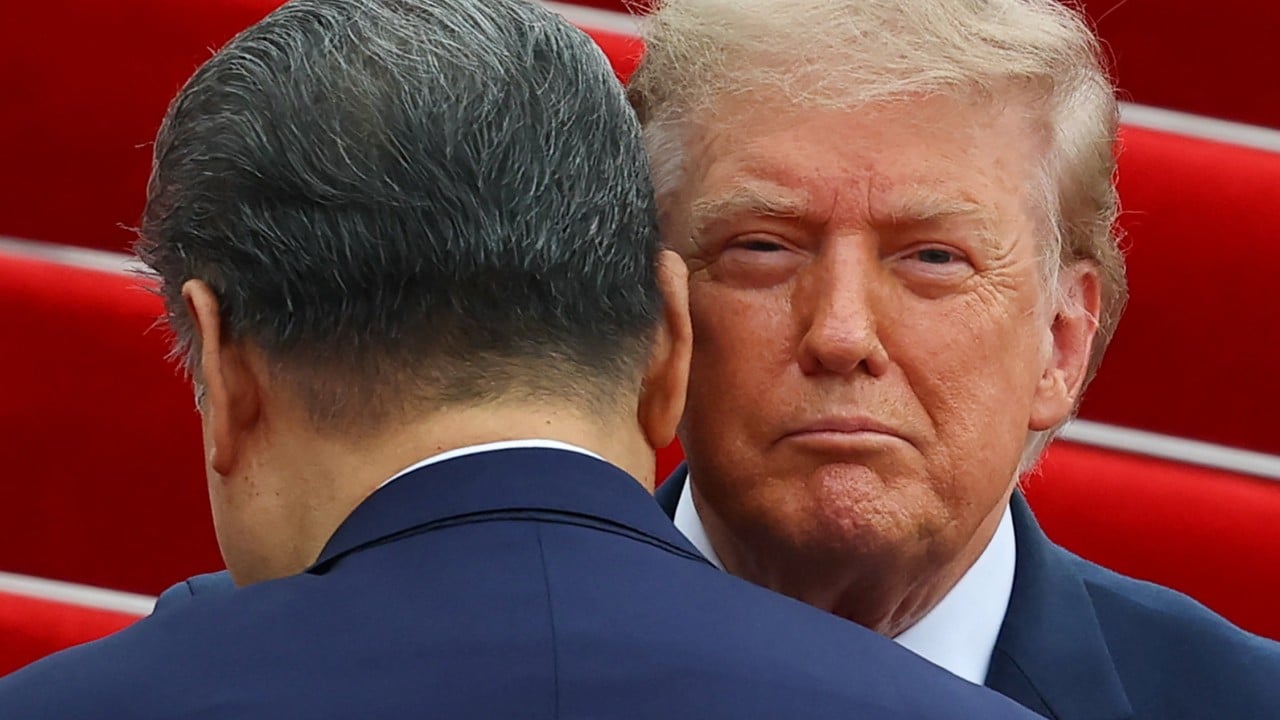
The last time a Chinese head of state greeted a visiting counterpart on the tarmac was in 1959 when paramount leader Mao Zedong was at Beijing’s airport to welcome the Soviet Union’s Nikita Khrushchev for a secret trip during a time of strategic distrust.
But this time it was different. After Trump walked down the staircase of Air Force One, the leaders of the two most powerful countries in the world hugged before the cameras – a rare display of physical affection by Xi.
China wants to make the message clear – the unparalleled honour given to Trump was a show of how it values the principle of reciprocity.
Reciprocity has become a key element in China-US relations and was articulated by Xi during his state visit to the US two months ago.
“When I visited the United States in September this year, President Trump and the first lady specially went to the airport to welcome me and held a grand welcome ceremony. China is a nation of etiquette and has a tradition of reciprocity,” Xi said to Trump as the two were on the tarmac, according to state news agency Xinhua.
He added that he looked forward to discussing bilateral ties, Asia-Pacific cooperation and global issues.
02:39
Xi and Putin pledge to maintain stable ties and global order ahead of trilateral meeting with Trump
Wednesday marked the start of what promises to be two days of intense summitry.
The world is eagerly waiting to see how the trilateral meeting of the three largest powers will unfold, particularly regarding any impact on the Ukraine war, North Korea and even the Middle East.
Kremlin senior adviser Yuri Ushakov was quoted by Russia’s official Tass news agency as saying the three sides were working intensively on a joint statement and that the parties would touch on a wide range of issues, “taking into account the conflicts tormenting the world”.
Those talks will be preceded by a bilateral meeting between Xi and Trump – the US president’s first such discussions since his Republican Party’s bruising midterm electoral defeats.
Analysts and business sectors are also watching closely for any concrete progress on the Boards of Trade and Investment agreed by the two countries earlier this year, potential AI cooperation, and any possible fallout from the scandal involving former Nvidia CEO Jensen Huang.
A wild card for Thursday is whether North Korean leader Kim Jong-un will join any of the talks. Kim is not taking part in the Asia-Pacific Economic Cooperation summit but earlier this week Trump floated the idea that the two might meet in Shenzhen.
63:34
Live: US President Donald Trump arrives in Shenzhen for Apec summit
Wednesday’s official activity began in the early hours, with Putin among the first leaders to arrive in the city.
The relationship between the two countries stood “as firm as a mountain amid wind and rain” and provided stability and certainty to a volatile and changing world, he said, according to a report by state news agency Xinhua.
Putin also gave a keynote address at the Apec CEO summit, during which he said Western sanctions were “failed attempts”.
He argued that “instruments of economic dominance” – including sanctions, tariffs and export restrictions – had lost their intimidating effect and could not stop Russia’s national growth. Instead, they were only hurting the European Union’s industrial capacity and competitiveness.
In his opening speech to the CEO summit, Xi called for cooperation and innovation to bring prosperity to the Asia-Pacific region to weather the turbulent world at a time when “global growth lacks momentum, and unilateralism and protectionism are rampant”.
He also assured world leaders that China would continue to open up, positioning the country as a “supersize market” and “a promised land of development” for the global business community through innovation.
“China will not only cut tariffs and expand market access but also go a step further – we will carry out reform in challenging areas, such as rules, regulation and standards, in order to fully ensure market access and an accommodating operating environment in the manufacturing sector, to steadily expand opening up in the service sector, and to foster a more stable and more predictable first-class environment for companies from around the world to invest and do business in China,” Xi said.
Xi added that China would support the establishment of a World Association for Bay Area Economic Cooperation “to deepen exchanges among bay areas from across the world”.
Xi calls for elimination of trade barriers in Apec summit speech
While the big powers are soaking up most of the attention in Shenzhen, Apec is also a platform for middle powers to exert influence on the world stage.
Among them is Canada, which has been drawn into a trade war with the United States. Canadian Prime Minister Mark Carney met Trump later in the day to discuss trade issues.
Carney said the two discussed ongoing work towards a mutually beneficial trade agreement aimed at creating quality jobs, boosting affordability and fully respecting Canada’s languages, culture and sovereignty.
Carney also said he raised the issue of AI global governance when he met Xi in Shenzhen on Tuesday, setting out Canada’s “model for how this governance can be developed”.
Putin lands in China for Apec summit
China’s relations with South Korea have also been improving.
“I hope that South Korea-China ties will move beyond full recovery to become a more mature strategic partnership,” South Korean President Lee Jae Myung told Xi in talks on Wednesday.
Lee was given a lavish reception at the airport early that morning, with more than 100 dancers waiting to greet him. The warm reception was a stark contrast to the low-key welcome given to Japanese Prime Minister Sanae Takaichi.
It is the first time a Japanese leader has visited China in seven years, but Takaichi’s welcome party consisted of a retired diplomat and the Japanese ambassador.
Still, courtesy prevailed. Ahead of the Apec “family photo” preceding the state dinner, Takaichi shook hands with Xi – their first in-person interaction since her remarks on Taiwan last year soured ties dramatically.
She said a few words to the Chinese leader, but Xi only smiled and did not respond. Xi’s wife, Peng Liyuan, also appeared to say nothing beyond a greeting.
More telling was the unusual photo taken of Xi, Trump and Putin. Putin walked over to Xi and Trump as they chatted briefly before the general photo of all the Apec leaders.
At the state dinner, Xi took the chance to tout Shenzhen as an example of the country’s innovation and international cooperation.
“Shenzhen’s story is a microcosm of China’s reform and opening-up,” Xi said in his toast to the guests, adding that the city’s development was “a successful example of Asia-Pacific cooperation”.
Yun Sun, an expert at the Washington-based Stimson Centre, said it was the first time a sitting US president had visited Shenzhen, a venue that “brings out the importance of the AI and chips discussion”.
She said recent events in the US would not greatly affect Beijing’s approach to ties. “I don’t think [the] midterm results or Nvidia has a major impact on how China will handle Trump,” she said.
“The key for China is what choices Trump will make.”
Additional reporting by Amber Wang, Dewey Sim, Cao Jiaxuan, Alyssa Chen, Fan Chen, Orange Wang and Khushboo Razdan
KioskNews shows a cleaned-up reading view extracted from the publisher’s page — the original always lives on their site, not ours.