Uncovering the Terracotta Army’s Stunning Hidden Artistry
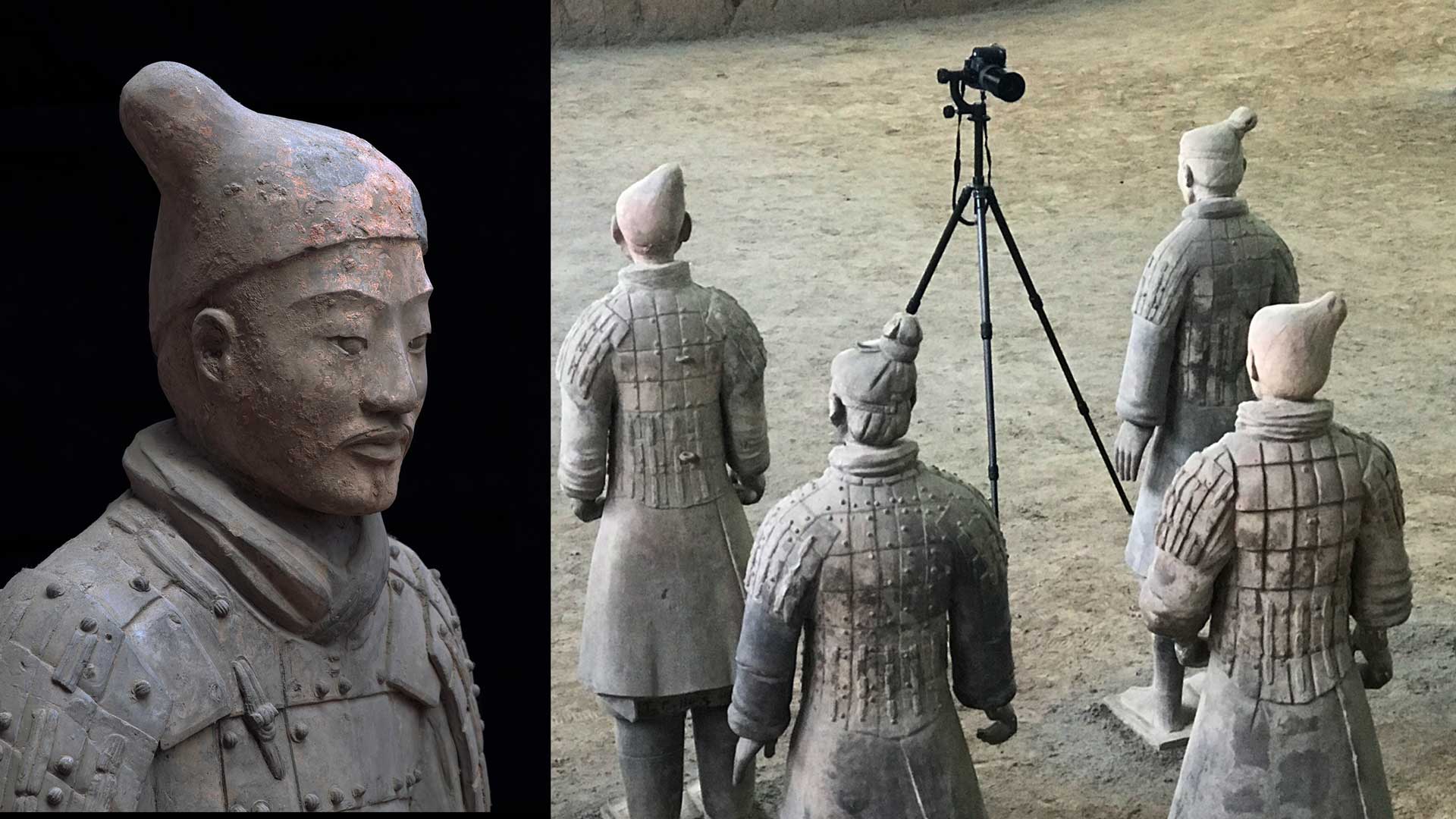
When glimpsing the Terracotta Army for the first time, almost everyone is awestruck by its sheer scale: thousands of armored clay figures standing in perfect formation, their gray earthen bodies stretching rank upon rank. At first glance, the ghostly 2,000-year-old soldiers look as if they were cast from a single mold.
But look closer, and the impression of uniformity begins to dissolve. No two faces are exactly alike: brows thick or faint, eyes wide open or slightly narrowed, cheekbones high or low, jawlines rounded or square. When viewed individually, each warrior is far more than a figure: it is a work of art as intricate as many Renaissance statues.
Zhao Hui (Steve Zhao) has spent much of the past 25 years trying to capture this hidden artistry. A veteran photographer who trained under cinematographer Peter Levy in the 1980s, Zhao became well known for his portraiture. His 1996 project “China Story” has toured more than 30 countries.
Since 2001, he has applied his talent for portrait photography to the Terracotta Army, amassing images of more than 2,000 figures. The works offer a striking new perspective on the warriors, often zooming in close enough to highlight the carved stroke of an eyebrow, the turn of a cheekbone, or even faint fingerprints left in the clay by a Qin dynasty artisan.
For Zhao, the project is also about more than changing perceptions of the Terracotta Army; it’s part of a wider effort to document, classify, and analyze it. The vast photo archive helps researchers understand the production processes, craftsmanship, and organization behind the relics — and, most importantly for Zhao, the anonymous master sculptors who carved them.
In this interview, Sixth Tone sat down with Zhao to discuss how his project began and how it has shaped our understanding of the Terracotta Warriors. The interview has been edited for brevity and clarity.
Sixth Tone: The Terracotta Army has long been a research focus for archaeologists and historians, but what led you to study them through high-definition photography?
Zhao: At first, it was just a routine assignment. In 2001, the China National Tourism Administration approached me to photograph the Terracotta Warriors. It was a rare opportunity, of course.
My task was to capture the warriors in the finest possible detail. That is far harder than most people imagine: heritage photography is not simply pointing a lens at an object. Every click of the shutter is a repeated negotiation with light, angle, material, and patience. The warriors are massive and their preservation conditions special, so every shoot requires meticulous preparation and on-site coordination.
After taking enough high-definition images, I began to notice striking details — the rise and fall of a brow ridge, the hooked line at the corner of an eye, the marks left by the sculptors’ hands. Perhaps it’s because I’m a portrait photographer, trained to observe people.
Looking at all those warrior faces, I noticed not only the differences between them but couldn’t stop wondering how those differences came about. Behind them lie the techniques and aesthetics of their makers. That is how I began studying the craftsmanship of the Terracotta Warriors — 25 years ago now.
Sixth Tone: You have said the creation of the Terracotta Army was not just a feat of manufacturing, but an artistic process. Why do you believe that?
Zhao: You have to distinguish between three separate steps in the production process. First, the rough cores of the heads, hands, and torsos were made separately; then a layer of fine clay was applied over the cores, and the details refined; finally, the parts were assembled and joined, air-dried, fired in kilns, and painted.
The key point is that the heads and torsos were made separately and joined only at the end. The torsos were mainly the work of craftsmen. They coiled strips of clay round and round to build up the body, tapering gradually from the legs to the waist, then carved the robes, armor, armor studs, and knotted cords. I’ve taken close-ups of torsos; magnified, you can see the traces of clay coils stacking and tightening upward.
As for the heads: a rough core was made first, then ears, topknots, braids, and caps or headcloths attached, followed by the fine carving of the facial features. This was the heart of the entire production — and the people responsible were probably not ordinary craftsmen, but a group of highly skilled sculptors and their assistants.
Sixth Tone: What evidence led you to that conclusion?
Zhao: Look carefully at the faces, and you’d reach the same conclusion. Those vivid, highly individualized faces are works of art: brows range from thick to sword-shaped; eyes are wide open, slightly narrowed, or upturned; the fullness of the cheeks, the height of the cheekbones, the roundness or squareness of the chins — all of them are different. These details embody each figure’s appearance, character, and psychology.
By carefully comparing different images, I can even recognize the signature techniques and styles of individual sculptors. Now, whenever I see a certain technique, I feel I’ve run into an old friend, and I want to say to that nameless sculptor: “Hi, it’s you again.”
In my view, these face-makers who left no names behind can rightly be called China’s Michelangelos.
Sixth Tone: But there’s a problem here. Even a sculptor as industrious as Michelangelo only produced a few dozen sculptures in his lifetime, while the Terracotta Army contains an estimated 8,000 figures. It’s hard to imagine so many high-level sculptors were available at that time.
Zhao: Good point. These sculptors made only faces — far less work than carving an entire figure — but 8,000 is still a staggering number. So I expect there was a “master-and-apprentice” model being used during production.
I’ve found some supporting clues: comparing groups of figures similar in style and technique, I often find that within a group there is one figure of finer modeling and more accurate proportions, while the others are relatively rough and unpolished. The former likely came from a master’s hand, the latter from apprentices.
Even so, the scale of the project still astounds me. In just over three years, they produced some 8,000 life-size figures with varied faces — a feat that pushed the limits of stamina and craft, and a testament to the Qin Empire’s extraordinary organizational capacity.
Sixth Tone: Back to your methodology. Your findings are largely based on observing the warriors up close through high-definition photographs. Now that 3D digitization technology is maturing, do you think it could provide further research breakthroughs?
Zhao: Digitization shouldn’t be oversimplified. If you can’t even take a good flat photograph, then creating a 3D model will be even harder. The workload and cost of 3D data acquisition are far higher than in 2D, and the processing difficulty grows exponentially.
Of course, photographing the warriors does “distort.” Turning three dimensions into two — how could it not? A single photograph is never a complete replica of “reality”; it is constrained by angle, lighting, and timing, and it carries the photographer’s choices and judgments. It is essentially a limited rendering of the objective world under specific conditions.
But don’t forget: my photography is a long process. When one photograph becomes 1,000, then 10,000; when images of different times, angles, and individuals converge into a system that can be cross-verified — photography becomes a cognitive tool for observing, comparing, and deducing. It prompts people to see cultural relics anew and provides material for further historical interpretation. That’s why I now call my work the “Visual Art of Archaeology.”
KioskNews shows a cleaned-up reading view extracted from the publisher’s page — the original always lives on their site, not ours.