This teen boy set out to get people talking about periods. He's now a Diana honoree
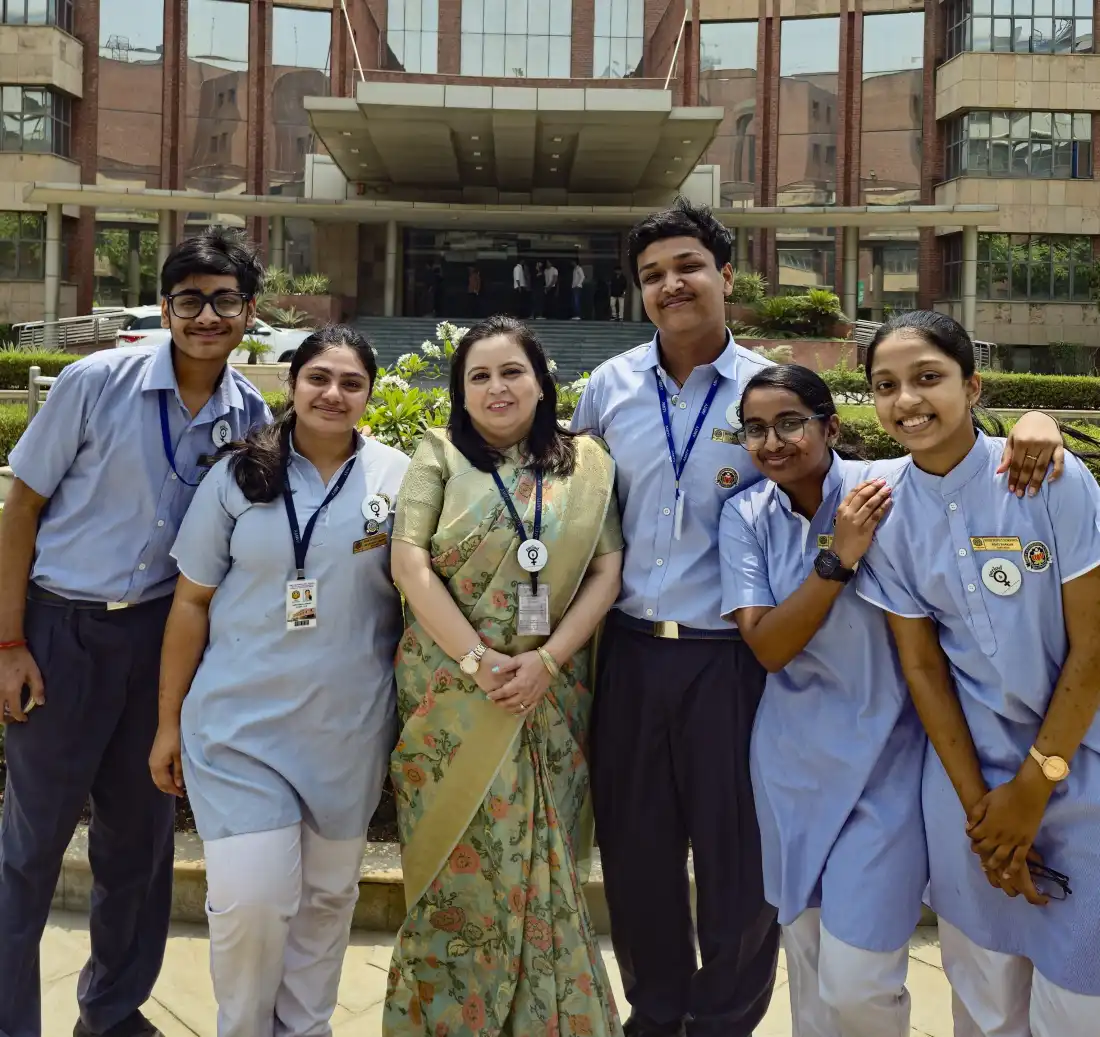
Aadvik Jain (third from right) has won a Princess Diana award for starting Team Period to counter menstrual stigma. He's standing with other members of this activist group and teacher Sonia Rao (center, in green sari). "Our work would not be possible without her guidance and support," he says. Team Period hide caption
Team Period
Can a teenage boy change the way people think about menstruation?
At just 14, Aadvik Jain, studying in India's capital city, Delhi, set out to do exactly that. It all began when he had to watch a close friend struggle with debilitating menstrual pain that wasn't being taken seriously.
This year, he's among the 198 young people from 44 countries who were honored with the Diana Award, an international recognition for young changemakers working to improve lives in their communities. The awardees were announced on November 4 at a virtual ceremony streamed internationally.
Established in memory of Diana, Princess of Wales, the international award recognizes young people ages 16 to 25 for their social action and humanitarian efforts. This year, India accounted for nearly a quarter of the recipients, with 49 honorees.
Among them are Shiv Mandlik, who invented a bendable pole to help construction workers avoid working at dangerous heights and who developed an app to detect falls; Krish Aggarwal, who created an inexpensive filter that can be fitted onto ordinary fans to reduce indoor air pollution; and Kushal Sachdeva, who at age 11 began feeding a starving street dog. His organization, Protect Paws, has reportedly helped more than 1,500 stray dogs by arranging for medical treatment, vaccinations and reflective collars.
And then there's Jain. Now 18, he leads Team Period, an initiative he started in 2024 with three close friends. Together, they are challenging menstrual stigma through workshops, street performances, awareness campaigns and efforts to improve access to menstrual pads and products. He's also set to start studying medicine and public health at the University of Bologna in Italy in February.
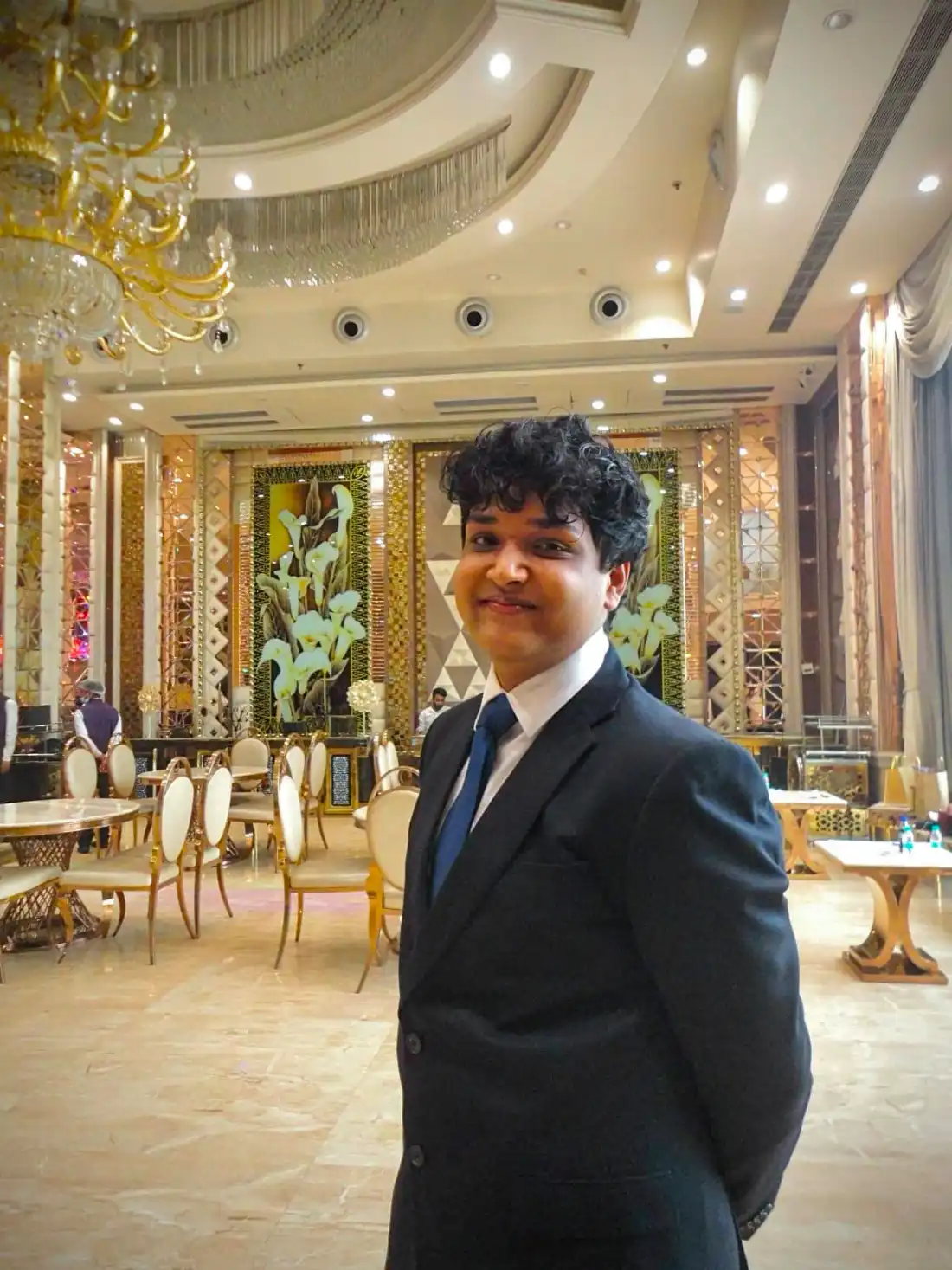
Aadvik Jain, founder of Team Period, plans to study medicine and public health in Italy next year. Team Period hide caption
Team Period
NPR spoke to Jain through a video call about the experiences that inspired him, the challenge of persuading boys and men to join the conversation on periods and what he has learned about changing deeply entrenched attitudes.
This interview has been edited for length and clarity.
You were just 14 when you became concerned about menstrual health. What happened to make you realize that something needed to change?
It started with something that happened to a very close friend of mine in 2023, when we were in the tenth grade. We had been friends since the fifth grade. She used to call me her brother and would tie a rakhi every year [a sacred thread that girls tie around the wrist of a brother or brother-like figure, as a symbol of their bond, during the Indian festival of Raksha Bandhan].
During our midterm examinations, I noticed that she was struggling. She was in so much pain. I could not put a finger on it. What's happening? Does she have a fever? What's going on? So I checked in on her, and she said "I'm on my period, and I'm having really bad cramps." And then she just started crying. We took her to the medical room, where she was given a painkiller, and her parents were called to take her home. In India, menstruation is something that is very concealed. It's a very hush-hush topic. Not a lot of people talk about it openly in their families.
She had been experiencing severe cramps for six to eight months, and before that, her periods had been very irregular. But the next day, she was back in school, with the same pain. Her parents thought she was trying to get out of her examinations.
She is such a bright person, but for one or two weeks every month, she would become like a wilted rose. She couldn't concentrate in class or do well in her tests.
I went home and asked my mother what we could do. My mother spoke to our teacher, who contacted my friend's parents and encouraged them to take her to a doctor.
She was subsequently diagnosed with PCOS [now referred to as PMOS, or polyendocrine metabolic ovarian syndrome], and doctors were also investigating the possibility of endometriosis. She received treatment, made changes to her lifestyle and gradually improved. She's so much better now, because of her own efforts, and because she got the help she needed at the right time.
That experience really stayed with me.
Why did her experience affect you so deeply?
I remember once breaking my little toe against the edge of my bed. My father left his office, which was two hours away, came home and took me to the emergency room. I had an X-ray, and my foot was bandaged.
I thought, what if we responded to menstrual pain with the same concern?
What if a girl could simply tell her father, "Dad, I'm having really bad cramps, and I can't go to school today," and he would say, "Okay, let me get you a heating pad"?
But because menstruation is such a hush-hush topic, especially around the men in a family, that kind of conversation often doesn't happen.
And sometimes, even the women in a family aren't able to support other women in the way they deserve.
I realized that this was something that needed attention.
How did that concern and empathy develop into Team Period?
I studied at Amity International School, and our school runs a program called Youth Power through its student newspaper, The Global Times. [the only registered school newspaper in India].
Schools form teams of four students, choose a social cause and spend several months working to create change in their communities. Then the schools compete with each other [to see who has the best ideas]. Our team consisted of me, Shivansh Arora, Aaratrika Jha Anand and Navya Manglik — so we're two boys and two girls.
Initially, Team Period began like any other school competition. We spent about six months working on the issue. But when the competition ended, I didn't want the work to end.
There is a certain feeling you get when you're talking to people, knowing that what you are saying matters, and maybe one day it could even change someone's life. But it wasn't just about that feeling. It was about the change we were creating at the grassroots level.
I have always been interested in public health, and I hope to work with an organization like the WHO or the United Nations one day. But as a 16- or 17-year-old, you can't just show up at the WHO and say you want to change things.
You have to start somewhere.
As a teenage boy, did you encounter resistance when you began talking about menstruation? Did girls ever accuse you of mansplaining?
Of course, people were surprised that a 15-year-old boy wanted to tackle menstrual shame.
But our friends were very supportive because we never approached the issue as experts. We approached it as learners. I never thought that I could explain what happens to a woman's body better than a woman herself.
At times, I was the face of the campaign. I was the spokesperson delivering speeches and talking to young women about menstruation. But it never came from a place of thinking that I knew more than they did. It came from a place of wanting to help solve a problem.
Everything we did was approached with empathy, sensitivity and respect. One girl might be completely comfortable talking about her periods in front of a classroom, while another might be deeply embarrassed.
Our goal is to end that shame, but we don't want to do it by shaming the person herself.
Were there moments when you realized that it might be harder than you thought to include boys in this conversation?
Yes. There was a workshop we organized at a school where the boys were asked to leave the room, so the girls could discuss these issues freely.
Initially, I was very upset because the whole point of our project was that boys should learn about menstruation, too.
But once the boys left, I saw girls who had been completely silent suddenly asking questions, laughing and speaking openly.
That was a learning experience for me.
Sometimes, girls need their own space to talk about these things. You can't force everyone to be comfortable immediately. We later held a separate session for the boys and eventually brought everyone together for a discussion. So at the end of the day, boys and girls were able to talk about it openly. I learned that creating an open environment is a process.
Can you describe an experience that convinced you your work was making a difference? Anything that really surprised you?
We once held an activity with middle-school students where we taught them to make simple heating pads using socks filled with lentils or chickpeas.
There was a boy, about 12 years old, who was very disruptive. He kept interrupting us and asking why he needed to learn about periods. His attitude was essentially that this had nothing to do with him. The teacher wanted to send him to another classroom, but we said no. We wanted him to stay and participate. About a year later, after I had finished school, I returned to visit my teachers and met that boy again.
He told me that his younger sister, who was barely 9 years old, had got her first period when they were alone at home. She was terrified. She had gone to the bathroom, seen the blood and started crying and screaming for help. But because of our workshop, he knew what was happening. He called his mother and asked where she kept the sanitary pads. He reassured his sister, helped her get cleaned up, made her a heating pad and even ordered chocolates for her.
By the time his mother returned, his sister was feeling much better.
He came up to me and thanked me. He said that when we first held the workshop, he couldn't understand why he needed to know any of this.
But when his sister needed help, he knew what to do. The fulfillment I felt in that moment was incomparable. To know that you've touched even one life is such a big honor.
You have used some unusual ways to get people talking about menstruation, including dance performances and flash mobs. How did those work?
We wanted to tackle menstrual shame from different directions, including through culture and performance.
One of our productions was a dance drama set during Durga Puja [a major Hindu festival honoring Goddess Durga's victory over a demon].
In the story, a young girl is performing the aarti [a Hindu ritual where a lamp is lit and prayers are offered] when her grandmother notices a menstrual stain on her clothes. The grandmother immediately excludes her from the prayers.
But Durga [the goddess] sees what has happened. She appears, comforts the girl and brings her back. I came up with the story, but the whole school helped put it together — the dance teachers, art teachers, costume designers, students and everyone involved in the production.
We performed it before an audience of more than 500 people in April 2025, and we've since performed or screened it at other events.
We also organized a flash mob at a mall and held activities at our school's winter carnival, where students, parents and grandparents participated in games about menstrual health.
One game involved picking colored chits containing questions about menstruation. People had only a short time to respond, which encouraged spontaneous answers instead of rehearsed ones. Sometimes a young boy would play, pick up a question and ask, all confused, "What is PCOS?"
We would stop the game and spend 10 minutes explaining it.
Our goal was to spark conversations.
You conducted surveys. Did this give you an insight into the way people think about menstruation?
We have been conducting surveys among students, parents and the wider community. At this point, we have collected around 4,000 responses.
One response that really struck us came from an eighth-grade girl.
She was angry that nobody cared if someone got a vegetable stain or ketchup on their clothes, but if a girl had a red menstrual stain on the back of her uniform, it became a huge issue.
Until then, our approach had been to teach boys to be sensitive — if a girl had a stain, you could quietly tell her or offer her your jacket.
But her response made us question that approach. Why should a menstrual stain be so embarrassing in the first place?
So we decided to normalize it.
We began wearing red stains on our uniforms. Some were stitched from red cloth, while others were stickers. At first, everyone laughed at us. Even the school objected because we were ruining the look of our uniforms with these big red patches.
But over the course of a week, more and more students joined in.
By the end, there was a sea of students wearing red stains. Some wore them on their backs, others on their shirts or identification cards.
When we conducted another survey months later, many students said they no longer felt that it was such a shame to spot or have a red stain.
We can't change attitudes across all of India immediately, but we were able to change something in our school.
In addition to changing attitudes and addressing stigma, what other aspects of menstrual care are you looking into?
There are several aspects to our work.
One is cultural — breaking down taboos and stigma. Another is logistical. How do you ensure that girls and women have access to menstrual products without feeling ashamed to ask for them? We installed a sanitary pad dispenser at our school.
Now we're talking to companies about how we could make dispensers available to other schools at a nominal cost. We are also exploring the possibility of developing our own design.
Disposal is another major issue. Used sanitary pads are often wrapped in newspaper and thrown into the garbage. But think about the people who sort that waste. How are they supposed to know what is inside the newspaper?
We're exploring a disposal system in which used pads can be sealed in specially designed bags, with clear warnings and illustrations in different languages. We want to think not just about the people using menstrual products but also those who handle the waste.
Your work has largely been concentrated in Delhi. Any plans to expand?
Until now, we've worked in government schools, orphanages, underserved neighborhoods and our own school in Delhi. We've also organized health camps.
But we were students, and our budgets were limited. We couldn't simply fly to Chennai or another city to replicate everything.
Now we want to decentralize Team Period and create local chapters.
Our team members are already spreading out to different cities and countries for their studies.
We'd like to bring in volunteers who speak different regional languages so that we can communicate more effectively with communities.
What does winning the Diana Award mean to you? Does it provide funding to help expand Team Period?
The Diana Award doesn't come with prize money.
But I think what it gives us is something equally valuable: recognition that our work matters.
When you're young and approaching potential sponsors or partners, people naturally have questions. They want to know whether you're legitimate and whether your work is making a difference. An international recognition like the Diana Award helps establish that credibility.
It gives us a platform to take our work to a larger audience.
For me, personally, it's deeply meaningful because we've faced moments when people questioned why boys were talking about menstruation. We've received strange looks from older people and even people of our own generation.
But this recognition tells us to keep showing up, even when things are difficult.
For stories about life in our changing world, subscribe to NPR's Global Health newsletter.
Kamala Thiagarajan is a freelance journalist based in Madurai, South India. She reports on global health, science and development and has been published in The New York Times , The British Medical Journal , the BBC, The Guardian and other outlets. You can find her on X: @Kamal_t.
KioskNews shows a cleaned-up reading view extracted from the publisher’s page — the original always lives on their site, not ours.