North Korean POWs in South Korea become focus of domestic, international controversy
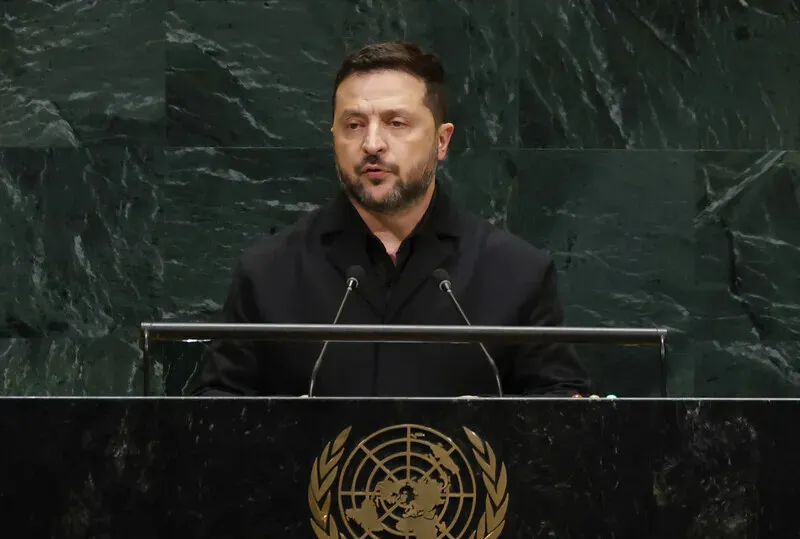
Ukrainian President Volodymyr Zelenskyy speaks before the UN General Assembly at the United Nations headquarters in New York, US, on Sept. 23, 2026. (UPI/Yonhap)
Controversy over Ukrainian President Volodymyr Zelenskyy’s disclosure of the handover of two North Korean prisoners of war to South Korea continued through the Chuseok holiday.
The Blue House and the Lee administration expressed regret over Zelenskyy’s announcement, saying the principle of confidentiality should have been maintained in the interest of human rights and national interests.
The main opposition People Power Party (PPP), however, went on the offensive, blasting the administration for not disclosing the transfer “to avoid upsetting North Korea.”
Critics argue that the party is turning a delicate matter into political wrangling despite concerns over the POWs’ safety and human rights, as well as the broader situation on the Korean Peninsula.
The controversy erupted Wednesday in New York when Zelenskyy, in his keynote speech at the United Nations General Assembly, said the two POWs had recently been sent to South Korea.
The next day, President Lee Jae Myung voiced his displeasure over the announcement.
“I don’t know what circumstances led the Ukrainian side to violate our confidential agreement and make the information public, but this is highly disappointing,” he wrote on his X account.
“Why wouldn’t there have been internal calls to publicize the transfer of North Korean POWs, especially if doing so could have helped restore public support for the administration?” he added. “But considering the various issues that public disclosure would cause, keeping it confidential was the most rational course of action in every respect, and this was what we agreed on.”
Seoul’s Ministry of Foreign Affairs said Friday that because the handover of POWs involves the personal safety of the individuals in question and their families, both South Korea and Ukraine “agreed to handle the matter confidentially.”
The Ukrainian presidential office denied this. Zelenskyy’s aide Dmytro Lytvyn said both sides never agreed to keep the transfer secret and called hiding the destination of specific POWs “wrong.”
A senior Blue House official said Thursday that the Lee administration had been informed through diplomatic channels that Zelenskyy’s speech might include details about the POWs, but said that what exactly would be said had not been articulated.
Given their differing stances on whether an arrangement existed to keep the matter under wraps, Seoul and Kyiv apparently had diverging views on the timing and scope of the handover’s secrecy.
This prompted the PPP to blast the Lee administration as “bending over backwards” to appease Pyongyang.
“This administration was probably not keen on the transfer in the first place because the arrival of North Korean POWs in South Korea poses an uncomfortable situation for North Korean [leader] Kim Jong-un,” PPP leader Jang Dong-hyuk told a news conference Sunday at the National Assembly. “Someone who throws away the lives of our troops and people just to appease North Korea’s Kim Jong-un is nothing less than a murderer and traitor.”
Jang’s remarks directly targeted the president’s comments on X, in which he criticized the PPP for its attacks on the administration.
“Those who endanger the lives of others and our national interest and security to advance their own petty gains are called murderers or traitors,” Lee wrote. “It’s wrong to condemn valid and justified measures to maintain confidentiality.”
The ruling Democratic Party also told its rival not to spread “conspiracy theories.”
“The PPP is spreading conspiracy theories despite the fact that this agreement was reached in private in consideration of the safety of the defectors, the well-being of their families in North Korea and the potential impact on the situation on the Korean Peninsula,” said Rep. Park Sung-joon, the ruling party’s chief spokesperson.
“Instead of raising conspiracy theories, the natural course of action for a normal political group should be to condemn and hold responsible those who raise an issue capable of undermining our national security,” he said.
Lee Byong-chul, a professor at Kyungnam University’s Institute for Far Eastern Studies, supported the administration’s bid to keep the handover secret.
“Given humanitarian concerns, the wishes of the POWs, inter-Korean relations, and [South] Korea’s ties with Ukraine and Russia, the administration appropriately decided on a low-key approach,” he said. “It seems that President Zelenskyy intended to use the transfer as a diplomatic asset by making it public, but the opposition party must also consider the national interest by not turning this into a political battle.”
By Jang Ye-ji, staff reporter; Jang Na-rye, staff reporter; Ko Han-sol, staff reporter
KioskNews shows a cleaned-up reading view extracted from the publisher’s page — the original always lives on their site, not ours.