Unions oppose rules allowing foreign teachers to teach non-English classes
By Rachel Lin and Esme Yeh / Staff reporter, with staff writer


Teacher unions yesterday expressed opposition to revised regulations allowing foreign teachers to teach life, arts and crafts, physical education (PE), or health classes, urging the Ministry of Education to withdraw the regulatory change.
The ministry on Jun. 30 announced revisions to its Regulations Governing Educational Institutions at All Levels Applying for Work Permits for Foreign Teachers and Their Administration (各級學校申請外國教師聘僱許可及管理辦法).
The revisions require public and private schools at the senior-high school level or below to hire foreign teachers to teach languages and other subjects related to arts or integrative activities, in line with the Bilingual 2030 policy.
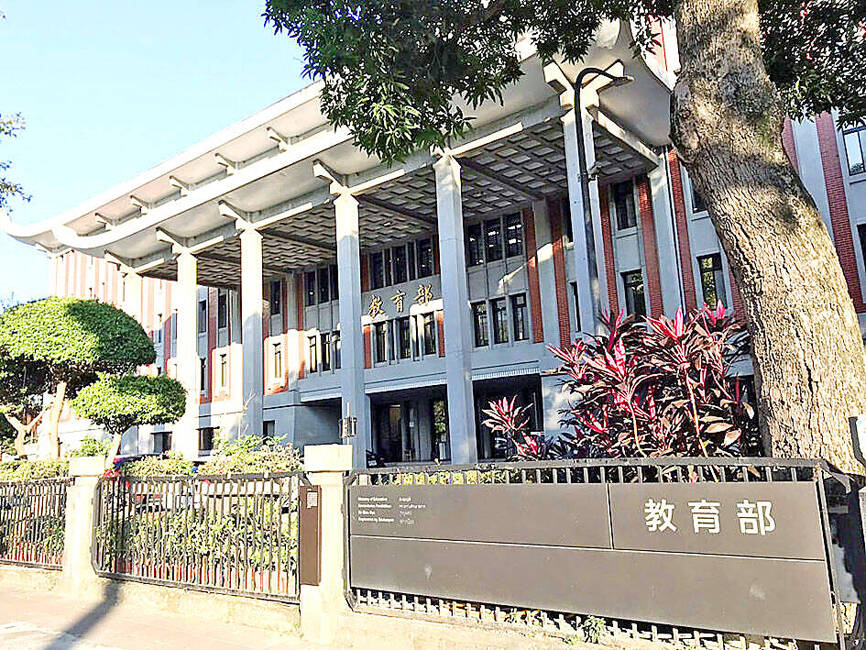
The entrance to the Ministry of Education in Taipei is pictured in an undated photograph.
Photo: Yang Mien-chieh, Taipei Times
However, some teacher unions said they are worried that arts and health classes might be reduced to English courses, undermining the autonomy of domestic education and the principle of “each subject is worth the same.”
Formosa Education Union (FEU) chairman Kuo Yen-cheng (郭彥成) said the 12-year basic education emphasizes holistic development and the principle of “each subject is worth the same.”
Life, arts and crafts, PE and health classes are not insignificant subjects, he said.
While the PE class involves physical development and sports safety, the arts and crafts class focuses on aesthetic experiences and cultural understanding, Kuo said.
The health class teaches students about bodily autonomy and public health, while the life class helps students learn about self, others and the environment, he said.
Those classes should not be reduced to supplementary tools for language practice, Kuo said.
Primary and secondary school education is not just about the delivery of knowledge and skills, but is also relevant to students’ identification with the land, language, history, and social values, FEU secretary-general Lee Ya-ching (李雅菁) said.
If the bilingual policy is overly centered on English or allow English thinking to dominate the teaching other subjects, local languages and cultures might be marginalized, she said, adding that it would weaken the autonomy of Taiwanese education.
Teacher unions are also concerned that the teacher training system might end up with double standards.
Taiwanese teachers may not become qualified teachers without undergoing the training, certification, internship and selection processes, the unions said.
Foreign teachers can assist in teaching and intercultural exchanges, but should not be allowed to enter arts or life subject areas under less strict standards and assume primary teaching responsibilities, they said.
FEU Education Policy Think Tank executive director Yang Yi-fei (楊逸飛) asked how foreign teachers’ expertise and competence should be determined and whether consistent professional standards would be applied to evaluating the performance of Taiwanese and foreign teachers.
Schools in the past few years have had difficulty hiring more teachers because of increases administrative burden, unstable teaching vacancies and insufficient protection for substitute teachers, Kuo said.
The ministry should solve the issue by improving teachers’ work conditions, instead of expanding the scope of subjects that foreign teachers can teach, he said.
The nine teacher unions issuing the joint statement included the FEU, the Tainan Education Union, the Kaohsiung Teachers’ Union, the Pingtung County Education Industry Union, the Yilan County Teacher Union, the Keelung Teacher Union, the Miaoli Teacher Union, the Hsinchu City Teachers’ Union, and the Hsinchu County Teacher Union.
KioskNews shows a cleaned-up reading view extracted from the publisher’s page — the original always lives on their site, not ours.