Choosing life, building hope: Former hostage turns to disability advocacy to honor wife, daughters

"I cannot change what was taken from me, but I can choose what I build,” says Eli Sharabi, a former resident of Kibbutz Be’eri who was taken hostage by Hamas terrorists on Oct. 7, 2023, and freed after enduring 491 days of brutal imprisonment in the tunnels of Gaza.
The image of an emaciated Sharabi freed from Hamas captivity, walking slowly through a jeering throng of Gazans into the hands of the International Red Cross on February 8, 2025, is permanently imprinted on the Israeli psyche. Sharabi, who lost 30 kilos during his imprisonment, weighed just 44 kilos upon his release. It was only after he returned to Israel that he learned that his wife Lianne, 48, and daughters Noiya, 16, and Yahel, 13, were murdered by Hamas terrorists in their Kibbutz Be’eri home on Oct. 7.
After his release, Sharabi became a prominent voice for the remaining hostages, met with world leaders, addressed the United Nations Security Council, and recounted his ordeal in interviews and his memoir, Hostage, which became an international bestseller.
Outwardly, at least, Sharabi, now 54, looks much as he did before his captivity, returning to a healthy weight. We sit at Shalva, the Israel Association for the Care and Inclusion of Persons with Disabilities, at the organization’s Jerusalem headquarters, with Kalman Samuels, Shalva’s founder and president, and his son Nachman, the group’s CEO.
Shalva provides therapy, education, rehabilitation, and family support for people with disabilities, from infancy through adulthood. Founded by Samuels and his wife Malki in 1990, it promotes inclusion while helping families navigate the challenges of caring for a loved one with disabilities.
What is Sharabi’s connection to Shalva?
“When my wife was younger and lived in England, she volunteered with children who had special needs,” he explains. Sharabi’s oldest daughter Noiya followed in her mother’s footsteps.
Noiya and Yahel often played with a girl with special needs who lived on the kibbutz, and they valued their relationship with her.
When Sharabi was working as the business manager for Kibbutz Be’eri, he came to the Shalva campus for a convention in 2017. “I was fascinated with the place, and after I came home to Be’eri, I told my wife and daughters, ‘I have to take you there.’ Sharabi never had the chance to bring them, but he says he always knew the work being done there would resonate with them.
Then came the horrors of Oct. 7. Sharabi, along with hundreds of other hostages, was held captive by the terrorists in Hamas’s underground tunnels in Gaza, under inhuman conditions. At that time, he did not know that his wife and daughters had been murdered.
“I remember sitting 50 meters underground, thinking about all the possible scenarios that could have happened to my family. I told my fellow hostages that if my wife and my daughters hadn’t survived, I would have no doubt where I would memorialize them – it would be through Shalva.”
After Sharabi was freed, he spent 10 days in the hospital, and then traveled throughout the world, met with world leaders, and lobbied for the remaining hostages’ freedom. Several months later, he visited Shalva, to ask the organization to name a room in memory of his wife and daughters.
Samuels recalls that Sharabi had told him, “I speak around the world, but there’s only one place that I want to actually be part of and create something and work together with. This is at Shalva.”
He explains the genesis of Sharabi’s interest in Shalva. “Eli called my wife Malki two weeks after he got out of Gaza. He told her he had visited Shalva once as the CFO of a company at a conference, and he went back and told his wife and children how amazing this magical place is.
“They were all involved in special education, and they begged him to take them to show them this magical place. That never happened.

“Two weeks after he came out [of Hamas captivity], he said, ‘Malki, Shalva is the only place I want a memorial for my wife and two daughters who were murdered.’
“Malki cried and said, ‘Eli, please come down in person, and we’ll do it together.’” Several months later, Sharabi came to Shalva, and Malki shared the idea she had. She went up one flight of stairs in the lobby and pointed out the area she wanted to dedicate to Sharabi’s wife and children.
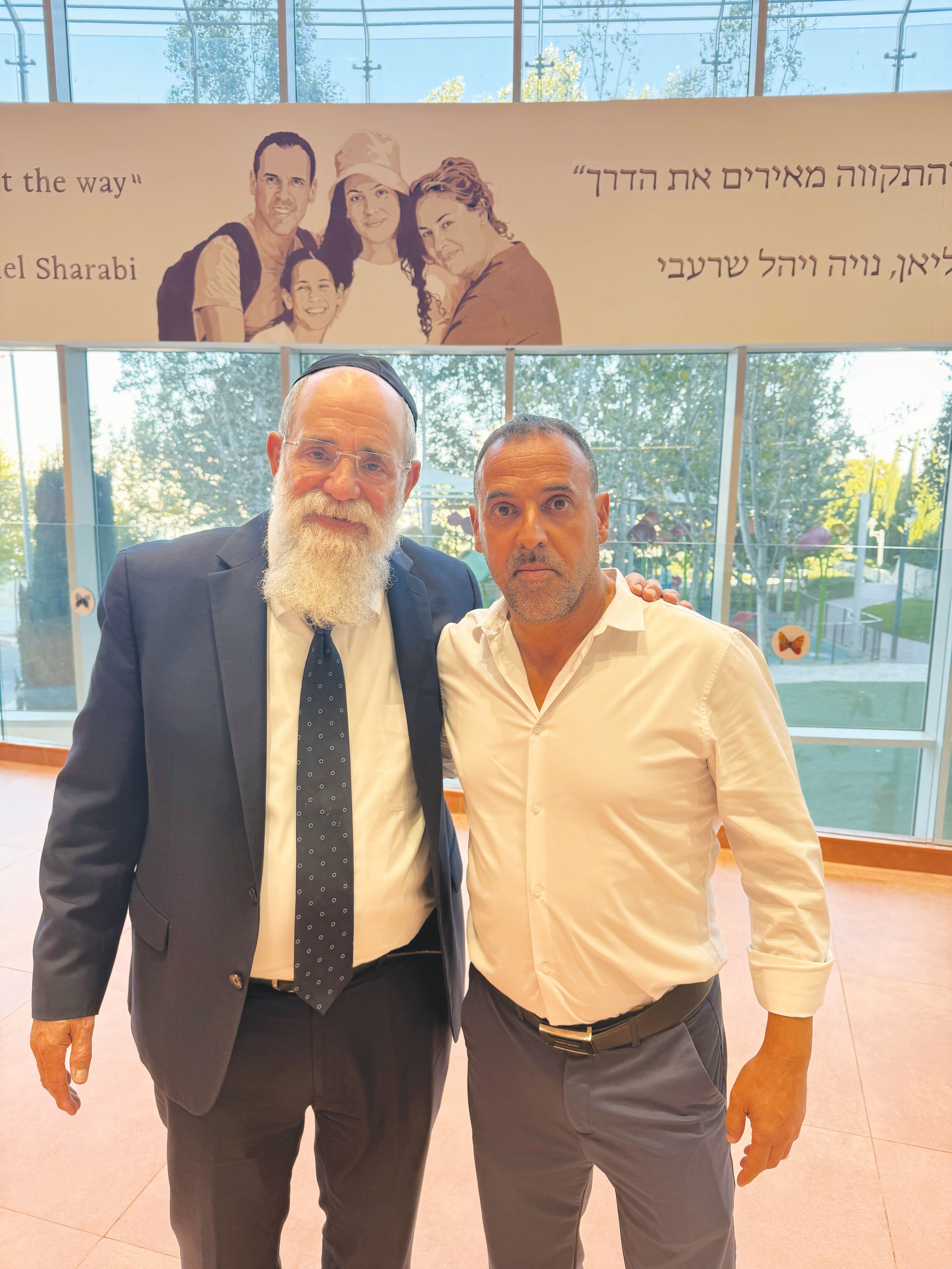
“Malki asked him for a picture of him with his wife and daughters, and he sent a photograph. From that photo, the artist painted the image, and Eli provided the wording on the wall. That was his wording, and the butterflies, of course, we added. The wall was completed several months ago.”
Honoring the departed: Diagnostic services, family support, and trauma treatment
Samuels and the Shalva team wanted to do more with Sharabi to help him fulfill his mission of memorializing his wife and daughters. Before their meeting, the government had turned to Shalva and asked them to create a center in Ashkelon to help residents of the South. The proposed center would provide diagnostic services, family support, and trauma treatment.
Samuels’s son Yochanan, along with the Shalva team, began investigating possible sites for the new Shalva center, and decided to build a new facility. They asked Sharabi for permission to call the center the Shalva Sharabi Family Center. “Eli said ‘yes,’ and that’s how we began,” he says.
Since then, Sharabi has traveled worldwide, raising funds for the new center, which is still under construction. The facility will serve 28 Gaza border communities as well as the southern region, operating from a permanent facility in the Marina View complex opposite the Ashkelon marina.
The Shalva Sharabi Center will address two pressing needs in southern Israel: accessible services for people with disabilities, and support for those affected by trauma. Families across the South often contend with long journeys, lengthy waiting lists, and fragmented care when seeking specialist assessments and treatment.
Building on Shalva’s existing model, the Family Center will bring diagnosis, therapy, rehabilitation, and family support together under one roof. Multidisciplinary teams will provide assessments and individualized care for infants, children, and adults. Services will include occupational therapy, physiotherapy, speech therapy, and Shalva’s “Me and My Mommy” early intervention program, alongside parental guidance and peer support.
The Horizons Pavilion will focus on trauma recovery and resilience for children and adults, soldiers, first responders, civilians, and families affected by the Oct. 7 Hamas-led massacres and the war. The initiative draws on Shalva’s experience providing therapeutic care, respite, and emotional support to evacuees, particularly people with disabilities and their families.
The center’s location near the Ashkelon Marina makes it an ideal site to combine individual and group therapies with outdoor and sea-based activities, designed to support recovery. Its programs will seek to strengthen coping skills, restore independence, and help individuals and families rebuild their connections to community life.
For Sharabi, the Shalva Sharabi Center in Ashkelon will remind him of his wife Lianne’s smile, Noiya’s passion for working with children with special needs, and how Yahel used to play with the child with special needs, in Kibbutz Be’eri. “This project gives me a great deal of strength, and is a meaningful way to honor the memory of Lianne, Noiya, and Yahel,” he says.
Having his name associated with the Shalva Center in Ashkelon epitomizes Sharabi’s philosophy of refusing to give up hope. “It just shows that life goes on. We cannot stop time. We can shape our future,” he adds.
“I can choose to stay in bed and cry all day. I chose differently from the moment I decided to act. Initially, it was for the remaining hostages who were held in Gaza; after that, for Jewish communities all around the world fighting antisemitism. For me, doing things means choosing life and helping to change the lives of others for good.
“The community of Be’eri lost more than 100 people in one day. So for me, it’s a big victory – after spending 491 days in captivity, most of them spent in Hamas tunnels – to believe that one day, I could come back to life and have a second chance to do things and impact others and influence Israeli society. It’s more than a dream.”
Sharabi says it will be deeply moving to walk into the Shalva Sharabi Center one day and see children and families receiving care. “It will be amazing. I can’t think of anything else that will provide the same amount of emotional happiness.”
Samuels and Sharabi: Different but intersecting worlds
Both Sharabi and Samuels say that although they come from different worlds, they have learned a great deal from each other. Sharabi says the partnership has introduced him to a world he barely knew. “I learned that, first of all, I know nothing about this world of kids with special needs and education. I always had my businesses and my career.
“The philanthropic world wasn’t part of my world, and it’s become very meaningful to me. It’s much more satisfying than another business. I learned a lot from Kalman about his passion. He is relentless about caring for all these kids, getting them and their families the services they need. It’s amazing to be with the Samuels family and to understand and learn.”
Samuels shares that he has learned how to rise above despair from Sharabi. “There’s every reason in the world that Eli should not have been able to get back on his feet. Yet he made a decision, early on, to ensure that his wife and daughter’s names would be in the public sphere and always remembered. Thank God, it is happening.
“But the idea that a person can get out of that and be a source of inspiration and hope for generations of people… Eli is spreading hope, which is probably the most important, most powerful element of mankind. When a person loses hope, he’s finished. And if a person has hope, it doesn’t matter what his situation is; life still has power. Eli has become this symbol of hope for the world.”
Like Sharabi, Shalva is also associated with that word. Its motto, “Inspiring Hope. Changing Lives,” suggests that the partnership between Sharabi and Shalva will bring hope and provide much-needed services for Israelis living in the South.
The Family Center, the first phase of the Shalva Sharabi Family Center in Ashkelon, is scheduled to open in January 2027, and the trauma center is planned to open in spring 2027. Samuels says they have raised $5 million toward the $10.5 million budget to complete the project. With nearly half the funding secured, the support of additional partners will help turn Sharabi’s vision of a living memorial into a place of healing for families across the South.
The drawing on the inside wall of the Shalva lobby features Eli, his wife, and his two daughters, with the words “Memory and hope light the way” in English and Hebrew, accompanied by three-dimensional images of three butterflies, to symbolize his family.
Samuels relates that when the artist began to paint the butterflies, a large butterfly flew inside the building and perched on the ledge. The artist, who was standing on a ladder some six meters above the building’s entrance, was a bit unnerved by the incident, he says.
On the second day, a different butterfly flew in, and on the third day, when she painted the third image, yet another butterfly arrived. “We have been in that building for over 10 years, and I have never seen a butterfly inside the lobby,” Samuels says. “The artist saw three large butterflies that sat and perched themselves near her.”
Samuels, who considers himself a realistic person with his feet on the ground, found the butterflies’ appearance inexplicable.
“For me, I feel very clearly that it’s just a good sign of the acceptance of his prayer – that his wife and daughters wanted to be there,” he says. “They didn’t get there in life, and somehow [Eli] wanted to give them a sense of peace.”■
KioskNews shows a cleaned-up reading view extracted from the publisher’s page — the original always lives on their site, not ours.