He killed Korea’s president 47 years ago. A posthumous retrial may finally answer why.
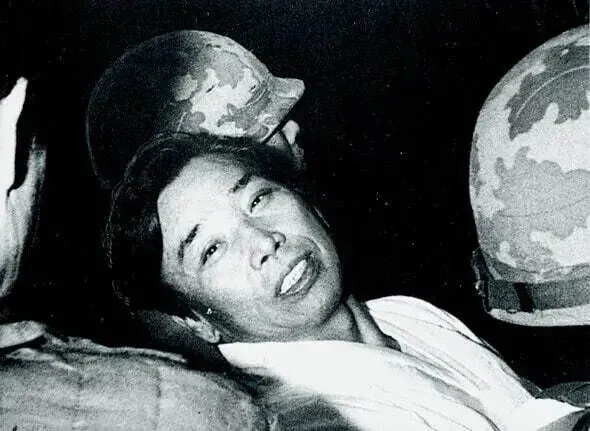
The trial of those involved in the assassination of Park Chung-hee proceeded at breakneck speed, from the first hearing at the Army Headquarters Martial Law Court on Dec. 4, 1979, to the prosecution’s demand for the death penalty at the ninth and final hearing on Dec. 18. Kim Jae-gyu, pictured, smiles brightly as he speaks to family members approaching the defendants’ dock in the courtroom. (from the Korea Times photo collection “Turbulent 1980s”)
With Monday marking the 47th anniversary of the assassination of former South Korean president Park Chung-hee, less than two months remain before sentencing in a posthumous retrial of his killer, former Korean Central Intelligence Agency director Kim Jae-gyu, on charges of homicide for the purpose of insurrection.
In an Oct. 6 parliamentary audit of the Supreme Court by the National Assembly Legislation and Judiciary Committee, opposition lawmakers criticized what they characterized as an attempt to make Kim “into a hero,” tying the retrial to the recent controversy over the film “The Assassin(s),” which depicts an assassination attempt on Park Chung-hee.
Meanwhile, Kim’s surviving family members and legal team have countered by stressing the need to investigate the whole truth behind the military tribunal’s argument at the time that Kim’s action was a form of “revolt for the purposes of insurrection.”
With historical assessments still at odds, many are watching to see what conclusion the judiciary reaches on the events of Oct. 26, 1979.
According to the Hankyoreh’s investigation on Sunday, the key issue in the retrial hearings — which began in July of last year — has had to do with whether Kim’s actions represented “revolt for the purposes of insurrection.”
At the time, the Supreme Court agreed with the charges of homicide for the purpose of insurrection and attempted incitement of insurrection, maintaining that Kim had slain Park in order to start an insurrection that would “overturn the national constitutional order and establish a new government.”
Kim argued in court that his actions had been an “unavoidable decision to end the Yushin dictatorship and restore liberal democracy,” but his claims were rejected.
Kim’s legal representatives in the retrial have focused on proving that his actions did not have the aim of causing an insurrection and that the “revolutionary committee” that he imagined was not meant to establish a new military regime.
Responding to the original court’s conclusion that Kim had “attempted to seize power by conceiving a revolutionary committee to take the place of existing constitutional institutions,” the legal team argued that although he did envision a revolutionary committee to deal with the event’s aftermath, his intent was that it would conform to existing state organizations and constitutional procedures.
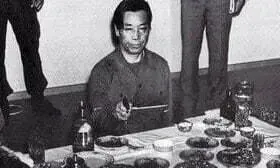
A restrained Kim Jae-gyu reenacts holding a gun pointed at Park Chung-hee on Nov. 7, 1979. (from the Yearbook of ’80s Photojournalism)
In a final hearing on Sept. 30, prosecutors requested a dismissal of the appeal, voicing a judgment on the revolutionary committee that was the polar opposite of the one shared by Kim’s legal team.
“Based on the testimony in court by Kim Jae-gyu and former presidential chief of staff Kim Gye-won, it has been sufficiently acknowledged that Kim Jae-gyu intended to declare martial law and establish a revolutionary committee to suppress constitutional organizations after assassinating the president,” prosecutors said.
“The existing judgment ruling that Kim’s actions were a revolt for the purpose of insurrection is sufficiently understandable,” they added.
But even the Supreme Court in 1980 did not produce a majority decision by eight justices. Six of the justices produced a minority opinion arguing that Kim’s actions did not meet the criteria for the crime of insurrection and that he should be charged with ordinary homicide instead.
The justices who submitted the minority opinion subsequently resigned after the ruling. One of them, Yang Byeong-ho, was even tortured by the Defense Security Command.
The Seoul High Court is set to issue its verdict in the retrial on Dec. 16.
Some legal world insiders are predicting the court could decide to dismiss the charges on the grounds that the military tribunal at the time was null and void. This would follow the precedent of other rulings stating that the martial law declaration issued the day after Park’s assassination was unconstitutional and illegal.
In such a situation, a substantive ruling on the insurrection charges could be omitted. But in light of the insistent demands by Kim’s surviving family members and others for a legal determination of the purpose and motives behind his act, some have raised the possibility that the court may also produce a substantive ruling.
KioskNews shows a cleaned-up reading view extracted from the publisher’s page — the original always lives on their site, not ours.