Livestock institute touts egg white processing method
By Esme Yeh / Staff reporter


The Taiwan Livestock Research Institute has developed a technique to repurpose salted egg white as food ingredients, with projections showing it could add more than NT$10 million (US$316,977) to the annual output of the domestic salted egg yolk processing industry.
The industry produces more than 4,300 tonnes of salted egg white each year as a by-product. While salted egg yolk is commonly used in pastries, including mooncakes, most salted egg whites are discarded due to their high salt content of up to 9 percent, institute director-general Huang Jeng-fang (黃振芳) said.
The new technique helped lower the salinity to 1.5 percent or less, with dietary fiber added to boost the processed nutritional value of egg whites, Huang said.
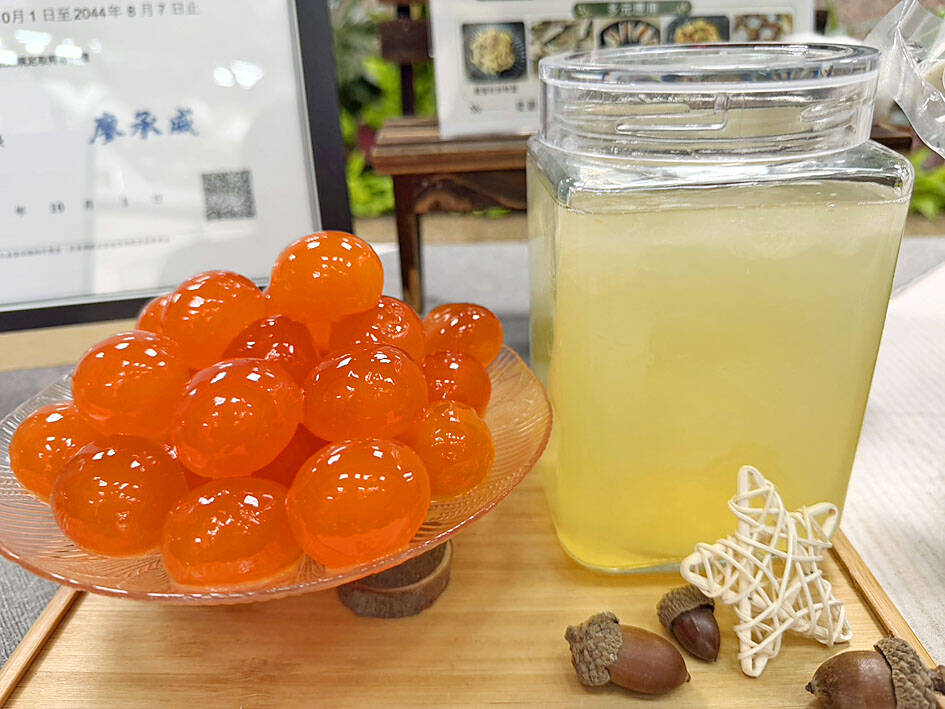
Salted egg yolks and egg whites are pictured at a news conference in Taipei yesterday.
Photo: Yang Yuan-ting, Taipei Times
Wu Ling-tsai (吳鈴彩), an assistant researcher at the institute who led technical development of the project, said konjac powder was integrated into the egg white to increase the fiber content.
It took the research team five years to develop the technique, which brought down the sodium content to 453mg per 100g, about the same as a tea egg, Wu said.
Processed salted egg whites have higher nutritional value than the unprocessed by-product, with 9.9g of protein, 4.7g of dietary fiber, 0.3g of fat and nearly no sugar per 100g, she said.
More than 100 boxes of duck eggs were used during the technical development process, with each egg weighing about 18kg, she said.
The salted egg whites were used in large quantities to overcome konjac powder’s characteristic of being highly incompatible with proteins, Wu said.
Operational details of the technique can be adjusted to create different shapes and mouth sensations for different food products tailored to food processors’ needs, she said.
The ratio of salted egg white by-products and their processed egg white output is about one to one, she said.
With about 3 tonnes of salted egg white disposed of per month and processed protein products costing about NT$300 per kilogram, the processing technique is projected to add NT$10.8 million or more to the industry’s annual output, Wu said.
Duck Farmer Association vice president Ou Ling-ho (歐陵合) thanked the institute for helping “turn the hot potato into gold.”
Salted egg white by-products were used for pig feed, but the government banned feeding pigs with kitchen waste, Ou said.
The institute’s technique benefits food processing operators and has the potential to advance high-protein fitness foods for gym-goers, he said.
The technique was patented last year and won a silver prize at the second Taiwan Agricultural Sustainability Awards in Taipei on Wednesday.
KioskNews shows a cleaned-up reading view extracted from the publisher’s page — the original always lives on their site, not ours.