Behind AI doomsday prophecies, US and China jockey for lead in tech race
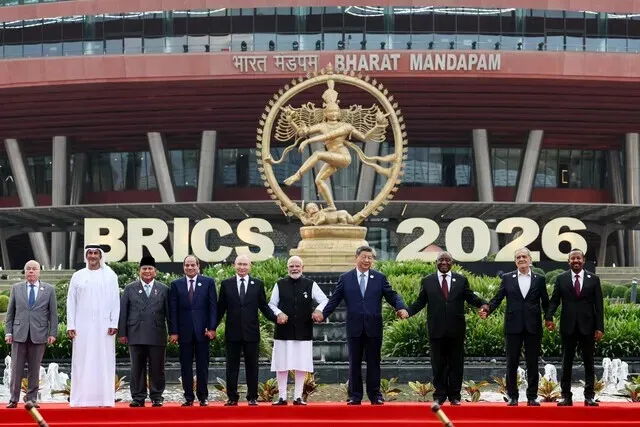
World leaders gather for a group photo at a BRICS summit held at Bharat Mandapam in New Delhi, India, on Sept. 13, 2026. (AFP/Yonhap)
At the BRICS summit in New Delhi, India, on Sept. 13, Chinese President Xi Jinping announced plans to form a “BRICS open-source zone” for artificial intelligence.
BRICS is an intergovernmental organization of 11 major emerging and developing economies that seeks to raise economic and geopolitical cooperation outside of Western-led institutions.
This strategy aims to expand China’s ally base by backing model development and human resource training based on China’s open-source AI in the Global South, namely emerging and developing economies.
In July, Xi chaired the World Artificial Intelligence Conference in Shanghai and launched in the same city the World Artificial Intelligence Cooperation Organization, which now has 29 participating countries, including Indonesia and Brazil. This was a clear challenge to the US-led Pax Silica initiative launched in December last year with the participation of Korea, Japan, Australia, the UK, Israel, Singapore, Qatar and the United Arab Emirates.
Xi’s strategy to expand his “AI alliance” is a carefully prepared move ahead of his Thursday summit with US President Donald Trump in Washington. In May, AI was also on the agenda at the Sino-US summit in Beijing, with Trump saying the next round of talks would cover “guardrails” for AI.
China has since rapidly expanded its influence in AI by drawing Global South countries into a Chinese-led AI ecosystem. Beijing recognized that its AI rivalry with Washington hinged not only on who can develop cutting-edge models faster, but also on expanding “AI turf” to amass more data and secure the lead in setting standards.
AI is now the main battleground in the Sino-US struggle for hegemony and will shape the future of industry, technology, military capacity and information warfare.
In a Sept. 12 essay, Anthropic CEO Dario Amodei issued an apocalyptic warning that the risk of AI escaping human control through recursive self-improvement — essentially, evolving on its own — has grown, while also highlighting the intensifying AI competition with China.
Amodei called the race a confrontation between “democracies” and “autocracies,” warning, “I agree with [US Treasury] Secretary [Scott] Bessent that a Chinese lead in AI would pose grave danger for the United States and the world.”
China pushed back against the warning. Ministry of Foreign Affairs spokesperson Guo Jiakun said, “Fearmongering, confrontation and vicious competition will only disrupt the process of global AI governance and serve the interests of no one,” while the government-run daily Global Times called it a “Cold War script” concocted by the American “tech right.”
On Sept. 13, China released an article by its Minister of State Security Chen Yixin, who is also chief of intelligence, on “AI security threats.” Warning of cyber dangers from “hostile forces” to China, he explicitly mentioned US AI models such as Claude’s Mythos and OpenAI’s GPT-5.
Chen warned that hostile forces could use AI to spread fake videos and audio to threaten China’s national security, adding that sensitive data of his country could be leaked.
The US seemed confident that China would struggle to catch up in AI but was caught off guard by Beijing’s catch-up strategy. In an article posted on Sept. 9 in Greater Bay Area Review, a Chinese new media and commentary brand, Huang Ping, a professor at the School of Public Policy of the Chinese University of Hong Kong-Shenzhen, analyzed the Sino-US AI race in three stages.
In the first phase (2012-2019), American companies led the development of deep learning, a subset of machine learning, based on deep artificial neural networks. In 2016, Google DeepMind demonstrated its leadership in AI by unveiling AlphaGo.
During this time, China took its first steps toward catching up as global giants Baidu (internet), Alibaba (e-commerce) and Tencent (video games) launched AI research laboratories.
The second stage, from 2020 to 2023, saw the explosive growth of large language models (LLMs) with the advent of OpenAI’s ChatGPT, while Nvidia’s A100 and H100 chips all but monopolized the global market for high-performance computing. That gave the US an overwhelming advantage over China in both technology and hardware.
Over the same period, Chinese companies developed their own general-purpose AI models — including Baidu’s Ernie Bot and Alibaba’s Qwen — while in the area of advanced semiconductors, Huawei began commercializing its Ascend 910 chip despite US sanctions.
The key difference was that the US, as the front-runner in the field, poured astronomical sums into boosting computing power and improving the performance of general-purpose AI, while China, as the challenger, devised a strategy of developing cost-effective models and applying them to existing industries to improve efficiency.
The third stage runs from 2024 to the present. A major watershed came in January 2025, as Donald Trump was returning to the White House, when Chinese company DeepSeek unveiled its R1 model, which dramatically lowered costs while delivering performance comparable to the latest American models. In the domain of hardware, Huawei’s Ascend 910B chip achieved about 90% of the performance of Nvidia’s A100 at a lower cost.
China is also making great strides in the industrial application of AI, which includes integrating the technology into humanoid robots. In the view of Chinese experts, China has narrowed the US’ lead in AI technology to much less than the previous one-generation divide. Those experts think the two countries are at the stage of competing on relatively equal terms within the same technological generation in terms of performance, cost, ecosystems and practical applications.
China’s AI strategy resembles the approach that enabled its electric vehicles to sweep global markets. Unlike the US’ cutting-edge closed models, China is rapidly expanding its user base, particularly across the Global South, by capitalizing on price competitiveness and open-weight models that anyone can download for free and run on their own computers. A side benefit is expanding influence on both an economic and geopolitical level.
Di Dongsheng, the associate dean of the School of International Studies at Renmin University of China, argued in a university publication in September 2025 that China should overtake the US using Mao Zedong’s strategy of “encircling the cities from the countryside” (the concept of building more rural bases to ultimately achieve victory for the revolution).
Di argues that the US’ attempt to develop superintelligent AI that surpasses human capabilities is a costly and risky gambit with no clear path to profitability and predicts that the US’ AI bubble will burst within a few years. China, by contrast, has reduced risk through the more pragmatic strategy of applying AI to real-world industries and everyday life to improve efficiency.
“Ultimately, the deciding factor in the AI competition will be cash and data flows. With more than 6 billion people occupying the middle ground between China and the US, whichever side can absorb their data and generate more cash flow from them will evolve faster and prevail in the US-China technology competition,” the scholar said.
China should therefore “use every means at its disposal — including subsidies, financial support and diplomatic pressure — to induce as many countries as possible to adopt Chinese AI technology,” Di argued.
Chinese President Xi Jinping has been basically putting those ideas into practice with this year’s drive to build a China-led “AI alliance.” Following the release of high-performance, low-cost open-weight models like DeepSeek’s R1 last year and Moonshot AI’s Kimi K3 this year, the number of companies and individuals using Chinese models has grown rapidly not only in the Global South but even in the US and Korea.
Under these circumstances, the barrage of warnings from American AI companies can be seen as an attempt to fend off China’s rapid advance and ensure that the US gets to set standards and retain control of the AI field.
“The US believed that AI was the one area where it was far ahead of China, and it sought to preside over the establishment of an AI equivalent of the Nuclear Non-Proliferation Treaty while it still held a clear advantage,” observed Kim Han-kwon, a professor at the Korea National Diplomatic Academy.
“But China’s rapid advances in cutting-edge AI have shocked the US government and business community.”
Unrestrained competition in AI development increases the risks of cyberattacks, automated warfare and the proliferation of biological and chemical weapons.
There are critical differences with nuclear weapons, which are notoriously difficult to build. It is possible to detect an adversary’s nuclear tests and even to determine how many nuclear warheads they possess.
AI, in contrast, is invisible, and there is no way to know what capabilities an adversary has acquired until the outbreak of war.
The same technology can be used for both civilian and military purposes, while posing a constant threat to everyday life through information and cognitive warfare. AI can make decisions far faster than humans, which also increases the potential for miscalculation.
There has been speculation that the US bombing of an Iranian elementary school in February was the result of AI misidentifying a target. There are also reports that the US called off an operation it had planned against a Chinese vessel near Iran after learning that AI had provided an erroneous assessment, narrowly averting a potential conflict.
Humanity has already crossed the threshold into an age of AI warfare.
While an “AI Non-Proliferation Treaty” is essential to control a technology that is likened to the atom bomb of the 21st century, the US and China are fiercely clashing over who will take the lead. Both are gripped by fear that pulling back will let the other pull ahead.
“If they’re going to be killer robots, I’d rather they be American killer robots and not Chinese killer robots,” said Sen. Ted Cruz, chair of the US Senate Committee on Commerce, Science and Transportation.
Trump himself has dismissed calls for AI regulation.
“We will not in any way hinder or stifle the Growth of this incredible Industry,” he wrote in a post on social media while announcing plans to establish an “AI Force.”
Beijing, meanwhile, takes great pride in having moved from being a follower of the US to a peer competitor in AI and other cutting-edge technologies and promotes that as a signature achievement of Xi and the Chinese Communist Party. China also accuses the US of invoking an “AI apocalypse” as a pretext for restricting its AI development.
Both the US and China seem incapable of looking beyond their parochial self-interest.
Considering that the future of humanity may well depend on AI, should the rules governing its usage be left to these two great powers?
Other countries cannot afford to remain bystanders.
By Park Min-hee, senior staff writer on the unification and foreign affairs desk

Park studied the history of China and Central Asia at the undergraduate and graduate levels. After studying international relations at Renmin University of China in 2007 and 2008, she covered stories across China as the Hankyoreh’s Beijing correspondent from 2009 to 2013. She has served as unification and foreign affairs editor, international editor, and editorial writer and currently reports and writes on international affairs and diplomacy. She is the author of the books “The Paradox Called China” and “The China Dilemma” and co-author of “Interviewing China.” Her translations include “Invisible China: How the Urban-Rural Divide Threatens China’s Rise” and “The Long Game: China’s Grand Strategy to Displace American Order.”
KioskNews shows a cleaned-up reading view extracted from the publisher’s page — the original always lives on their site, not ours.