Copilot subdued after stabbing pilot in alleged attempt to crash plane full of Israelis
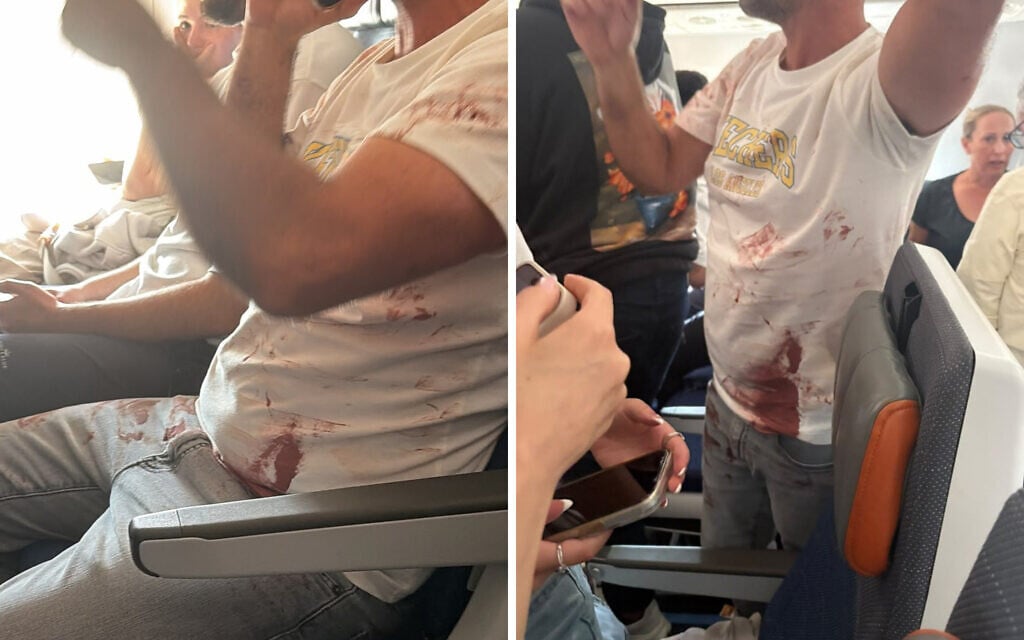
A commercial flight from Dubai to Tel Aviv made an emergency landing in Saudi Arabia on Wednesday after a bloody clash in the cockpit that Israeli officials suspect was an attempt to wrest control of the plane and crash it in an act of terrorism. None of the 180-odd passengers, most of whom were Israeli, were reported injured.
People who were on the plane, and loved ones to whom they’d spoken, told Hebrew media that it appeared the flight’s copilot had stabbed the captain, at which point the plane went out of control. A group of Israeli passengers managed to storm the cockpit, subdued the stabber and stabilized the plane, witnesses said. About an hour later, it landed in Saudi Arabia.
There were no immediate official statement on the circumstances of the incident by Israeli, Saudi or Emirati authorities.
0:00 / 0:00
Promoted: Nefesh B'Nefesh - Aliyah is Now

The captain was an Emirati citizen, and the co-pilot an Omani. According to one passenger, the captain was “seriously wounded” and was taken for treatment after the plane landed.
The flydubai flight from Dubai to Tel Aviv sent a “squawk code” of 7700, an international emergency signal, some time before 9:30 a.m., according to flight tracking data. It then sent a 7500 code, signaling a hijacking or unlawful interference, a short time later.
Get The Times of Israel's Daily Edition by email and never miss our top stories
By signing up, you agree to the terms
In the intervening time, Israeli Air Force fighter jets were scrambled toward the plane, security sources said. Prime Minister Benjamin Netanyahu and Defense Minister Israel Katz also held emergency consultations, and the Israel Defense Forces said Chief of Staff Lt. Gen. Eyal Zamir conducted an assessment with senior officers.
“The situation is under control, and all measures are currently being taken to bring the Israeli passengers back to Israel safely,” said the Prime Minister’s Office, in a statement around 10:45.
As of early afternoon, Israeli officials still could not say definitively that the incident was a terror attack, but that was the growing assessment. However, other options were also being looked into, including a mental health episode that was not nationalistic in nature.
It wasn’t immediately clear how the Israelis would be brought back from Saudi Arabia. Israel’s civilian airlines offered to fly them, but there was also the option of using the air force, which would require Saudi approval. The Gulf kingdom has extensive intelligence ties with Israel but no formal diplomatic relationship.
In a dramatic and graphic video from the plane, moments after the alleged attack on the captain by his copilot, the captain could be seen covered in blood on the floor of the aircraft, outside the cockpit, as passengers tended to him. A second crewmember was seen tied up beside him, seemingly unconscious.
One Israeli passenger told the person filming: “We were attacked and are guarding the pilot.”
Another passenger said: “They tried to murder the pilot. We subdued [the attacker].
Someone pointed to the bound man and said: “This is the man who… stabbed him.”
A man who was on board the flight recorded a video to his family that was shared on social media, recounting what happened.
“There’s a pilot who’s seriously wounded, they evacuated him,” he said, in addition to “a terrorist whose condition we don’t know, but he’s tied up.”
“It was rough,” he said. “It was rough. Surely, in a few minutes we’ll return home — I need to change clothes,” he joked, explaining: “These are covered in blood.”
In another video, apparently recorded moments after the fight aboard the flydubai plane, a passenger with blood on his face could be seen telling the camera, “We’re here during the hijacking of an airplane. At this point we’ve subdued the terrorists, we’re approaching landing. Whoever is hearing me, we need help.”
“We’re landing in Tabuk, apparently in Saudi Arabia. An unknown, unfamiliar area. On the plane, everybody is safe and sound, other than the pilot. We need help.”
“After the Israelis took control of the situation, they managed to stabilize the plane,” a passenger named Adam told Channel 13, noting: “Three or four people saved 180 lives.”
“We prayed ‘Shema Yisrael,’” another passenger told Channel 12. “There were also moments when we thought we weren’t going to make it out alive.”
A video published by Hebrew media outlets that The Times of Israel could not independently verify purported to show the interior of the plane as it landed, with passengers celebrating, clapping and singing.
The flight, Tel Aviv-bound 1073 carrying a reported 180 passengers — including dozens of Israelis — departed Dubai and climbed to a cruising altitude of 34,000 feet, according to flight tracking data.
Two hours and 15 minutes into the flight, the Boeing 737 MAX suddenly took a sharp nosedive, dropping from 34,000 to around 17,000 feet in under a minute as it sped up from 411 knots to nearly 600.
The plane recovered slightly for several seconds, reaching 21,725 feet, before dropping sharply again, this time to just under 15,000 feet.
Over the next hour, the plane failed to maintain a steady altitude, though it remained around 15,000 feet, indicating it was being controlled by hand rather than autopilot.
The aircraft sent a “squawk code” of 7700, a general international emergency signal, as it flew along the Jordanian-Saudi border.
The flight then switched to a code 7500, meaning a hijacking or unlawful interference. The plane briefly entered Jordanian airspace before turning back into Saudi Arabia.
The aircraft switched back to code 7700 as it approached Tabuk airport in Saudi Arabia, where it landed.
It appears to have sustained damage to the rudder on the rear of the aircraft, based on images showing that a section of the rudder is missing from the vertical stabilizer.
Arik Zer, a former Shin Bet head of flight security, said the rapid plunge of the plane likely caused the damage, telling Channel 12 that this would not have been caused by any outside object impacting the plane.
KioskNews shows a cleaned-up reading view extracted from the publisher’s page — the original always lives on their site, not ours.