Margaret Atwood tells journalists to ‘search deep within your hearts’ over Steven Galloway coverage
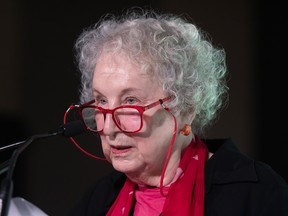
Canada’s most respected writer gave a backhanded scolding to the country’s media establishment at a charity gala for failing to cover the firing and blacklisting of author and former professor Steven Galloway, and for only coming late to this scandalous story of sex, creative writing and alleged defamation.
Sign In or Create an Account
“Finally the Canadian press is covering it, after eight years of mostly not,” Margaret Atwood said while accepting an award from Journalists for Human Rights in Toronto. “As one of those attacked online, trashed and derided as a ‘due processer’ for asking for an open investigation with information and evidence from the University of British Columbia, I’m happy to see that.
“Luckily, I couldn’t be fired from a university, blacklisted from festivals, or, if I was, I’d have noticed,” Atwood said. This joke got a laugh, but it was also a poignant criticism of the assembled journalistic decision makers, still waiting on their main course of chicken and kale.

Get a dash of perspective along with the trending news of the day in a very readable format.
By signing up you consent to receive the above newsletter from Postmedia Network Inc.
A welcome email is on its way. If you don't see it, please check your junk folder.
The next issue of NP Posted will soon be in your inbox.
We encountered an issue signing you up. Please try again
“But did the press stand up for Article 10 (of the 1948 Universal Declaration of Human Rights) back then, the right of every human being to a fair, open and impartial trial? Search deep within your hearts,” she told them.
Galloway was suspended and later fired by UBC over a former student’s allegation of sexual assault, and subsequent complaints of other misconduct. A judge’s review found on a balance of probabilities he had not committed sexual assault, and he was later awarded $167,000 from UBC through arbitration. He filed a lawsuit in 2018.
The civil trial, over his libel claim against four women, is hearing evidence now in Vancouver over the events from 2015, in the intense early days of Canada’s cultural reckoning with sexual violence, just before the criminal trial of Jian Ghomeshi.
Atwood’s audience Thursday night included many of Canada’s top media executives, editors and writers. The fundraiser gala for Journalists for Human Rights, a charity that sponsors media training in developing countries, also included remarks by prominent journalists including Lyse Doucet, chief international correspondent for the British Broadcasting Corporation, and Lisa LaFlamme, former anchor of CTV National News.
Atwood is one of several dozen major Canadian arts and literary figures who signed a 2016 letter called UBC Accountable advocating for Galloway’s right to due process.
She also recently wrote a commentary alleging UBC, where she once taught and wrote, mishandled public money by giving it to Galloway’s accuser, a former student with whom he claims to have had a consensual affair, and who is now one of the civil defendants. The school is not a party to the trial, though Atwood wrote it was “instrumental in trashing Galloway’s life by jumping the gun before a smidgen of due diligence.”
At the gala, Atwood spoke of “mobs” that “can be right in principle but wrong in application,” from the Paris mob of the French Revolution with its legitimate complaints of socioeconomic inequality to the moral crusades of modern social media. “But just principles can inspire and enrage hate-filled, vicious piling on. Verdict first, no trial, guilty by identity.”
Atwood was accepting an award, and focused most of her speech on the wider issues of human rights abuses by governments and other powerful interests, and the role of the journalist in confronting them, specifically legacy media companies, which have less money both for investigating and for defending against litigation.
“This has made them more cautious. I won’t say timid. And it has emboldened their enemies, would-be power grabbers who don’t like criticism in the press and wish to squash and exclude,” she said.
Atwood, who spoke from a lectern for about 10 minutes, was keenly familiar with the gala’s setting, the Arcadian Court ballroom, high in the Simpson’s tower on Bay Street near Toronto’s Old City Hall.
In The Blind Assassin, the 2000 historical novel that won her the first of two Booker Prizes, it is the fictional setting for a fateful lunch meeting between the narrator protagonist Iris Chase and her manipulative sister-in-law Winifred Griffen Prior, which begins with the memorable and menacing introduction: “Call me Freddie. All my chums do, and I want us to be great chums.”
“This was where the ladies lunched,” Atwood wrote, “up at the top of Simpsons department store, on Queen Street – a high, wide space, said to be “Byzantine” in design (which meant it had archways and potted palms), done in lilac and silver, with streamlined contours for the lighting fixtures and the chairs. A balcony ran around it halfway up, with wrought-iron railings; that was for men only, for businessmen. They could sit up there and look down on the ladies, feathered and twittering, as if in an aviary.”
Our website is the place for the latest breaking news, exclusive scoops, longreads and provocative commentary. Please bookmark nationalpost.com and sign up for our newsletters here.
Join the Conversation
This website uses cookies to personalize your content (including ads), and allows us to analyze our traffic. Read more about cookies here. By continuing to use our site, you agree to our Terms of Use and Privacy Policy.
KioskNews shows a cleaned-up reading view extracted from the publisher’s page — the original always lives on their site, not ours.