Mahama tasks new Supreme Court justices to make justice more accessible
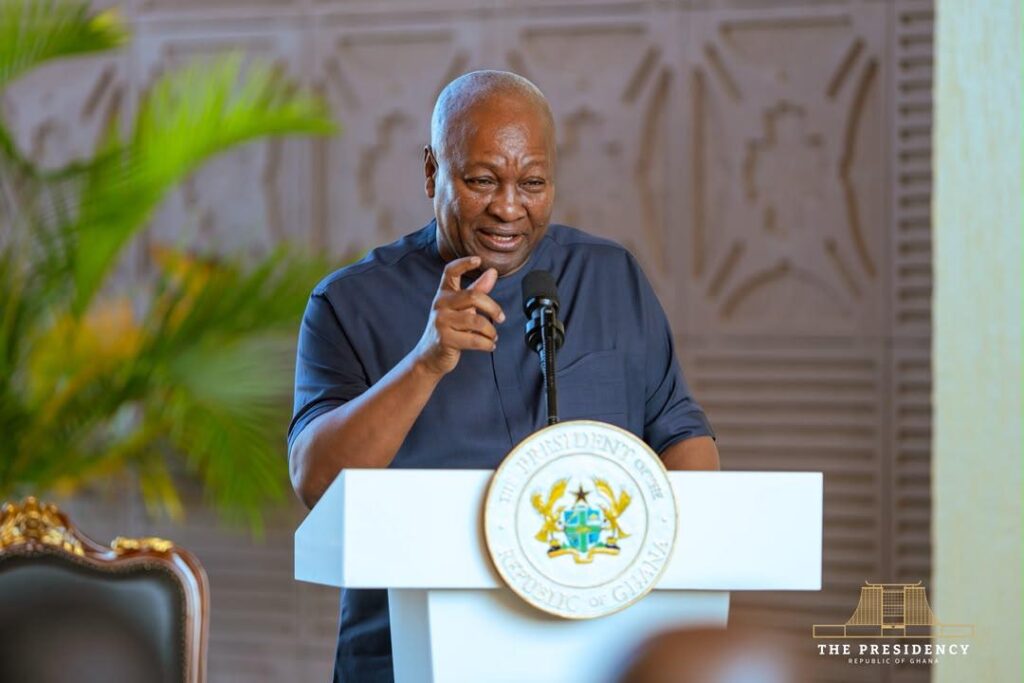
President John Dramani Mahama has charged Ghana’s newly appointed Supreme Court justices to help bridge the gap between constitutional justice and the everyday experiences of citizens, warning that judicial independence must be matched by efficiency, accountability and timely delivery of justice.
Speaking at the swearing-in of three new Supreme Court justices at Jubilee House on Thursday, September 10, President Mahama said the judiciary’s credibility depended not only on the quality of its decisions but also on whether ordinary Ghanaians could access justice without undue delay.
Justice Sophia Rosetta Oduokouan Bernasko-Essah, Justice Edward Amoako Asante and Anthony Fawson Jr, popularly known as Tony Fawson, were sworn into office after receiving Parliament’s approval.
The President said their appointment came with a responsibility extending beyond the determination of individual cases, as the Supreme Court remains the final judicial authority on matters affecting the Constitution, national governance and the development of Ghanaian law.
President Mahama said the ultimate measure of a strong judiciary was public confidence that cases would be decided independently, impartially and according to the law.
He stressed that Supreme Court judges required more than legal expertise, identifying sound judgement, integrity, intellectual courage, patience and commitment to justice as essential qualities.
According to him, the oath taken by the new justices represented a solemn obligation to the Ghanaian people rather than a ceremonial exercise.
He urged them to protect constitutional rights, uphold the separation of powers and ensure that no person or institution was placed above the law.
But beyond constitutional principles, Mr Mahama said the judiciary must confront practical challenges that affect citizens' ability to obtain justice.
“Justice delayed continues to impose immense hardship on our ordinary citizens,” he said, pointing to prolonged cases, avoidable adjournments and delays in delivering judgments as factors that undermine confidence in the judicial system.
He consequently called on the judiciary to pursue reforms that improve efficiency, make appropriate use of technology and ensure that access to justice does not depend on a person's income, status or location.
The President said the three new justices brought distinct professional experiences that could strengthen the Supreme Court's deliberations.
Justice Bernasko-Essah joins the Court with extensive experience from the Court of Appeal. Mr Mahama said her exposure to complex legal questions and the administration of justice would contribute to improving the quality, clarity and consistency of Supreme Court judgments.
Justice Amoako Asante brings both national and regional judicial experience, having served on the Court of Appeal and as President of the ECOWAS Court of Justice. The President said his work at the regional court had given him valuable exposure to issues including human rights, regional integration, treaty obligations and the relationship between domestic and international law.
Mr Fawson, meanwhile, joins the bench from private legal practice and previously served as President of the Ghana Bar Association.
President Mahama said his experience offered an important perspective on the challenges faced by litigants, businesses, public institutions and lawyers who rely on the justice system.
He also cautioned Mr Fawson that the transition from the bar to the bench required a different standard of responsibility.
While an advocate advances a client's case, he said, a judge must rise above competing interests and determine matters solely on the law, evidence and dictates of justice.
President Mahama reaffirmed his administration's commitment to judicial independence, describing it as a protection for citizens rather than a privilege for judges.
He said judges must be free to determine even politically sensitive or unpopular cases without fear or favour, but added that such independence had to be accompanied by accountability, discipline and fidelity to the judicial oath.
Public confidence, he said, would ultimately depend on both judicial conduct and the effectiveness of the courts.
The President's remarks therefore placed the new justices at the centre of a broader expectation for a judiciary that is independent in decision-making while also responsive to the practical needs of citizens.
He expressed confidence that the combination of judicial, regional and private-practice experience brought by the three appointees would deepen the Supreme Court's work and contribute to the continued development of Ghana's constitutional democracy.
DISCLAIMER: The Views, Comments, Opinions, Contributions and Statements made by Readers and Contributors on this platform do not necessarily represent the views or policy of Multimedia Group Limited.
Tags:
DISCLAIMER: The Views, Comments, Opinions, Contributions and Statements made by Readers and Contributors on this platform do not necessarily represent the views or policy of Multimedia Group Limited.
KioskNews shows a cleaned-up reading view extracted from the publisher’s page — the original always lives on their site, not ours.