ABS-CBN talks up its ‘new’ future, but its new owners weren’t in the room

For a company that makes a living creating drama, ABS-CBN’s annual stockholders’ meeting (ASM) on Wednesday, August 19, had remarkably little of it.
There was no ballroom full of stockholders, no live audience, not even the usual performance from one of the artists whose shows, movies, music, and endorsements remain among the company’s biggest earners. Everything happened online, much like an increasing share of ABS-CBN’s business itself. Executives appeared in boxes on a screen, every microphone but those of the designated speakers stayed muted, questions had been submitted beforehand, and most of the votes had already been cast days before anyone logged in.
In under 40 minutes, the company worked through the familiar rituals of an annual meeting. The minutes of the previous meeting were approved, followed by the financial statements and management report. The acts of the board and management were ratified, seven directors were elected, and the external auditor was appointed. There were stockholder questions about Gandang Gabi Vice (returning in September on GMA, iWant, and Kapamilya Channel), Pinoy Big Brother (another GMA collaboration launches in October, from a new and more cost-efficient PBB house), Noli de Castro (on medical leave and expected back once cleared by his doctors), ABS-CBN’s remaining real estate moves (the transfer to ELJ building is now expected to be completed by mid-2027), and possible deeper partnerships with GMA Network, Manny Pangilinan’s MediaQuest, and Romualdez-linked Prime Media Holdings, ABS-CBN’s partner in Media Serbisyo (management said it remains open to partnerships with other media companies). Chairman Martin Lopez then asked if there was any other business, and there was none. Meeting adjourned.
It was an orderly, sanitized, almost frictionless annual meeting for a company in the middle of anything but a frictionless transition. But outside that virtual room, ABS-CBN is being rearranged.
Just a week earlier, the company had announced P6 billion in fresh equity that could substantially alter who owns it: P3.5 billion from I&C Holdings Corp., P2.2 billion combined from three Lopez family branches — Crème Investment, Mantes, and Presta — using personal resources, and P300 million from Lopez Inc., the private family holding company that currently controls ABS-CBN. The recapitalization requires 1,643,835,616 new common shares, almost twice the roughly 900 million common shares the company has issued today.
None of that was specifically put before stockholders on Wednesday. There was no presentation on the P6 billion, no specific discussion of I&C, no resolution seeking approval of the new shares, no explanation of what ownership would look like after they are issued, and no director representing the investor putting up the single biggest check.
The timing explains, at least in part, why the recapitalization was not among the matters stockholders had been asked to vote on. What it does not entirely explain is why one of ABS-CBN’s biggest corporate developments since the franchise loss barely intruded into management’s conversation with its owners.
The meeting that came before the rescue
The explanation starts with dates. July 16 determined who could vote. July 29 determined what those stockholders would be asked to vote on, when ABS-CBN’s notice and agenda went out after weeks of filings and review by the Securities and Exchange Commission (SEC). Stockholder registration and validation then ran through August 9, and validated stockholders and proxies were asked to cast their votes through a secure online platform by that date, on the matters already contained in the published agenda.
Only then did the rescue arrive. On August 12, I&C, the three Lopez family branches and Lopez Inc. signed their subscription agreements. On August 13, the ABS-CBN board approved the deal and the increase in capital stock it requires. On August 19, stockholders finally met. By the time I&C and the Lopez investors signed, ABS-CBN’s existing stockholders had already been asked to finish voting three days earlier, and the board had not even acted on the recapitalization when voting closed. ABS-CBN’s own Definitive Information Statement had already told stockholders what not to expect from this meeting: “No action is to be taken with respect to the authorization or issuance of securities.” No specific securities resolution was presented Wednesday.
The calendar therefore explains why the P6-billion recapitalization did not suddenly materialize as another item on the ballot. An increase in authorized capital stock isn’t routine annual-meeting business: after board approval, it requires the approval of stockholders representing at least two-thirds of the outstanding capital stock, as well as the required corporate and regulatory process.
This also explains some of the names that were not there. Gabby Lopez, whose family branch recently sold its stake in Lopez Inc., was not returning to the ABS-CBN board. Neither Ramon Ang, whose investments are at the private Lopez Inc. level rather than directly in ABS-CBN, nor minority shareholder and now Batangas lawmaker Leandro Leviste, had representatives among the 7 nominees. Those transactions changed ownership upstairs at Lopez Inc.; they did not automatically rewrite a board slate downstairs at ABS-CBN that had already gone through the nomination and voting process.
What Wednesday’s meeting did was complete the corporate business laid out weeks earlier, even as another ABS-CBN was already being assembled around it.
‘A new ABS-CBN’
Carlo Katigbak had his own meaning for that phrase. The ABS-CBN president spent much of his report describing a company that has spent 6 years trying to find a viable business after losing the broadcast franchise around which much of the old one had been built. “We recognize that we are not yet where we need to be,” he told stockholders. It had been a difficult chapter in ABS-CBN’s history, he acknowledged, but management continued to believe “with complete confidence” that the momentum stockholders were seeing would carry the company through to profitability. Our revenues were recovering, costs were significantly lower, debt had been reduced and losses continued to narrow,” he said.
At the same time, ABS-CBN’s stories continued to find audiences across television, digital platforms, cinemas, music, and overseas markets. Then came perhaps the clearest description of what management thinks the post-franchise ABS-CBN has become: “We no longer depend on owning platforms to reach audiences, instead building partnerships that would have once seemed impossible.” ABS-CBN, Katigbak said, continues to create the stories, develops the talent and owns intellectual property that audiences want, but those stories can now travel through somebody else’s broadcast network, a streaming service, YouTube, cinemas, music platforms or markets overseas. “This is a new ABS-CBN that we are building,” Katigbak said, faithful to its old mission but adapting to a different time and circumstance. Its “next chapter,” he said, would be about proving that ABS-CBN can rebuild a company strong enough to serve Filipinos for generations to come.

There is an almost literal quality to Katigbak’s phrase now. The “new ABS-CBN” is no longer merely a different way of making and distributing television shows, films, music and news. A new capital structure is being built around it. New owners are coming in. And eventually, that may mean a different balance of power around the board table.
But almost none of that new ABS-CBN was visible in Wednesday’s virtual room.
A board caught between two ABS-CBNs
The ASM did change two of ABS-CBN’s 7 directors. Independent directors Randy David and Emmanuel “Noel” de Dios are leaving after years on the board, with Martin Lopez thanking them Wednesday for their “guidance and wisdom.” Their replacements are Monico Jacob and Honorio Poblador IV, also independent directors. They join Charo Santos-Concio, Carlo Katigbak, and three Lopez family members from three different branches: Piki Lopez from the Oscar branch, Martin Lopez from the Manolo branch, and Rafael Lopez from the Geny branch and the brother of former ABS-CBN chairman Gabby Lopez.
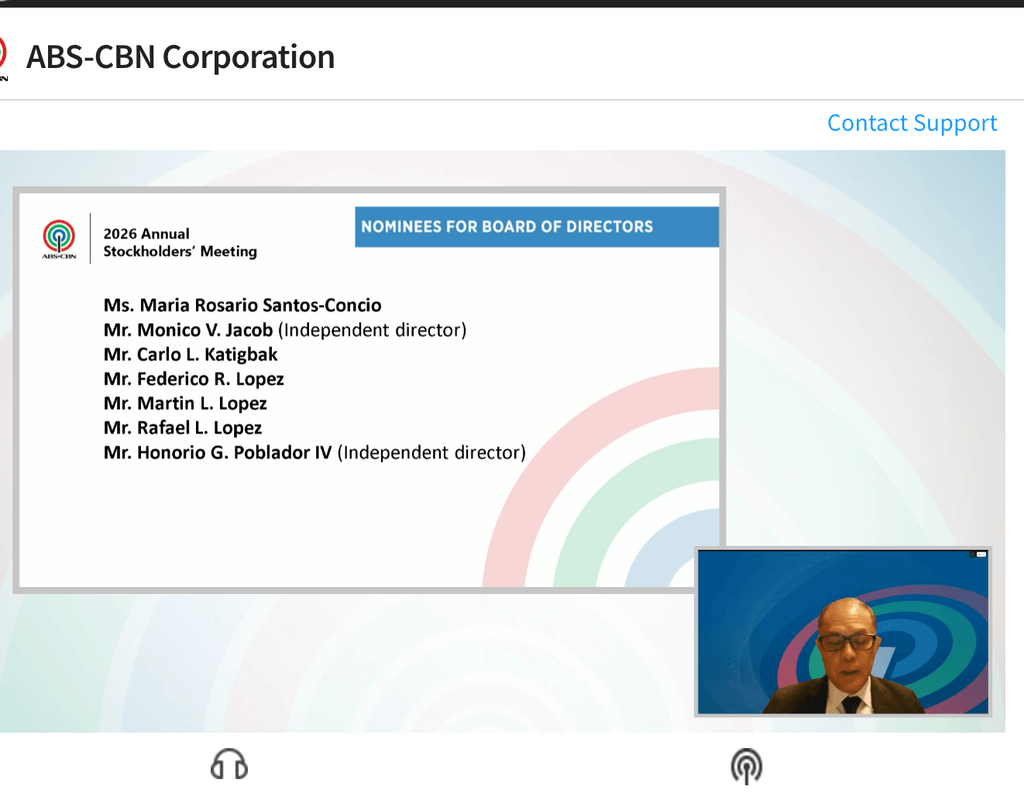
There is no I&C Holdings representative, which again is unsurprising once the dates are considered: the nominations and voting process preceded I&C’s August 12 subscription agreement. Stockholders therefore elected a new board Wednesday, but one designed before the ownership transformation now underway began taking shape.
If I&C’s P3.5 billion eventually translates into roughly 38% of ABS-CBN’s enlarged common share base, as the announced investment amounts would imply if all investors subscribe at the same price, another question follows: when, if at all, does that economic stake translate into a board seat? Does I&C eventually get representation, does the board expand, does someone leave, or has the investor agreed to put in P3.5 billion without immediate board representation?
But the board is only one part of the transition still unfinished. Before the new investors can come in, ABS-CBN has a more basic problem to solve: it does not presently have enough shares to give them.
First, make the pie bigger
ABS-CBN has agreed to issue 1,643,835,616 new common shares in exchange for the P6 billion, according to its August 14 disclosure to the Philippine Stock Exchange (PSE). But the company is presently authorized to issue only 1.3 billion common shares in total, nearly 900 million of which have already been issued. Put simply, ABS-CBN has promised its new investors considerably more shares than it currently has available.
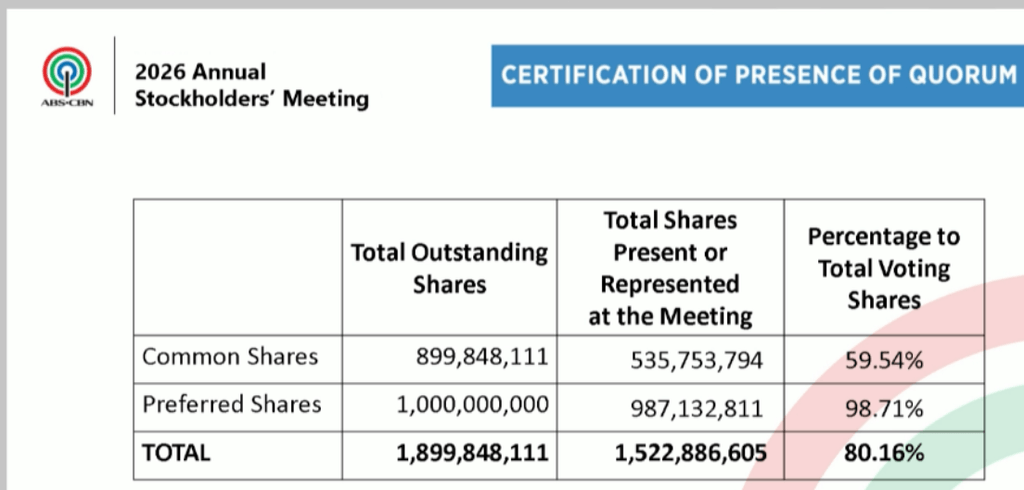
Before I&C and the Lopez investors can put in their money and ABS-CBN can hand them their shares, the company first has to enlarge the corporate pie, or the ceiling on the number of shares it is allowed to issue. Put simply, ABS-CBN has promised its new investors considerably more shares than it currently has available to give them. Before I&C and the Lopez investors can put their money in and ABS-CBN can hand them the shares, the company first has to enlarge the corporate pie — the ceiling on the number of shares it is allowed to issue.
The board approved the capital increase on August 13. But no specific resolution seeking stockholder approval of that increase was among the matters presented at Wednesday’s ASM. The Definitive Information Statement had already made that clear: “No action is to be taken with respect to the authorization or issuance of securities.”
It is therefore likely that ABS-CBN will call a special stockholders’ meeting for that two-thirds vote.
Smaller, leaner, but profitable?
Katigbak’s case for the “new ABS-CBN” rested partly on numbers describing a considerably smaller company than the broadcaster that lost its franchise in 2020. Revenue excluding Sky Cable fell from P33.2 billion in 2019 to P9.3 billion in 2021, then climbed back to P12.6 billion in 2025, its highest since the franchise loss. General expenses and manpower costs dropped from P15 billion to P6.9 billion over the same stretch, a 54% cut. Debt fell 58%, from P20.5 billion to just under ₱8.5 billion, aided by asset sales. Yet ABS-CBN still has the audiences that made it powerful in the first place. Katigbak pointed to BINI’s global streams, Batang Quiapo and It’s Showtime, Star Cinema films, ABS-CBN productions on streaming platforms, more than 55 million YouTube subscribers, TV Patrol and ANC, and Filipino content reaching markets overseas.

The Q&A supplied small but concrete examples of how the model works. Gandang Gabi Vice returns in September on GMA, iWant, and Kapamilya Channel. A new Pinoy Big Brother season launches in October, also with GMA, moving into a house the company says will be more cost-efficient. Asked about deeper joint ventures with GMA and MediaQuest, chief partnerships officer Roberto Barreiro said ABS-CBN remained open to working with other media companies “under terms that are beneficial to the company.” The strategy is becoming visible: ABS-CBN provides the content, talent, and intellectual property, distributes them across its own and other companies’ platforms, and tries to do it with a dramatically smaller fixed-cost base. (READ: Streaming services ‘winning hearts and minds’ of Filipinos, says new study)

Whether that model is profitable enough is the harder question. The financial evidence Katigbak presented for ABS-CBN’s recovery stopped largely at 2025. But the first half of 2026 complicates the picture. Consolidated revenues fell 17% to P6.88 billion. Net loss more than doubled from P852 million to P1.83 billion. EBITDA swung from a positive P568 million to negative P498 million. Content production and distribution, the segment sitting at the heart of the post-franchise strategy, posted a loss of about P1.24 billion and negative EBITDA of its own.
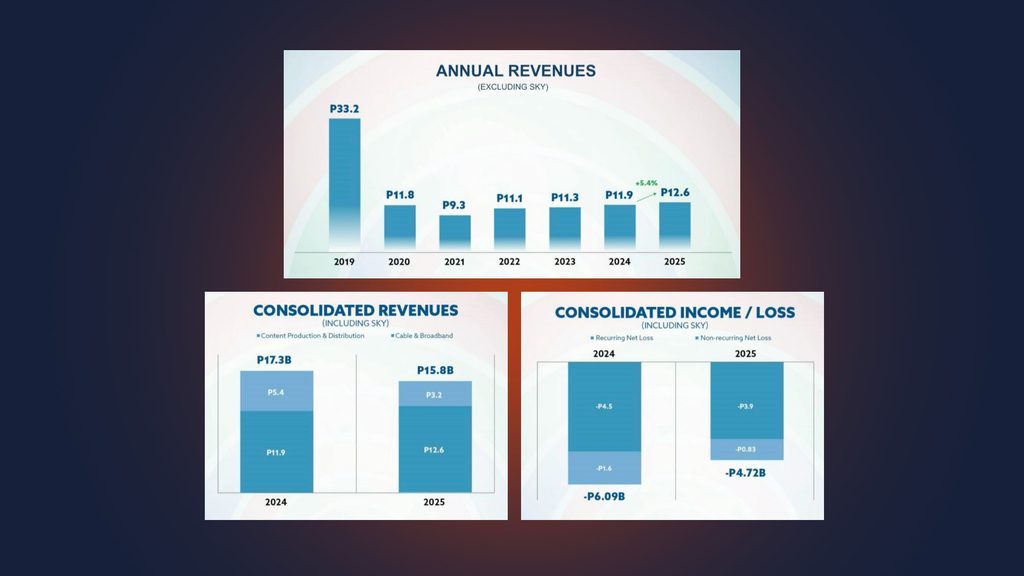
The 2025 numbers show a company that got smaller, cheaper, and less indebted. But the first 6 months of 2026 raise the harder question of whether that smaller company has actually found a way to consistently generate cash, or is still looking for one.

Which makes I&C’s P3.5-billion commitment perhaps the most interesting vote of confidence surrounding Wednesday’s meeting, even though I&C itself was not part of it. What does a turnaround investor see in this version of ABS-CBN that makes it worth betting P3.5 billion now?

Paying for the difficult chapter
Katigbak himself acknowledged the other side of the rebuild. “We owe it to our shareholders to deliver a fair return on your capital,” he told stockholders. “We owe it to our banks, our employees and our partners to make good on all our obligations.” Those obligations remain considerable, and they are why the P6 billion is not simply growth capital waiting to finance ABS-CBN’s next hit show.
The ABS-CBN parent still carries roughly P8.4 billion in bank loans, with another P3.4 billion at Sky Cable. BPI’s extension on a P5-billion facility expires August 31, just 12 days after the ASM, while UnionBank’s extension on P4.75 billion expires September 30. Longer-term refinancing remained under negotiation as of the company’s most recent disclosures. Former employees are still owed retirement and separation obligations accumulated through years of retrenchment.
Then there are the other bills that get much less attention. As of June 30, the group had roughly P12 billion in trade and other payables, including about P6.5 billion in production costs and other accrued expenses, P1.77 billion in trade payables, P1.44 billion in taxes, P639 million in salaries and employee benefits, P500 million in advances from stockholders, and P908 million in other obligations. They have different maturities and payment arrangements. But together they show how many claims are already competing for ABS-CBN’s cash, including whatever portion of the fresh P6 billion eventually becomes available to repair the balance sheet. ABS-CBN has said the proceeds will go to working capital, strengthening its balance sheet and other general corporate purposes. It has not disclosed a detailed waterfall.
That leaves the same questions hanging after the ASM that were hanging before it: how much of the P6 billion goes to the banks, how much to former employees, suppliers and other obligations, how much stays inside ABS-CBN as working capital, and, after paying for the difficult chapter Katigbak described, how much will actually be left to build the next one?

Every box but one
The meeting ended as neatly as it began. The minutes were approved, the accounts approved, board and management acts ratified, 7 directors elected and the auditor appointed. ABS-CBN chair Martin Lopez then asked if there was any other business, and there wasn’t.
Every box on Wednesday’s agenda had been ticked, but outside that agenda, the harder work was only beginning. The P6 billion has yet to come in. ABS-CBN still needs enough authorized shares to issue the 1.64 billion it has promised investors. The banks’ latest deadlines are approaching. The fresh money already has many potential claims on it. And I&C, the investor putting up the biggest check, is not represented on the newly elected board.
Katigbak called what management is building the “new ABS-CBN.”
Wednesday’s stockholders’ meeting belonged mostly to the one that came before it. The next stockholder vote may be where the new ABS-CBN finally shows up. – Rappler.com
Lala Rimando wrote about Philippine business, and managed newsrooms, including Newsbreak, ABS-CBN, Rappler, and Forbes, for over 25 years. She’s now based in La Union, taking care of her mom with dementia, and working on the multimedia biography of the late John Gokongwei.
Below are some of the author’s articles on the Lopez family saga:
- Part 1 | Debt, discipline, and daring: Inside the Lopez Group’s high-risk bets
- Part 2 | The Lopezes, presidents, and the cost of dissent
- Part 3 | Lopez vs Lopez: The secrecy fight behind the Razon power deals
- Who writes the Lopez story? How lawyers, headlines, and ABS-CBN shape a family war
- EXCLUSIVE: Inside Piki Lopez’s town hall as cousins rally for ABS-CBN
- How to make yourself very expensive to fire: The Lopez cousins’ war
- First Gen sat on a P23.5-billion Lopez clause for 60 days, then the family went to war
- When the ASM has no election: What the Lopez family dispute means for every investor
- From ‘king’ to ‘steward’: How Piki Lopez answered the Lopez family rift question
- The business case of the Lopez-Razon gas and hydro deals
- An Indonesian billionaire wants EDC: The $5-B offer raising the stakes in the Lopez feud
- The company the Lopezes gave up Meralco for: EDC, from oil crisis child to takeover target
- Making sense of US firm KKR’s offer on Lopez family’s First Gen
KioskNews shows a cleaned-up reading view extracted from the publisher’s page — the original always lives on their site, not ours.