TSMC banks record aid as fabs expand
Taiwan Semiconductor Manufacturing Co (TSMC, 台積電) received a combined NT$167.586 billion (US$5.1 billion) in subsidies from the governments of the US, Japan, Germany and China in the first nine months of this year to support its operations in the four markets.
According to a financial report released on Friday, the world’s largest contract chipmaker received NT$166.996 billion in subsidies from the four governments in the third quarter, after receiving only NT$590 million in the first half of the year.
The combined subsidies for the January-to-September period hit a record high, helping cover TSMC’s expenses related to property purchases, plant construction and production equipment as part of the chipmaker’s global expansion plan.
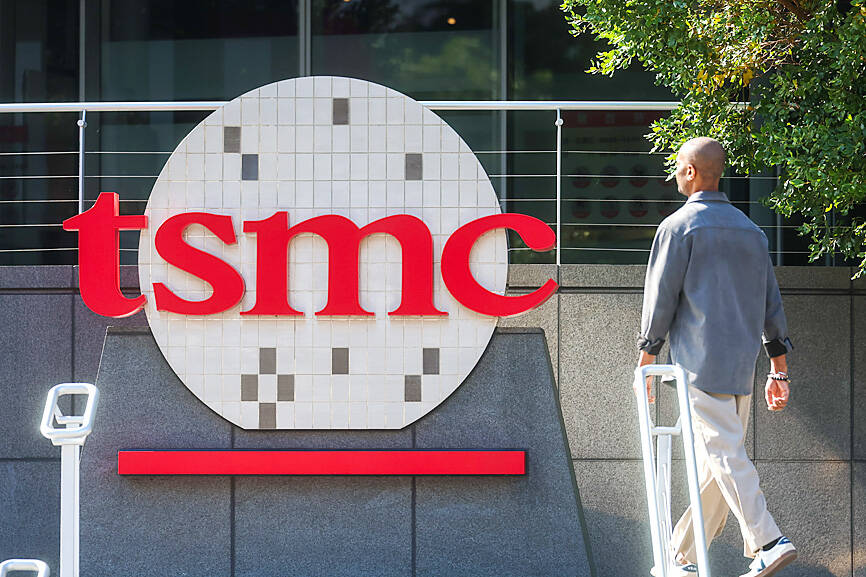
A worker walks past the logo of Taiwan Semiconductor Manufacturing Co at its facilities in Hsinchu on Jan. 29.
Photo: Daniel Ceng, AP
To receive the financial assistance, TSMC subsidiaries — TSMC Arizona Corp in the US, European Semiconductor Manufacturing Co (ESMC) in Dresden, Germany, Japan Advanced Semiconductor Manufacturing Inc (JASM) in Kumamoto, Japan, and TSMC Nanjing Co in China — have signed agreements with local governments in the areas where they operate.
In Nanjing, TSMC operates a 12-inch wafer fab.
In Arizona, TSMC’s first fab began commercial production in the fourth quarter of 2024 using the advanced 4 nanometer process. Construction of a second fab in Arizona has been completed, with equipment installation underway. The facility is scheduled to begin mass production in the third quarter of next year using the more sophisticated 3nm process.
In Kumamoto, TSMC’s first fab began commercial production at the end of 2024, while construction of a second fab is underway, with mass production scheduled to begin in 2028.
TSMC’s Dresden fab is scheduled to begin mass production next year.
The nine-month financial statements show that TSMC Arizona posted a profit of NT$53.986 billion, while JASM generated a profit of NT$2.396 billion. ESMC, meanwhile, remained in the red, reporting a loss of NT$1.079 billion.
KioskNews shows a cleaned-up reading view extracted from the publisher’s page — the original always lives on their site, not ours.