Ministerial pay update ensures financial sacrifice doesn’t deter political talent: Observers
SINGAPORE – Benchmarking ministerial salaries to the median income of the top 1,000 Singapore citizens continues to reflect the desired talent pool that the city-state seeks to draw from for political leadership, said analysts.
At the same time, applying a significant 40 per cent discount stresses the ethos required of public service, they added, while noting that the formula will always be a judgment call, with each review providing a reference point for future adjustments.
Observers’ comments followed changes to ministerial salaries that Prime Minister Lawrence Wong announced in Parliament on Sept 8.
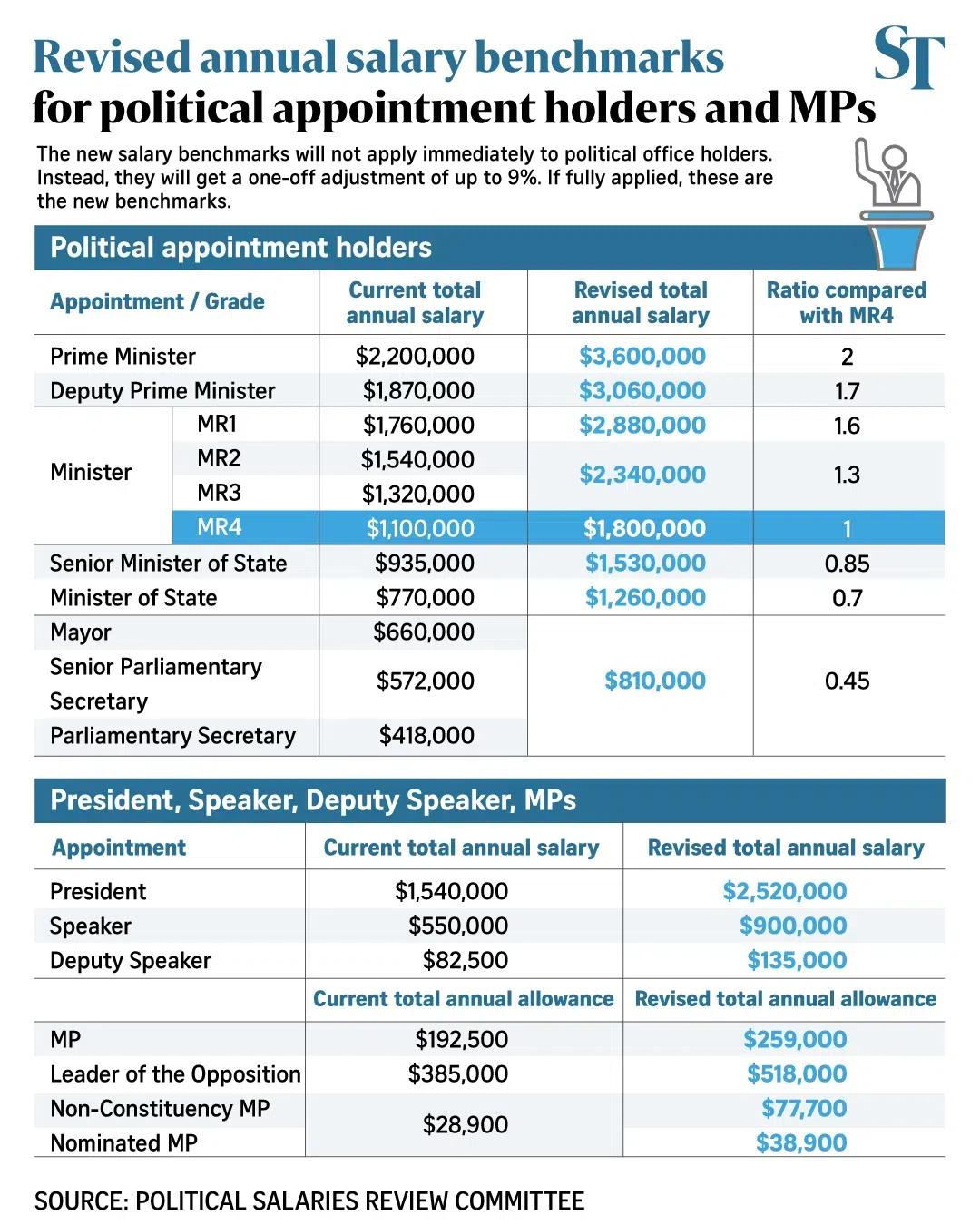
The annual benchmark pay for ministers at the entry-level grade, which has been unchanged since 2011, will rise from $1.1 million to $1.8 million, though PM Wong said the Government will not move to the proposed salary levels in one step.
Instead, ministers will get a one-time adjustment of up to 9 per cent when the new salaries take effect on Oct 15, which will bring their annual salary from $1.1 million to $1.2 million, with further pay adjustments to be based on performance.
Analysts noted that the updated salary framework is not meant to match top private-sector compensation, but will help to manage financial opportunity costs so that capable candidates are not deterred from entering political service.
Aaron Maniam, deputy director of the Institute of Policy Studies, noted that the pool of 1,000 includes jobs with similar scope, complexity, budgets and decision-making demands to a minister’s role.
He added that the size of the pool had been enlarged over the years, reflecting the reality that Singapore needs to draw its leaders from a wide range of roles and functions.
The reference pool started out with 24 top earners from six professions in 1994, was increased to 48 top earners from six professions in 2007, before going up to 1,000 top earners from across the economy following the 2012 salary review that was backdated to 2011.
Ng Siew Quan, former PwC partner who is on the board of several charities, said benchmarking to this pool of talent was reasonable.
“(The ministers) will be taking care of six million people… Therefore, you want to look for top talents, and not just good enough,” he said.
However, Singapore Management University associate law professor Eugene Tan suggested the pool be further enlarged.
“Top 1,000 earners strike me as being highly selective and perhaps elitist,” he said, adding that a legitimate question is whether there is any empirical basis for this number.
He suggested expanding the pool further, noting that the Prime Minister had said he wants to recruit capable Singaporeans not only from the private sector or public service, but also from other walks of life.
“Those from the other walks of life are unlikely to fall into the region of the top 1,000 earners,” said Tan.
Institute for Human Resource Professionals chief executive officer Aslam Sardar said that while there is value in a consistent benchmark, it should not be treated as something that will never change.
“As Singapore’s income distribution and senior talent pool evolve, future reviews should continue to assess whether the reference group remains relevant,” he said.
In its report, the latest salary review committee said it affirmed the benchmark after reviewing the data, which showed that the pool comprises Singaporeans from a diverse range of industries and professions.
The committee considered expanding the pool, but concluded that the top 1,000 earners better reflect the calibre of Singaporeans who are up to the job.
The size of the pool, though, should be seen in combination with the 40 per cent discount applied to reflect the ethos of public service, said observers.
Noting that this is a key component of the benchmark, Aslam and Ng said it prevents political salaries from matching top private-sector pay and maintains the distinction between political and commercial leadership roles.
“People who enter public service are making a choice based on purpose and contribution, not simply financial reward,” said Aslam.
While not all will agree on the size of the pool or the quantum of the discount, it provides a baseline on which society can debate, said Norshahril Saat, principal fellow at the ISEAS – Yusof Ishak Institute.
“Every mechanism has its justification, which is debatable, but a decision has to be made to operationalise the values the salary structure seeks to address.”
Analysts said the adjustment will ensure that pay does not become a hindrance to political recruitment, even if some sacrifice remains.
The current framework, which was set in 2012 but backdated to 2011, has not been changed since. Changes recommended by a review committee in 2017 were not adopted, while a review slated for 2023 was deferred to 2026 because of geopolitical and economic uncertainties.
Aslam noted that Singapore’s economy, wages, productivity and labour market have changed in the last 15 years, while political salaries have remained unchanged.
“Remuneration frameworks need to keep pace with the market and with the responsibilities of the roles they support,” he said. “When a framework remains unchanged for too long, there is a risk that the benchmark becomes less relevant over time.”
Tan said: “The new benchmark will still lag behind what the private sector commands, but the benchmark was never and should never be competitive.”
Even so, more should be done to ascertain the true opportunity cost of joining politics before settling on a benchmark salary, said David Leong, chairman and chief executive of PeopleWorldwide Consulting.
Not every candidate will be giving up as much, he added.
“Public office should certainly not require an unreasonable financial sacrifice. But neither should we automatically assume that every person entering politics has walked away from a multimillion-dollar private-sector career,” he said.
Ultimately, said the analysts, the salary adjustments are not meant to act alone in attracting suitable candidates.
Maniam said: “Politics is one of the most exacting careers around – it is not only cognitively and emotionally demanding, but also places significant pressures and creates scrutiny on individuals and their families.”
They emphasised the importance of inculcating in Singaporeans a strong sense of community spirit and willingness to serve, whether in political office or other public and social causes.
“It is imperative for society to be instilled and inculcated with the ethos of public service. Even if pay is not an issue, the lack of such an ethos will mean the pipeline of political leaders will not be healthy,” said Tan.
KioskNews shows a cleaned-up reading view extracted from the publisher’s page — the original always lives on their site, not ours.