Run or hide? Benguet school tests active-attack response without fake gunfire
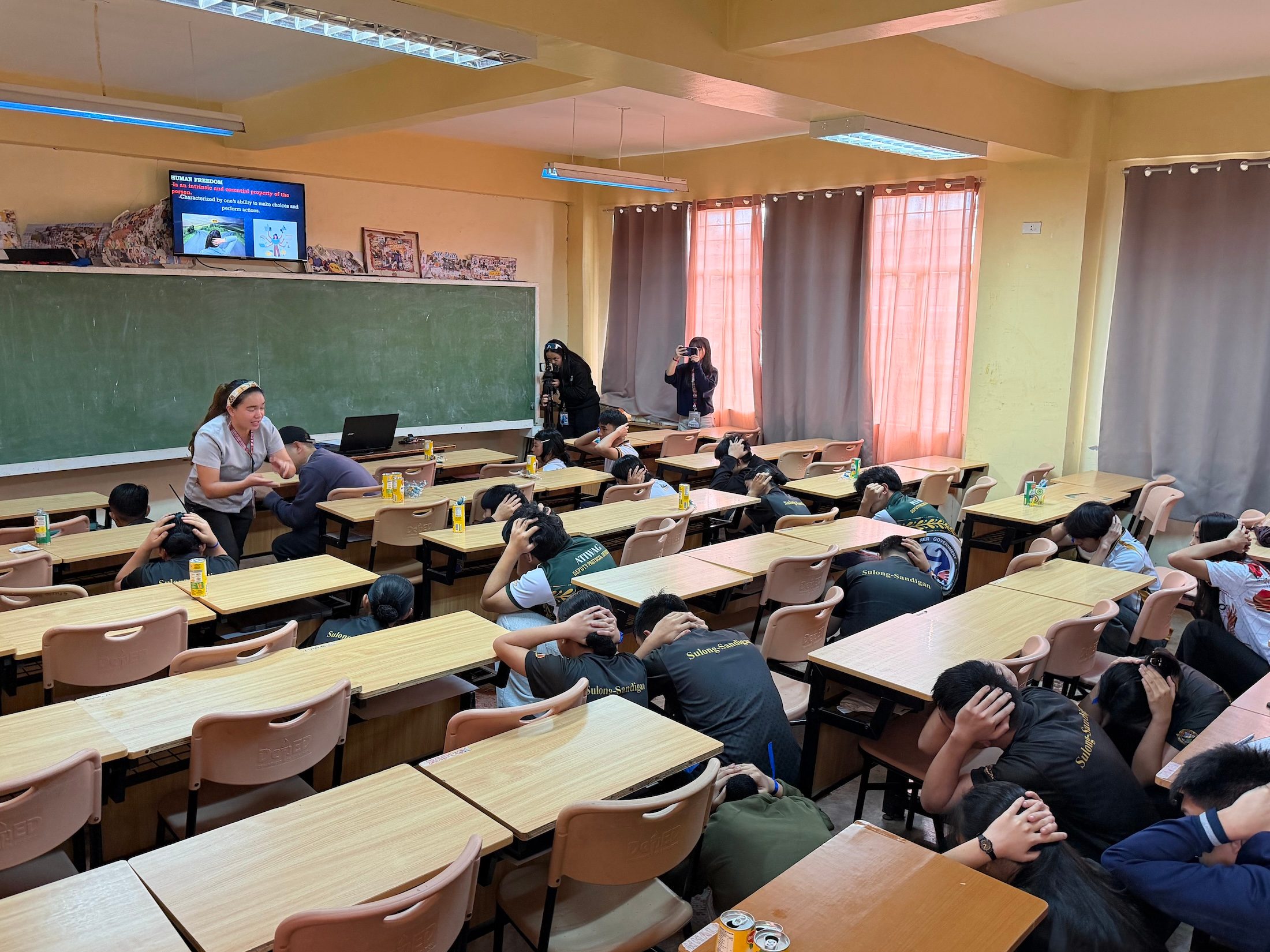
The drill was designed to test decisions, communication, police coordination, and recovery without using imitation weapons, simulated gunfire, or other hyper-realistic elements that could unnecessarily frighten learners
AT A GLANCE
- A nationwide school safety drill was conducted at Benguet National High School to prepare for active-attack incidents without using imitation weapons or simulated gunfire.
- The drill involved various scenarios, including a suspected armed threat outside and a threat inside the school, with different responses based on the location of the threat.
- Police officials emphasized the importance of ongoing preparedness beyond drills, including improving security measures and coordination among schools and emergency responders.
This is AI-generated. Read the article for full context. Report any errors.
LA TRINIDAD, Benguet — No fake gunshots rang through the campus and no one played an armed attacker. Yet classrooms locked down, some learners moved to safety, others hid, and police teams swept through Benguet National High School on Wednesday, September 9.
The exercise was part of a nationwide school safety drill for active-attack incidents, with Benguet National High School serving as the Cordillera ceremonial venue. It was designed to test decisions, communication, police coordination, and recovery without using imitation weapons, simulated gunfire, or other hyper-realistic elements that could unnecessarily frighten learners.
Forty senior high school learners took part in the exercise. Schools Division Superintendent Carmel Meris said parents were informed beforehand and signed waivers allowing their children to participate. Learners were also oriented before the drill, while participating agencies conducted a series of preparations ahead of the exercise.
“Today, we are gathering not because we expect an emergency to happen, but because we believe in being prepared before it happens,” assistant school head Eugene Espiritu told participants.
The drill was originally scheduled for September 3, to coincide with the nationwide active shooting drill of the Department of Education (DepEd), but was moved because of weather-related class suspensions.
Different threat, different response
The first scenario involved a suspected armed threat outside the school perimeter.
Security personnel were expected to recognize the threat, secure gates and access points, alert school authorities and law enforcement, and place the campus under a lockout.
Under the drill plan, learners and personnel were to remain inside secured buildings while outdoor activities and unnecessary movement were stopped. Teachers were tasked to keep learners calm and together, monitor official communications, and wait for verified instructions.
Police responders then simulated containing the threat before an all-clear was issued.
A separate scenario began with the threat already inside the school. This time, the exercise demonstrated that there was no single response for everyone.
One classroom, located away from the reported direction of the threat, practiced a controlled run response using a pre-identified safe route. Another classroom, positioned closer to the danger, practiced hiding and remaining inside a secured room.
The drill plan stressed that running and hiding were not sequential steps. Different groups could take different protective actions at the same time depending on the location of the threat, available information, and whether a safe escape route existed.
Once a full lockdown was declared, teachers were expected to account for learners while police took over the law-enforcement response.
Personnel from the La Trinidad Municipal Police Station acted as first responders, with additional support from the Benguet 2nd Provincial Mobile Force Company. Tactical operations remained under police authority, with the school instructed not to direct or interfere with the police response.
The drill did not end at “all clear.”
The exercise also tested what should happen after the immediate threat had been contained.
Police had to confirm that the designated area was secure before the school could begin a controlled transition out of lockdown.
Teachers then rechecked attendance and reported whether all learners were accounted for. Movement from classrooms was controlled, with learners brought to a reunification area rather than simply dismissed.
The drill plan also required verification before a learner could be released to a parent, guardian, or authorized representative.
Psychosocial first aid was built into the recovery phase for learners who might experience fear, anxiety, confusion, or emotional distress during the exercise. Participation in such support was voluntary, and learners were not required to recount or relive the simulated incident to receive assistance.
The school safety evaluation tool likewise required organizers to check whether the exercise was age-appropriate and trauma-informed and whether it avoided prohibited fear-inducing elements such as aggressor role-playing, imitation weapons, simulated casualties, and simulated gunfire.
Police spot gaps beyond the exercise
Police officials said preparedness should go beyond completing a drill and include identifying ordinary security weaknesses that could matter in a real emergency.
La Trinidad police chief Lieutenant Colonel Zacarias Dausen said schools should continue strengthening control of entry and exit points, improve inspection procedures, and review CCTV coverage for possible blind spots.
He also stressed the importance of coordination among schools, police, disaster response teams, and medical personnel.
That accountability aspect was built into the evaluation tool, which covered not only learner behavior but also the school’s contingency plan, safe areas, evacuation routes, emergency communications, coordination with police, accountability procedures, medical services, and post-incident recovery.
Meris said district and school officials who observed the exercise were expected to bring the lessons back to their own areas and replicate the preparedness measures.
The point of the exercise, officials said, was not to make schools feel like places under siege.
It was to make sure that in the unlikely event of a serious armed threat, learners, teachers, and responders would not be encountering the procedures for the first time. – Rappler.com
KioskNews shows a cleaned-up reading view extracted from the publisher’s page — the original always lives on their site, not ours.