Caribbean hot spot loses men to war machine
AFP, BAJOS DE HAINA, Dominican Republic


Halfway around the world from Russia, in a Caribbean tourism hot spot, men young and old are being lured by Moscow with tantalizing job offers, only to find themselves en route to the front lines in Ukraine.
Moscow and Kyiv have recruited thousands of foreign nationals into their armies since Russia launched its invasion of Ukraine in 2022.
Moscow is accused, in some cases, of using fake job ads to hoodwink men from deprived backgrounds in Africa, Asia and Latin America into traveling to Russia and then forcing them to fight on arrival.
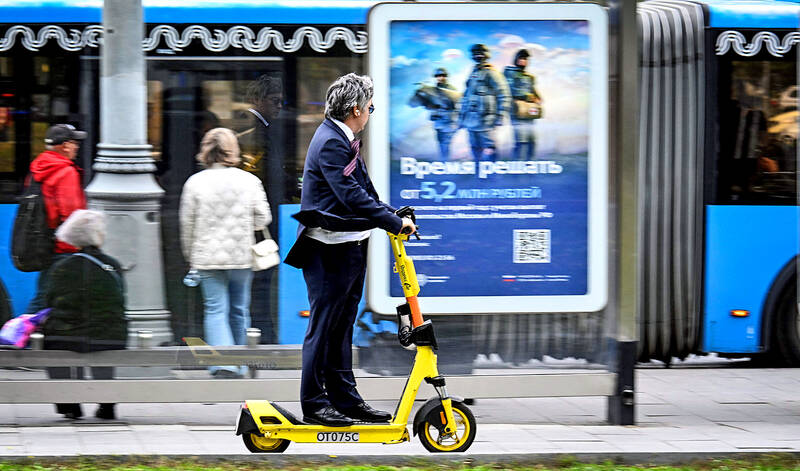
A man on a scooter rolls past a billboard promoting contract army service in Moscow on Sept. 21.
Photo: AFP
From countries such as India, Kenya, Equatorial Guinea, Colombia and Brazil, the long arm of Russian recruitment has reached the Dominican Republic.
Jesus Campusano, a 52-year-old from the impoverished port city of Bajos de Haina, was offered thousands of dollars to work as a welder in the city of Kazan.
When he arrived in the country at the end of July he was transferred to a Russian military base, from where he fears being deployed to the war against Ukraine.
The government has identified 20 Dominicans who were tricked into enlisting in the Russian armed forces, Dominican President Luis Abinader said last month in New York, adding that the matter was under investigation.
Campusano applied for a job through an online link.
When he arrived at Kazan airport, about 1,000km from the Ukraine border, he was given a document in Russian to sign, his 54-year-old sister Cristina Campusano said.
The authorities then took his passport, gave him a uniform, and told him he was going to be trained up as a police officer.
However, last week, his sister said they told him “they were going to take him to the war to fight.”
“I need the authorities to help me, because we are desperate and I want our brother back,” she said.
Amnesty International last month said Russia was preying on civilians “from low-income countries in the global south” with false promises of jobs in security, logistics, construction, information technology and other sectors.
However, some of those enlisted volunteered to fight.
A Dominican man, Juan Carlos Savila, has posted videos on Instagram showing himself in action on the front line.
In one, he can be seen hiding in the undergrowth while gunfire and explosions ring out nearby.
In another, he related how he was injured after stepping on a landmine.
“We cannot forbid people from engaging in activities. What we want to do is warn them so they understand the reality of what they are signing up for”, Abinader said.
Carlos Sanchez Diaz, a Dominican human rights coordinator, said that most of the Dominicans wearing Russian uniforms were recruited under false pretenses.
He said up to 100 were the victims of entrapment.
“It’s clearly a scam. These are people from vulnerable sectors, living below the poverty line,” Sanchez Diaz said.
He related one device used by the recruiters: “an invitation to a cultural exchange in Kazan.”
“But when they arrive, there’s no cultural exchange. They’re put on a plane and from there taken to a military base,” he said.
Maico Enrique Campusano, also from Bajos de Haina, but no relation of Jesus Campusano, was offered work as an advertising professional.
He traveled to Panama, where a recruiter was waiting for him, and then flew on to Kazan via Istanbul.
He too ended up in a military base, being put through his paces “from four in the morning until six in the evening,” his mother, Jaqueline del Carmen Feliz, said.
Feliz said she could not sleep at night with worry.
“He’s not Russian, nor is he Ukrainian, so he shouldn’t be out there. I want him back,” she said.
When she asks him about the situation in Russia, he replies: “Don’t worry, I’m fine,” she said.
KioskNews shows a cleaned-up reading view extracted from the publisher’s page — the original always lives on their site, not ours.