After Orban, Hungarian football's state-funded boom faces reckoning
FELCSUT, Hungary/BUDAPEST, Nov 18 : The gleaming Pancho Arena in the Hungarian village of Felcsut stands as a symbol of former Prime Minister Viktor Orban's ambitions to return football to the golden era of the all-conquering "Magical Magyars" in the 1950s.
Located in his boyhood village and metres from his country home, Pancho Arena opened in 2014 during a more than decade-long bonanza for Hungarian soccer clubs that received hundreds of millions of euros in subsidies and grants.
Yet the glory days did not return and since the football-loving Orban's election defeat in April, teams now face a funding crunch. At a recent match in Felcsut, barely 1,000 fans showed up, some grumbling about the future of the game they love.
"Under Orban, football depended on public money and state companies," said former parliament member Zoltan Kesz, who has also written about football funding in Hungary.
"The real question is which clubs can survive without this ecosystem."
An Orban-era tax scheme known as TAO had funnelled about 677 billion forints ($2.07 billion) into football clubs, while another 60 billion forints came from grants and state sponsorship, the Interior Ministry told Reuters.
The scheme allowed companies to donate part of their corporate tax to sports clubs rather than the state treasury.
But with Orban gone and new Prime Minister Peter Magyar promising greater transparency, TAO is to be abolished with 150 billion forints ($458 million) set aside instead in the budget in direct funding for spectator sports.
Puskas Akademia, located in Orban's hometown village and rebranded in 2007 on the birthday of Hungary's greatest player Ferenc Puskas, received some €123 million of the funding, according to a tally by Magyar's government.
The club disputes accusations of opaque use of funds, saying in a statement in late October that the investment had created Hungary's most prolific talent pipeline.
Last month, Magyar condemned the "tangled, opaque and corrupt" TAO scheme and said clubs that had "overspent recklessly and without justification" must adapt.
Several clubs are already up for sale due to the funding uncertainty and high cost of maintaining big new stadiums not filling to capacity, sources in the football industry, ownership groups and mergers and acquisitions told Reuters.
Others are halting projects and seeking to cut player salaries.
"The (state funding) model is still just about functioning in this season, but in the longer term it will certainly be gone," said Hungarian sports economist Gabor Szabados.
"Teams unable to generate genuine market-based revenue will be in very serious trouble."
NO WORLD CUPS
In one example, three-times former domestic champions Videoton FC Fehervar are scrambling to plug a potential budget hole of between 500 million and 750 million forints by mid-2027, according to the city mayor.
Orban ally Istvan Garancsi gave the team away to the local council for 1 forint after top-flight relegation in 2025 and two potential buyers have now pulled out.
"Alongside political uncertainty, the increasingly serious problems affecting the economy, as well as uncertainty surrounding state and football association support schemes, have significantly complicated the sale process," Szekesfehervar city mayor Andras Cser-Palkovics told Reuters of the club that was once a European cup finalist.
In power from 1998 to 2002 and then 2010 to 2026, Orban's governments built influence through sport, favouring teams owned by friends and allies, sports economists and former politicians and officials say.
According to Magyar, state-owned companies gave out sponsorship money based on "political instructions."
Orban himself had once been a competent striker for his hometown club. As national leader, his government's funding helped build or modernize dozens of stadiums including the majestic 67,215-capacity, €500 million Puskas Arena in Budapest that hosted the 2026 Champions League final.
Orban has rejected criticism of the TAO scheme, describing the funds as "donations by profitable companies," which created room for large-scale investment in Hungarian sports.
"These made possible the intensive renewal of Hungary's sports infrastructure and unprecedented levels of support for youth and amateur sport. (Not only in football)," Orban wrote on Puskas Akademia's website earlier this month.
Yet Hungary failed to qualify for a World Cup in that period: a far cry from the Puskas-led four-year unbeaten streak that ended in a famous World Cup final in 1954 when the Magical Magyars led West Germany 2-0 before succumbing 3-2.
And despite all the spending, Hungary rates a disappointing 18th in European football's "coefficient" ranking for performances by clubs around the continent.
The millions flooding into Hungarian clubs offered little bang for the buck, according to researchers from Hungary's ELTE-KRTK university.
Bigger stadiums in fact saddled clubs with higher maintenance costs while not attracting new fans, they said, citing Debrecen's €34 million stadium built in 2014 with a 20,340 capacity but normally drawing a quarter of that.
Capacity utilisation was an important indicator, researcher Gergely Csurilla told Reuters.
"Debrecen is the best example," he said. "You can see photographs from Debrecen matches in which the spectators are lost in the 20,000-seat stadium because there is no real crowd."
SPONSORSHIP REVIEW
Interviews with more than a dozen sponsors, owners, market experts and football agents painted a picture of clubs urgently seeking new income sources while the state reforms the system and sponsors review positions.
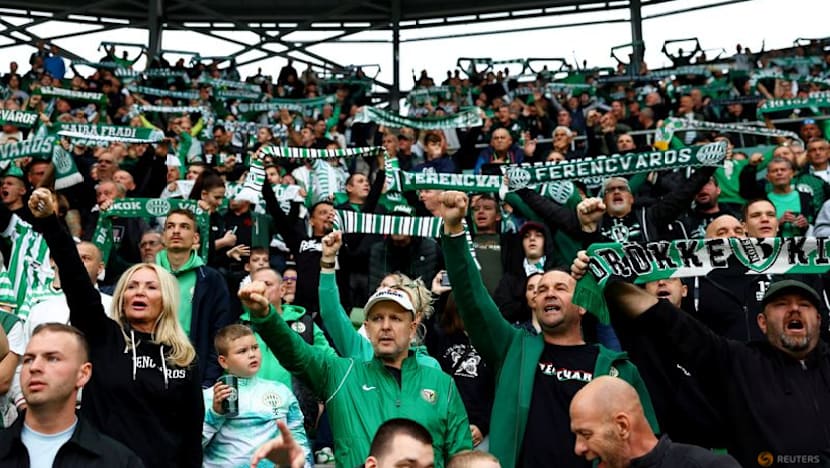
State energy group MVM told Reuters it was reviewing its long-standing sponsorship contract with top-flight club Ferencvaros worth about €12 million per year between 2024 and 2026.
Magyar has also promised to introduce strict conflict-of-interest rules in sport that would purge officials linked to former ruling party Fidesz from leadership positions in major soccer clubs, such as Ferencvaros and MTK.
"The various sports were taken over, and Fidesz politicians treated federations and clubs as their personal fiefdoms," he said, naming Ferencvaros chairman Gabor Kubatov and MTK chairman Tamas Deutsch, among other Fidesz-linked officials.
"We reached the point where anyone looking at the leadership of the national sports federations or the largest clubs would, almost as a matter of course, find Fidesz politicians serving as presidents or board members."
Fidesz's press office and MTK did not respond to emailed questions for comment.
Ferencvaros told Reuters by email that the government's proposed changes were unconstitutional and designed to push political opponents out of sport.
"The bill is therefore, beyond Ferencvaros, an open attack on the independence of all of Hungarian sport," it said.
The Interior Ministry told Reuters that the government's aim was to replace multiple sports funding methods — "which in many cases have involved concealed forms of funding" — with a streamlined single channel from central government.
The ministry has accused Ferencvaros of misusing 25 billion forints ($76 million) of public funds earmarked for the construction of sports facilities in Budapest, but eventually spent on operating expenses and player acquisitions.
Ferencvaros has disputed those findings and requested a follow-up verification of how the funds were spent. Its press office did not respond to Reuters requests for comment.
The club's chief executive officer Pal Orosz told the team's YouTube channel in late September the club had lowered wage costs of first-team players by about 30 per cent this season in response to changing business conditions.
"This is a company that always has to adapt to the given economic conditions," Orosz said. "There are times when economic conditions are favourable, and there are times when they are not so favourable."
KioskNews shows a cleaned-up reading view extracted from the publisher’s page — the original always lives on their site, not ours.