Research center develops new black soybean cultivar
By Esme Yeh / Staff reporter


The Hualien District Agricultural Research and Extension Station has developed the “Lanyang No. 1” black soybean, which is expected to boost black soybean production due to its lodging resistance and consistent ripening stage.
The Lanyang No. 1 cultivar was selectively bred and developed from heirloom black soybean seeds from Yilan County — a small yellow-kernel black soybean variety that has been passed down locally for more than 50 years, the station said.
Yilan’s heirloom black soybean is a traditional ingredient in locally brewed soy sauce or fermented tofu, it said.
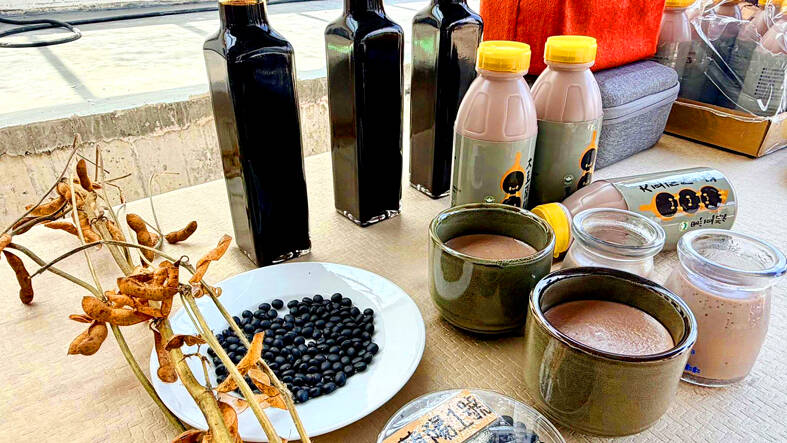
Products made with “Lanyang No. 1” black soybeans are pictured in an undated photograph.
Photo courtesy of the Hualien District Agricultural Research and Extension Station
However, genotypes of such heirloom varieties are complex, leading to varying ripening stages and a higher plant lodging rate in field cultivation, the station said.
That constituted a major challenge for local black soybean growers in shifting to mechanized farming and field management, it said, adding that Lanyang No. 1 overcame the challenge.
Lanyang No. 1 exhibits a semi-indeterminate growth pattern with many branches and pods and long internodes, the station said.
It is also characterized by its white flowers, making it distinctive from most other black soybean cultivars in Taiwan, the station said, adding that the cultivar’s 100-grain weight ranges from 12g to 15g.
Under organic spring cropping, the average production of Lanyang No. 1 in eastern Taiwan reached 1.5 tonnes per hectare, it said.
Gee Young Farm director Wu Ching-chung (吳慶鐘), who participated in the collaborative research done by the station, said he is confident that Lanyang No. 1 would facilitate mass production of black soybeans.
Lanyang No. 1 had more consistent growth patterns, making it easier to manage the crop in fields with greater production, he said.
The station said it would continue to promote the cultivation techniques of Lanyang No. 1 and assist local growers in resolving potential difficulties.
KioskNews shows a cleaned-up reading view extracted from the publisher’s page — the original always lives on their site, not ours.