Would you let your AI digital twin take the stage?
Already have Rappler+?
to listen to groundbreaking journalism.
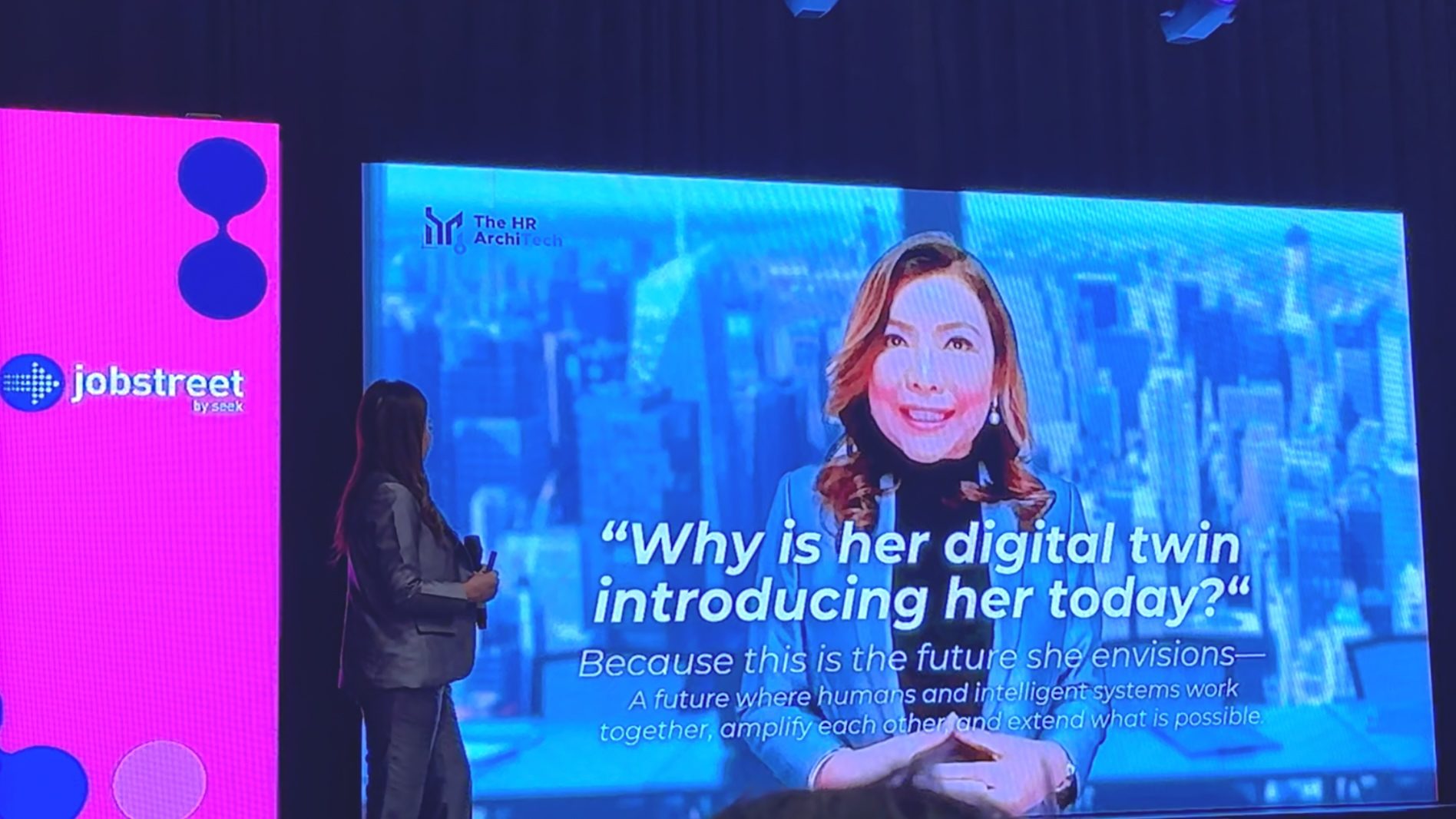
Lance Spencer Yu/Rappler
ASEAMETRICS CEO Liza Manalo-Mapagu lets an AI twin borrow her face and voice to extend her reach, but says one rule is non-negotiable: 'You have to be transparent.'
More than 200 business leaders and HR practitioners had gathered for Jobstreet Connect to discuss how artificial intelligence is creeping into hiring, workplace systems, and management. Then, before the keynote speaker herself even appeared, the audience got a rather curious preview of what could be the future: an AI version of her took the stage first.
Onscreen was ASEAMETRICS CEO Liza Manalo-Mapagu, or at least her likeness — a digital twin carrying her face, voice, and professional biography.
“Why is her digital twin introducing her? This is the future she envisions. A future where humans and intelligence systems work together, amplify each other, and extend what is possible,” said the avatar in a flat — but eerily human — tone. “I am not here to replace her voice. I am here to scale it.”
A minute later, the real Manalo-Mapagu walked onstage.
“Palakpakan naman natin ‘yung digital twin (Let’s give a round of applause for the digital twin),” she said, before saying with a smile, “It’s always better human.”

Manalo-Mapagu told Rappler afterward that there are only so many hours in a human day, while a digital version of herself can help extend her reach and spread her advocacy on artificial intelligence to more people.
“Human beings are limited in terms of time, in terms of efforts,” she said, describing the twin as another way to distribute her own knowledge and content.
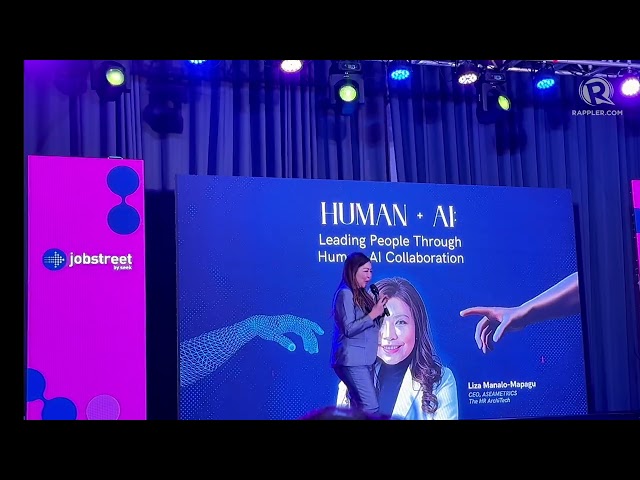
Which naturally leads to a very 2026 question: if technology can convincingly reproduce your face and voice, when should you actually let it?
For the HR expert, there are clear rules. The clearest one, in her view, is disclosure.
“You have to be transparent,” she told Rappler, saying her videos include a caveat identifying the avatar as a digital twin created through Synthesia and making clear that the content itself still comes from her.
That kind of disclosure is becoming basic etiquette in today’s Wild West of generative AI. If your digital double is going to borrow your face and voice, the audience should not have to wonder whether that’s the real you in front of a camera. More importantly, the flesh-and-blood person behind the avatar should still be accountable for whatever the synthetic version says.
That question — where the machine can stand in for a human, and where the human still has to show up — became a common theme too throughout the conference.

Jobstreet, after all, was not just discussing AI in the abstract. The highlight of the day was the unveiling of what the popular job board called seekAi, an employment-focused AI engine that can rank applicants, recommend recruiters’ next steps, automate reference checks, and even conduct pre-screening voice interviews before a human recruiter steps in.
And while some might feel that AI encroaching into a field literally called human resources feels a tad dystopian, AI optimists like Manalo-Mapagu would take a different view.
She told Rappler that AI interviewers can be more patient, do not get tired after a long day of back-to-back candidates, and can standardize the questions asked at the initial stage. But at the end of the day, she still wants the human to return before the consequential decisions are made.
Whatever view you might take, AI is already here. How do you manage it?
If you ask DITO Telecommunity chief human resources officer Holy Ampaguey, the answer is perhaps the most HR answer possible.
“I would actually onboard AI the way I would onboard a new colleague,” she said at the conference.
Give the AI a job description so everyone knows what it is supposed to do. Give it a code of conduct and a human supervisor. Put it through a probationary period or pilot test with clear standards for whether it stays, then finally, like any other worker, give it a performance review and ask whether it is actually making people’s jobs better. – Rappler.com
KioskNews shows a cleaned-up reading view extracted from the publisher’s page — the original always lives on their site, not ours.