Why Ottawa plans to allow MAID for people incapable of consenting moments before death
Just as one debate over euthanasia is being settled, another is emerging over Canada’s plans to allow people to consent to medical aid in dying (MAID) at some future date when they are no longer of sound mind.
Sign In or Create an Account
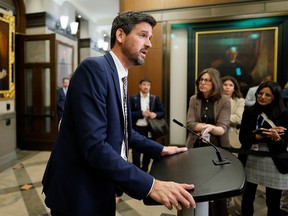
In a surprise move this week, federal Justice Minister Sean Fraser announced the Liberal government is fine-tuning a bill to be introduced sometime this fall that, in addition to placing an indeterminate hold on MAID for mental illness alone, would decriminalize “advance requests” for doctor-administered death.
Critics say the government is preparing to cross a new line, this one based on the fundamental principle of consent.

Get a dash of perspective along with the trending news of the day in a very readable format.
By signing up you consent to receive the above newsletter from Postmedia Network Inc.
A welcome email is on its way. If you don't see it, please check your junk folder.
The next issue of NP Posted will soon be in your inbox.
We encountered an issue signing you up. Please try again
Performing euthanasia on the basis of a person’s advance request “will mean that people will receive MAID when they no longer understand what is happening to them,” said Trudo Lemmens, a University of Toronto professor of health law and policy.
Another thorny ethical concern: who makes the final call that it’s time to act on an advance request once the person has lost the capacity to decide for themselves?
The Criminal Code generally requires that a person have the capacity to consent to receive MAID immediately before death is administered.
The Liberal government is proposing to change that.
Here’s a look at why that’s making some people nervous.
Advance requests would allow people who have been diagnosed with a serious and incurable disease that will eventually lead to incapacity to draft a document outlining the specific conditions under which they would prefer to die, which would then be provided after they have lost capacity.
In its report following a “national conversation” on the issue, the federal government offered the hypothetical example of a man named “Charlie” who, after being diagnosed with Alzheimer’s disease, “decides that should his health decline rapidly and he starts experiencing intolerable suffering after he has lost capacity to make health care decisions, he would like to have MAID provided.”
His advance request would set out conditions that, for Charlie, would constitute “endurable and intolerable suffering,” a formal criterion for MAID. That could include not being able to feed himself, get out of bed or recognize his children.
If these conditions were to arise, the advance request would state that it would be his explicit wish to be provided MAID.
The Criminal Code currently requires that a person have capacity to give explicit, final consent before death. The only exception involves people who are close to a natural death and have already been approved for MAID and have a date set, but are at risk of losing capacity before the scheduled date. In those cases, people can sign a waiver of final consent.
In March, Alberta became the only province to explicitly ban advance requests for MAID. Fraser said it will be up to provinces to decide whether to allow people to make advance requests.
On Oct. 30, 2024, Quebec joined the Netherlands in accepting advance requests for people diagnosed with dementia and other serious conditions that will lead to incapacity.
However, as the Montreal Gazette’s Aaron Derfel has reported, with no amendment to the Criminal Code, many MAID providers in Quebec are anxious about being prosecuted, despite the province’s directive to criminal prosecutors that pursuing doctors who comply with the provincial law would “not be in the public interest.”
Even then, about 3,000 advance requests have now been added to a Quebec registry; between 30 to 40 deaths have been performed under the directives so far.
According to the federal government’s recently conducted national conversation on the issue, an online questionnaire completed by more than 46,000 adults between December 2024 and February 2025 found 69 per cent supported advance requests for people diagnosed with a serious or incurable condition that will lead to a loss of capacity.
Twenty-six per cent said they oppose them.
Some participants in roundtable discussions said final consent is “an essential guardrail. Without it they said that vulnerable individuals would be at risk,” according to the report. Some questioned how people can make a truly informed decision, given they don’t know for certain what they’ll be experiencing in the future.
Likewise, some wondered how to manage circumstances “where the person meets the conditions set out in their advance request but appears to refuse MAID after they have lost capacity.”
“Euthanasia for people who are incapacitated is a very, very delicate matter,” Montreal family physician Laurence Normand-Rivest said this week at a press conference on Parliament Hill organized by the Euthanasia Prevention Coalition. “They don’t have the privilege to consent at the moment where we kill them,” Normand-Rivest said.
“They show a lot of resistance. They need to be sedated. They don’t want an injection, and to have an IV … People think it will be a peaceful death but in fact we see a lot of struggle and battle when doctors euthanize incapacitated patients,” she said.
Dr. Laurent Boisvert, a MAID provider and president of Quebec’s Dying with Dignity association, said that, in his experience, deaths performed under advance requests aren’t nearly so disturbing.
He has personally performed three or four such MAID provisions. “I didn’t have this type of problem, but I know that at some point I can be in front of a patient who is quite aggressive, who doesn’t want to be touched and we need to sedate this patient” in order to insert the IV, Boisvert said.
“But calling this a distressing procedure, I don’t think so.”
People can appoint one or two trusted people — a spouse, an adult child — to make sure their advance request is respected, he said.
In conversations with colleagues, “it seems that it has worked well (with) no big problems at this time,” Boisvert said.
On the morning of her death, the doctor secretly slipped a sedative into the woman’s coffee. She did not tell the woman she was about to die. Despite the sedative, the woman appeared to try to get up in the middle of the procedure and “resisted physically,” the doctor initially reported to the euthanasia committee. The woman’s son-in-law laid her back down so the doctor could inject her. The doctor was eventually acquitted of breaking Dutch euthanasia laws after a judge ruled the woman’s prior written request was sufficient and that there was no legal requirement for the doctor to verify the “current death wish,” BBC reported.
Dying with Dignity Canada said the proposed legislation would only decriminalize advance requests in provinces and territories that also pass legislation permitting them, creating at best a patchwork system across Canada. “At worst, some people in Canada may never have access to advance requests in their province or territory,” CEO Helen Long said.
Fraser, the federal justice minister, said advance requests would allow people at risk of losing their decision-making capacity “to live out their remaining years, rather than being put in a position where they fear they have to take that decision prematurely.”
While he can understand the appeal they hold for some, psychiatrist Dr. Sonu Gaind said there are several unresolved concerns, including how people, once they lose capacity, could withdraw their consent.
“Meaning that, if they change their mind, and they’ve lost capacity, what do you do? How do you deal with it? How do you know?” It’s a concern reflected in the coffee case in the Netherlands, he said.
Advance requests are also based on what people think they would and would not want in the future. “We’re not very good at knowing how we’ll actually deal with things and cope with things” months or years later, said Gaind, a University of Toronto professor. Studies show people who suffer spinal cord injuries, for example, adapt in ways they never thought possible, he said.
“How do we predict that for our future selves? We don’t know how we will actually adapt and feel in the future once something happens.”
What’s not talked about enough, he said, is what gets “projected into the decision” to end a person’s life.
“Once the person has lost capacity, then the agency for actually fulfilling their prior wishes falls on someone else,” Gaind said. “It’s inevitable, it has to: It falls on someone else to make a judgment that, ‘OK, have the conditions now been met'” to warrant MAID.
It would fall onto an assessor, yet the MAID literature shows the personal views and values of the assessor influences the end-of-life decisions that are made, Gaind said.
“You risk having an illusion that, ‘Oh, we’re compassionately fulfilling patient autonomy,’ but in fact are we now, in some of these situations, allowing internalized ableism of assessors to get projected onto these assessments of patients who’ve, at this point, lost capacity?”
Others worry about coercion.
“A court can undo a will that was unduly influenced,” Heather Campbell Pope, a lawyer and chair of Dementia Justice Canada, said in a statement.
“But once MAID is provided, there is no meaningful remedy if we find later that the person was pressured to make the advance request” or pressured to go along with it, she said.
“It is simply too late.”
National Post
Our website is the place for the latest breaking news, exclusive scoops, longreads and provocative commentary. Please bookmark nationalpost.com and sign up for our newsletters here.
Join the Conversation
This website uses cookies to personalize your content (including ads), and allows us to analyze our traffic. Read more about cookies here. By continuing to use our site, you agree to our Terms of Use and Privacy Policy.
KioskNews shows a cleaned-up reading view extracted from the publisher’s page — the original always lives on their site, not ours.