North-South Corridor opening delayed two years amid construction challenges
SINGAPORE – The 21.5km highway linking the northern towns to the city will be delayed by two years due to unexpectedly difficult ground conditions that require more complex construction work.
The North-South Corridor (NSC) viaduct, which runs from Admiralty West to Lentor Avenue, will now open in stages from 2029, instead of 2027.
The tunnel section from Lentor Avenue to East Coast Parkway will open in phases from 2031 instead of 2029, the Land Transport Authority (LTA) said on Sept 17.
From 2028, roads, footpaths and nearby areas affected by construction works will open in stages, and noise barriers will start coming down.
Pedestrian overhead bridges affected by the construction of the tunnel section will go back up from 2029.
With more than 90 per cent of the foundation works for the 8.8km viaduct and the 12.3km tunnel completed, works along the viaduct will focus on installing above-ground structures like columns, crossheads and viaduct segments.
As for the tunnel, most of the work will carry on underground from 2027, and help ease disruption to surrounding roads, LTA said.
The decision to push back opening dates by two years stems from delays at critical stages of construction, which had a knock-on effect on later stages of construction, LTA added.
This is despite efforts to carry on with works safely and optimise construction methods, it said.
In a press briefing on Sept 8, LTA detailed some of the challenges it faced as the project entered its most complex engineering phase.
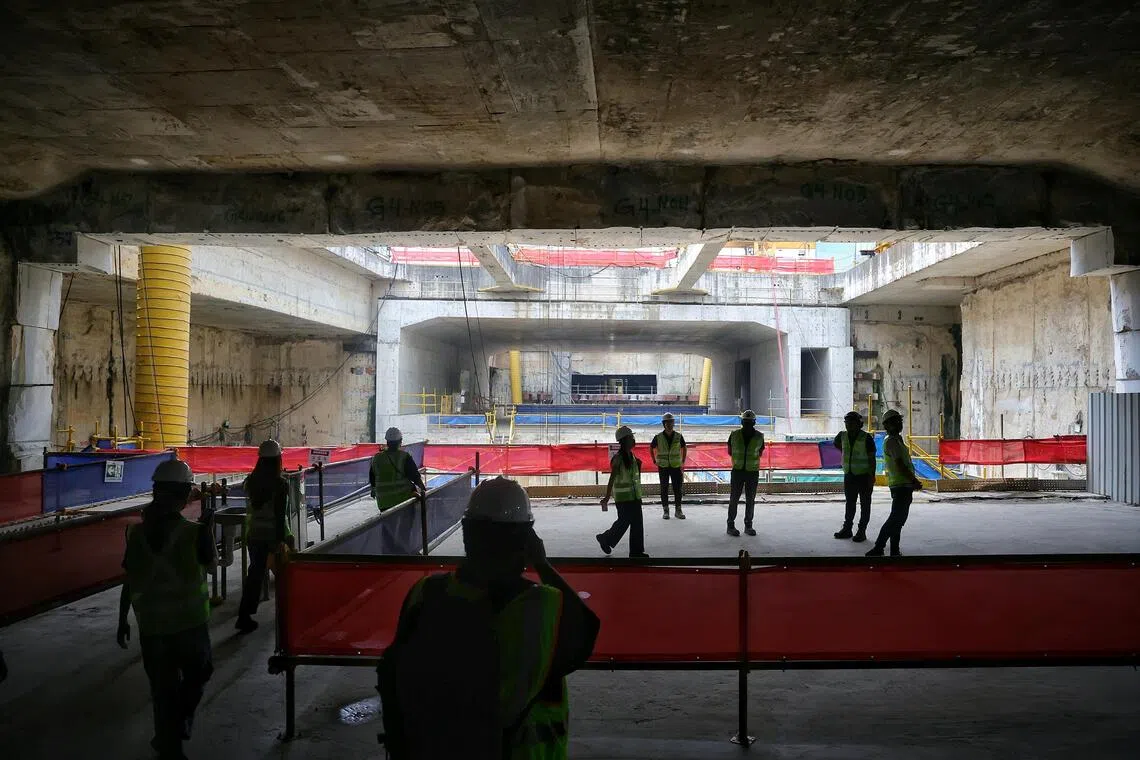
The southbound tunnel during a site visit to the Novena section of the North-South Corridor on Sept 15.
ST PHOTO: KEVIN LIM
These include the ground conditions in Gambas Avenue and Woodlands Avenue 8, where the viaduct is located. Some piles had to be driven deeper than planned to get past the unanticipated layer of broken rock beneath the surface.
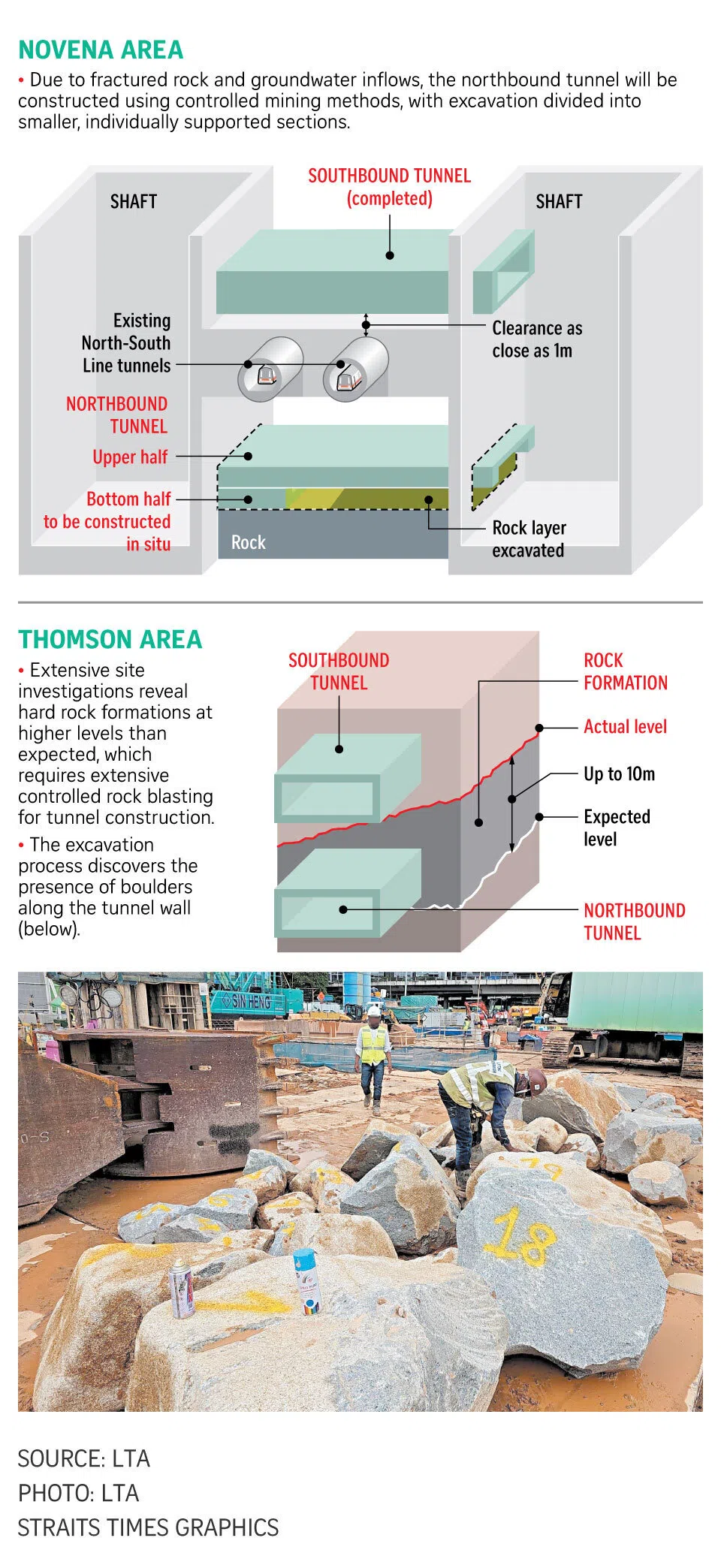
In Novena, broken rock and underground water seepage required additional preparatory works, along with a different and more complex mining method to ensure that the construction would not put the North-South MRT line at risk. An MRT line that is in operation is located just 1m away from the NSC tunnels.
Works in the Thomson area were affected by harder-than-expected rock formations underground, requiring rock blasting and ground stabilisation works before excavation could proceed.
When asked if completion dates could change again, an LTA spokesman said construction is being closely monitored and LTA will continue to work with contractors to manage the remaining works and address challenges promptly.
As for the extra costs caused by the delay, that can be determined only after the project is completed, the spokesman added.

When asked how any cost overrun will be calculated, the spokesman said figures will be compared against information provided to tenderers during the tender process.
LTA added that it expects contractors to have taken into account the construction risks involved when pricing their bids.
The contractors can submit claims if the actual ground conditions differ from the baseline information provided. LTA will assess the claims and consider additional payment if they are found to be valid under the provisions of the contract.
On Sept 15, reporters were allowed access to a work site in Novena, and could view the stretch between Revenue House and Novena Square, where the NSC crosses the North-South MRT Line.
At this section, the northbound and southbound NSC tunnels are stacked, with the MRT line sandwiched between them.
While the southbound tunnel has been completed, tunnelling is still under way for the northbound tunnel that passes below the MRT line.
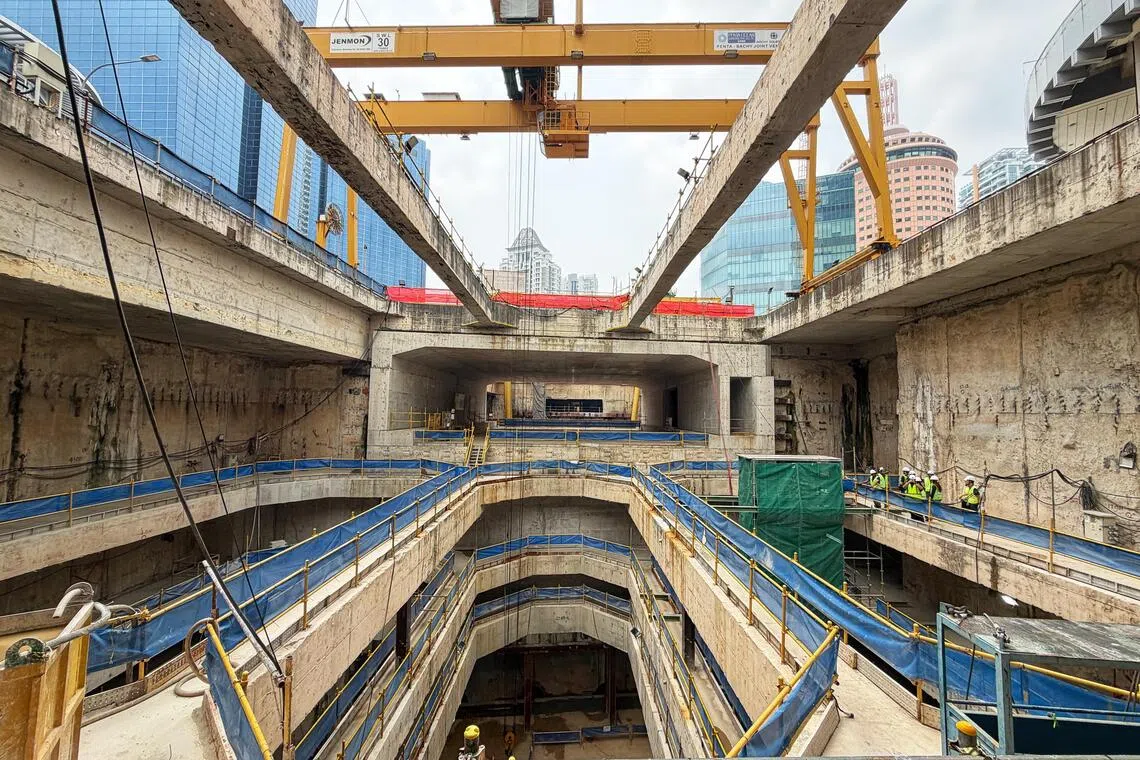
The North-South Corridor’s southbound tunnel (top) over-crossing and northbound tunnel (bottom) under-crossing the North-South MRT line at the Novena work site on Sept 15.
ST PHOTO: KEVIN LIM
The northbound tunnel needs to be excavated in two stages because of the distinct ground conditions. The top half of the tunnel cuts through softer ground with water seeping in, while the bottom half is built by excavating through solid rock.
For the top half, large tubes are inserted into the ground and steel support frames are erected to stabilise the ground and prevent the soil from loosening.
After excavators have advanced the tunnel by around 2m, concrete is sprayed onto the exposed surface to stabilise the ground. Another set of steel frames is then installed before excavation continues.
Excavation of the top half of the tunnel is expected to finish by 2026, before work can begin on the bottom half. Controlled blasting will then be used to break the hard rock, as part of the mining work. This stage of the construction is projected to take up to 2028.

NSC construction works began in 2018, and were expected to end by 2026. However, the Covid-19 pandemic hit all building projects in Singapore, and the NSC end date was pushed back to 2029.
When completed, the NSC is expected to ease congestion on the Central Expressway and major arteries like Thomson Road and Marymount Road.
It will also widen access to upcoming developments in the northern region and link to key expressways like the Seletar Expressway, Pan-Island Expressway and East Coast Parkway.
With traffic being channelled away, the streets – in the future – will give priority to public transport, pedestrians and cyclists, while making more room for community spaces.
KioskNews shows a cleaned-up reading view extracted from the publisher’s page — the original always lives on their site, not ours.