Aaron Rodgers’ grubby fall is no tragedy. But it does expose the NFL’s underbelly | Howard Bryant

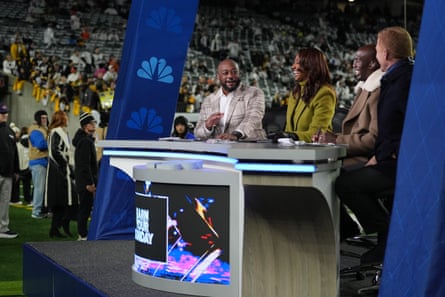
During half-time of the NFL’s Thanksgiving Day finale between the Chiefs and Bills, NBC analyst and former Pittsburgh Steelers head coach Mike Tomlin referred to this week’s Aaron Rodgers-Mike McCarthy disaster as a “dumpster fire.”
Tomlin may have intended for his analysis to pertain only to the Steelers, but his description indicted the totality of the NFL universe today, from the behavior of one of its iconic players, to the chaos surrounding arguably the most stable franchise in league history, to the embarrassing demystification of coach culture. Simultaneously, the rift exposed the NFL’s league-sanctioned punditry as woefully ill-equipped to handle even the most basic of repertorial tasks. Maybe journalism actually matters after all.
Between Tomlin and the ex-players in studio across the league’s rights-holding media, the general reaction to the week was not the facts of what has occurred in Pittsburgh and how a team in the playoff chase must navigate communication issues between the players and its head coach, but of “sadness.” Even Tomlin – who cleared the low bar as the voice most closely resembling insight – joined the chorus expressing sadness that Rodgers broke the golden rule that players should not air in-house grievances publicly; sadness that if this be the last note of Rodgers’s storied 22-career, it will certainly be remembered as a sour one; sadness that the proud and professional McCarthy was apparently betrayed by an egotist who prefers a flamethrower to a handshake. The league’s voices lined up and adopted the collective tone of tragedy.
Rodgers was once touted for his intelligence on the field and off, but the last decade-plus has unleashed what many in the game acknowledge internally to be the real Rodgers – the narcissist who lacks regards for others, the anti-vaxxer whose opinions have made him a tinfoil political thinker, the destructive rogue element apparently unafraid of losing the lucrative, NFL-controlled post-career financial opportunities that come with staying in line, that long-game bait that keeps everyone in line.
The criticism of him, however, comes with an important incongruity: no one in the Steelers locker room, including McCarthy, has disputed the veracity of Rodgers’ accusations, which have included the coach sleeping in meetings, and missing or being late to others. Rodgers essentially said a competitive team has been rudderless because the coach is failing to lead, but the true indictment of the league is that a sport that sells itself on rugged “accountability” – and routinely ends the careers of players who do not meet that standard – has focused not on whether McCarthy has let his team down, the actual source of the dumpster fire, but Rodgers and his tactlessness.
The word sadness did not seem to encapsulate an actual sadness, say that perhaps McCarthy is not physically well enough to perform his responsibilities, or that he is admirably and foolishly attempting to coach a football team while hiding an illness. Instead, the universal lament stemmed from the lack of control – the league allowed itself to be betrayed by its own machinery, for Rodgers torpedoed McCarthy via an appearance on ESPN, the NFL rightsholder that airs McAfee’s show and is also broadcasting this year’s Super Bowl.
Rodgers confirmed his selfishness and unprofessionalism by essentially being a whistleblower – admirable in some professions, a betrayal in others – but because nothing he has said has been disputed as untrue, his critique of McCarthy cannot be dismissed. He exposed McCarthy who, after the Steelers defeated the Broncos on Friday, acknowledged his lack of attention to the defensive units, a damning admission that he attempted to conceal with coachspeak. It is an issue, McCarthy said, that will be addressed in the offseason – itself a bold assumption that he will have the opportunity regardless of this year’s outcomes.
It should also not be forgotten that the Rodgers-McCarthy implosion is occurring at a time when both culturally and politically America has engaged in a full, frontal assault against the supposed incompetence, undeserving promotions and elevations of Black people, women and people of color encapsulated under the heading DEI. In step with, and in fear of Donald Trump, Major League Baseball has both discontinued and muted programs that were supposed to expand its narrow hiring practices and grow the sport, under the guise that such efforts discriminate against white people. The NFL has done the same.
Elsewhere, universities across the country have eliminated majors and departments that center the nonwhite, non-straight, non-male experience. Once aspirational, the term “the Rooney Rule,” is now toxic. Merit, we are told, has once again become the only criteria by which jobs are awarded. And given the ease with which Americans have accepted the idea that Black people in high positions had ascended unfairly, that women in predominately male fields did not earn their place, we have been told through the political policies of the White House and the corporate retreat from nonwhite hiring that merit and whiteness are synonymous.
Rodgers and McCarthy have further exposed this already farcical and insulting presupposition into complete absurdity, for neither of them has proven themselves particularly fit to lead. The NFL, which watched its weekly shield-protectors scramble in vain to say something of use, was revealed as certainly as its corporate media partners. And nor should it be forgotten that McCarthy’s apparent unprofessionalism follows an offseason in which New England Patriots coach Mike Vrabel saw himself embroiled in allegations he had an affair with a female journalist. If McCarthy has been as mediocre as Rodgers alleges, he is yet another extension of the myth of the NFL head coach, man of accountability, leader of men.
None of this, it should be noted, is a tragedy. If anything in football deserves such solemnity, it should be CTE, or the gruesomeness of a sport that inevitably sends players to the dreaded blue tent and then the hospital. The sadness being expressed through the Rodgers-McCarthy mini-drama is no tragedy, but exactly what happens when the league for once cannot control the truth, when daylight captures too much of is true face.
Howard Bryant is the author of 11 books, including Full Dissidence: Notes from an Uneven Playing Field, and Kings and Pawns: Jackie Robinson and Paul Robeson in America. He also writes on Substack
Year-end fundraiser
$0 of $2,000,000 goal
A moment full of possibility – and risk
We hope you appreciated this article. Before you close this tab, can we ask you to spare 37 seconds to sustain the Guardian’s fearless journalism in the decisive year ahead?
In the last two years alone, Donald Trump has eroded many of the pillars of US democracy – slashing funds for universities, undermining science, shutting down arts institutions, and attacking the free press as an “enemy of the American people” and “a threat to our national security”. While he and his allies have enriched themselves and spread lies, federal forces have harassed and imprisoned innocent people and violated the constitutional rights of many Americans.
Now, in a sweeping change election, the American people have spoken: Donald Trump, Pete Hegseth, RFK Jr, Elon Musk and the tech oligarchs may finally be held to account. A majority of American voters have demanded an end to the costly and immoral wars, the flagrant profiteering, and the corrosive attacks on communities and democratic institutions.
It’s a moment full of possibility, with more stories than we can possibly cover. New leaders are emerging from Texas and Michigan to Iowa and South Carolina – and heading to Washington to fight for affordability, against wealth inequality, and for human survival in the face of AI and the climate crisis.
These new leaders will be facing a cornered Trump and his hardline chief of staff, Stephen Miller, who have nothing left to lose. The next few years are critical for the future of the country. Journalism that covers the epic clash between these forces has a vital role to play right now.
Investigative journalism provides a fact-based paper trail for an emboldened Congress to follow. Members of Congress – and the American public – often rely on our in-depth reporting to inform the tough questions, to connect the dots and to pursue accountability for wrongdoing.
At the Guardian, our newsroom is devoted to uncovering the truth and conveying it to as many people as possible. We’re not alone in this mission, but this kind of journalism faces unprecedented hurdles: big tech threatening our financial stability and stealing our work for AI, billionaire owners telling journalists what to publish, and a hostile executive branch intent on suppressing our reporting.
The Guardian is free to dig deep without fear because we’re funded by our readers. Our readers hold us to account, and we hold the powerful to account.
However, this only works when enough of our readers contribute. Against the advice of most industry analysts, we’ve refused to put up a paywall – we believe good journalism should be freely available to all people, regardless of ability to pay. If you’re counting on our reporting, and you can’t afford to pay, please stop reading this message and go back to our articles.
If you can afford to contribute, please know that your support is not only helping yourself – from voters in Kansas to immigrants in Minnesota and families in Gaza, your generosity is bringing factual news to people around the globe.
Today is among our most important fundraising days of the year. To sustain our unique financial model, our goal is to raise $2,000,000 before the new Congress is seated on 3 January. More than 19,000 people have contributed already. If you can afford 37 seconds, please join our ranks – and show your support for the rekindling of democracy in the US and around the world.
KioskNews shows a cleaned-up reading view extracted from the publisher’s page — the original always lives on their site, not ours.