‘You’re constantly on alert’: keeping Ukraine’s trains running under threat of drone attacks

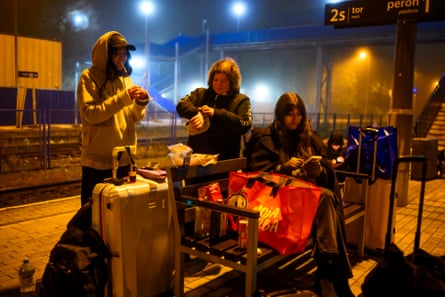
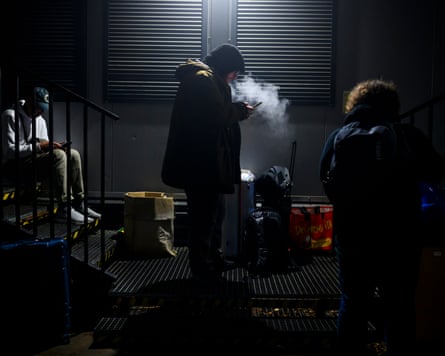
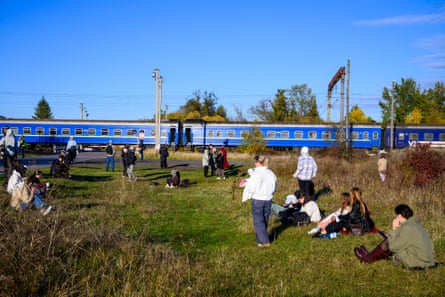
Just after midnight, Anastasiia Krasnokutska was hiding in a forest staring up at the sky in horror. Russian Shahed drones were circling over the train that she and hundreds of other passengers had just fled. As she hid behind a tree, the 26-year-old could hear the explosions of anti-aircraft fire and the whirr of the motors above in what felt like a scene from a war movie. It was no accident that so many unmanned aerial vehicles would swarm over them all at once, she understood: the train and its passengers were Russia’s target now.

“Papa, you can’t imagine the hell that’s happening here,” Krasnokutska, 26, wrote to her father that evening in April from the nearby Myrhorod train station as it came under attack from the drones. “There are shaheds coming from every direction. People are running everywhere. The shelters are closed. They’re hitting the train station.”
She sent him an image of an explosion and a plume of smoke from a drone strike.
“I am so scared that you travel this route,” she said.
Krasnokutska was witnessing the early days of Russia’s great new offensive on the Ukrainian railway system, a calculated campaign that has disrupted travel across the country, threatened to paralyse Ukraine’s military and economy, and left Ukrzalyznitsia, the state railway, scrambling to survive the “darkest time in the history of this company”, according to its chief executive.

Since the beginning of Russia’s war nearly five years ago, Ukraine’s train system served as the pride of a nation that boasted it could maintain scheduled service even during a war. But advances in drone and missile technology and the Kremlin’s shift towards destroying Ukraine’s crucial infrastructure has now made it the main target after the electrical grid – and pushed rail workers, passengers and the country’s leadership to the limits of their endurance to keep the system running.
Russian missiles and drones are targeting the dwindling fleet of locomotives that move Ukraine’s railcars – destroying or damaging more than 600 since the beginning of the invasion – and striking the mobile railway yards tasked with repairing the locomotives meant to keep the country moving.
Oleksandr Pertsovskyi, the young chief executive of Ukrzaliznytsia, rubs his eyes often as he sits in the secret command centre that he has set up to monitor the drone threat. In the bunker deep underground, he lists the devastating toll on Ukraine’s economy and its exports of grain, iron and coal, the cut-off frontline communities that can no longer be serviced by rail, the signal to foreign leaders that they are risking their lives to come to Ukraine, and finally the psychological effect to “showcase to people that the country is falling apart, that there is no bright kind of light at the end of the tunnel”.

The disruptions are extensive. Ukraine evacuated passengers from trains upwards of 130 times per day in October because of the threat of drone strikes. When Krasnokutska took a train from her home in Warsaw to Kyiv late last month, she was scheduled to arrive at 7.58am. The train arrived at 4am the next morning instead, nearly 20 hours behind schedule, with four evacuations en route when drones strayed too close to the trains. By the time she arrived in her native Kharkiv, she had been travelling for two days.
She said she didn’t oppose the extra security precautions. “As much as I would want to keep sleeping,” she said, “of course it is better to sit in the bushes for a bit than, God forbid, to die in the train.”
Pertsovskyi and his team monitor the attacks from the Iron Command Centre, as they’ve called it, where every wall is covered in screens and televisions. There are real-time maps of drones approaching trains, status updates on evacuations, statistics on the losses of locomotives, and a postmortem report showing a carriage ripped open by a Russian Shahed drone. As Pertsovskyi shuttles between meetings through glass doors that silently slide open and closed, beyond them stand a line of aides, engineers and military officers waiting to speak with him.
It is the morning after Russia launched a big strike against power and electrical plants in an effort to plunge Ukraine’s cities into blackout this winter. That same night, Ukrzalyznitsia counted 15 strikes from drones and ballistic missiles on rail yards and depots where workers are desperately trying to repair the damaged locomotives.
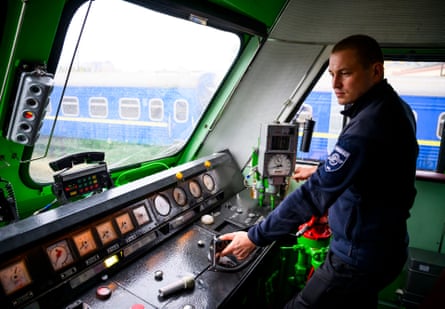
Mykola Kostyuchenko knows that locomotives are a prime target. He is the first machinist from a family of railway workers and has driven special trains with VIP passengers and worked near the frontlines, where the risk is the highest. “You’re constantly on high alert,” he said. “It could happen at any moment. Everyone’s constantly warning you: ‘Be careful, be careful, be careful’, but you still have to get the job done.”
But the risk is even greater for the Ukrainians who work in the depots, he said. Standing in a locomotive with a shattered window from one strike on the depot yards, he described the threat from drones and ballistic missiles. “If there’s a drone threat, you might just about have time to run to shelter, but with missile strikes, you don’t stand a chance,” he said. “Bang! And that’s it.”
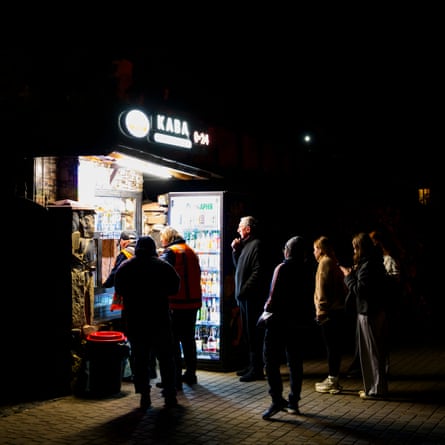
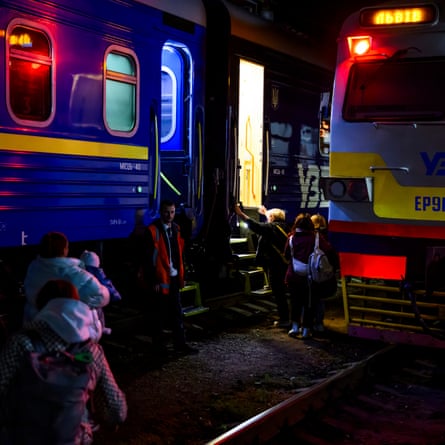
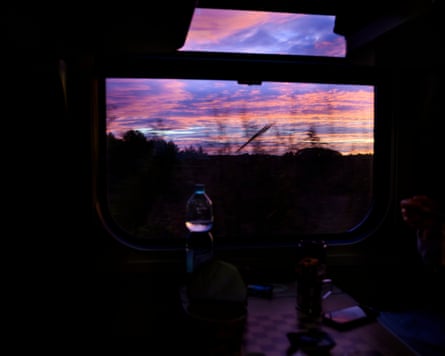
The work is extremely dangerous: more than 69 railway workers have been killed and 322 more have been injured since the beginning of the war. When asked how he determines that this is the darkest moment in the history of the company, Pertsovskyi answers quickly: “Look at every single measure you can think about.”
Pertsovskyi established the monitoring bunker in November as it became clear that Russia had developed the ability to strike moving trains. The need for it reflects one of the most important technological shifts in the war: Russia’s ability to mass-produce jet-powered drones, including the Geran-4 and Geran-5, that are able to receive dynamic targeting data from mesh networks to target a moving object far from its borders.
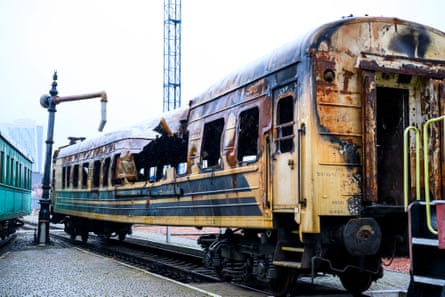
The new reality hit when Russia struck a train operating on the Barvinkove–Lviv–Chop line on 26 January, killing five people. The rusted, destroyed carriage now stands in the main railway station as a memorial, he said, and a reminder to passengers of why the constant evacuations are necessary, despite the fact that they can extend a trip by many hours. The deadly strikes continue: a Russian attack on a railway platform in Dnipro beginning on 29 October killed 15 people, including five railway employees, and wounded dozens more.
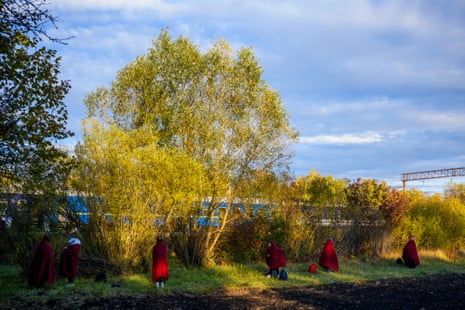
The “worst is yet to come,” predicts Pertsovskyi. Drones now can use image recognition tools to fly alongside the rails and look for something that “looks like a train,” he said, meaning they don’t need to receive radio signals from an operator.
“It’s a really dystopian future that we live in,” he said. “If I was told five years ago that we had to run trains under kamikaze drones that would be image-powered, have images of the locomotives … I’d say that person was crazy.”
“Today it’s the normal operational reality,” he added.

Ukrzalyznitsia is now engaged in a three-pronged strategy to save and acquire enough locomotives to keep the railways moving. To do so, it is repairing damaged locomotives at its rail yards, acquiring newly produced stock that should begin to arrive in 2027, and scouring nearby countries for new locomotives that use the same gauge as Ukraine does. They are nearly breaking even, he claimed, but it’s likely to become much more difficult as the damaged locomotives start to be more difficult to repair.
Railways are ‘like the veins in the body’
The campaign has put unprecedented stress on the thousands of men and women who run Ukraine’s railway system. Iryna Yurchenko, a conductor, began working on the railways when she was 18 years old – 36 years ago. As she sees it, the railways in Ukraine are “like the veins in the body through which blood flows”.
“You can’t live without blood in the body,” she added.
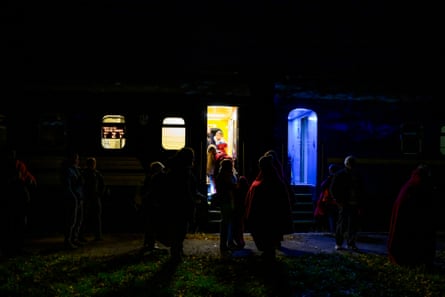
She said that the best way to prevent panic on board begins with the conductors who announce evacuations, gather the passengers and usher them into the forests near the railway lines – sometimes out into the freezing cold, sometimes five or more times a night when the strikes are particularly heavy. Usually they offer coffee or tea, and try to keep their voices calm.
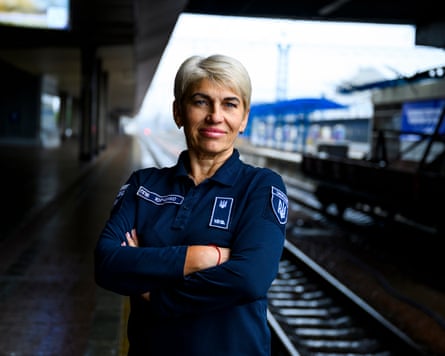
“We’ve been living through this war for four-and-a-half years now,” she said. “We’ve been carrying out evacuations since the very first days. Back then, it was very painful, frightening and uncertain. Now, I suppose, we’ve become quite hardened to it.”
Her children – including her son Dmytro Kozatsky, who documented the siege of the Azovstal metalworks as a soldier in the Azov battalion – have both suggested that she retire. But she says she will keep working through the war.
“It’s not that I’m not worried,” she added. “Only a fool isn’t afraid.”
After visiting her parents in Kharkiv, Krasnokutska had a decision to make – would she risk another trip on the train back to her home in Warsaw? Or would she take the bus instead?
She recalled spending some of the most important moments of the war on Ukraine’s trains. She woke up on 24 February 2022 on the top bunk of a sleeper cabin from Kyiv to Kharkiv with phone service cutting in and out. At 5am, as Russian troops attacked, she recalled, “absolutely everyone started to call me and said the war had started”. She heard cries and shouts on the train, she said. “People were in shock” as the train pulled into Kharkiv in a country now at war, she said.
Weighing up her options, she said she was now at a tipping point.
“I got back on the trains after the attack because my parents are here and I needed some way to come back and see them,” she said. “But now I’m going to have to stick with the bus because it’s so dangerous. And it would take just as long anyway.”
KioskNews shows a cleaned-up reading view extracted from the publisher’s page — the original always lives on their site, not ours.