Two energy transition agendas converge on Rengit Island
Jakarta (ANTARA) - Rengit Island may be just a tiny dot on Indonesia's energy map. But in August 2026, it became the intersection of two major initiatives: the target to build 100 gigawatt-peak (GWp) solar power capacity and an international collaboration forged through the Just Energy Transition Partnership (JETP).
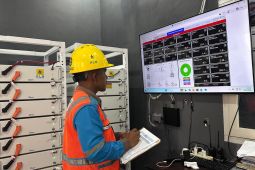
On Rengit Island in Bangka Belitung province, state-owned power utility PLN developed the Green Energy Ecosystem Technopark (GEET)—a clean energy ecosystem that integrates solar power, energy storage batteries, wind turbines, green hydrogen production and storage, fuel cells, and an energy management system.
Launched on August 22, 2026, GEET also serves as a hub for learning and testing clean energy technologies for small-island power grids. The ecosystem has upgraded electricity service on Rengit Island from around 12 hours to 24 hours a day.
During the launch of the 100 GWp national solar power program on August 25, 2026, the Ministry of Energy and Mineral Resources cited the 0.078-megawatt peak (MWp) solar plant on Rengit Island as one of four projects tied to the initiative.
Despite its relatively small capacity, Rengit Island stands as an island-scale laboratory to demonstrate how solar energy, energy storage, wind, and hydrogen can be integrated to bolster energy resilience while expanding access to electricity.
There, the clean energy transition partnership between Indonesia and Germany takes on a more concrete form, moving beyond commitments on paper.
At the policy dialogue titled "The Trilemma of Clean Energy Transition" in Jakarta on September 22, 2026, Bettina Kellersmann, Head of the Southeast Asia Department at the German Federal Ministry for Economic Cooperation and Development, highlighted the pilot project for green hydrogen—a clean fuel produced from water—on Rengit Island as one of three areas of JETP support.
JETP is a partnership model between several developed nations and developing countries aimed at phasing out fossil fuels. The initiative has been running in Indonesia since it was agreed upon at the 2022 G20 Summit in Bali.
Beyond the pilot project, JETP support also includes over US$20 billion in renewable energy funding and the removal of regulatory hurdles through a dedicated implementation unit.
The urgency behind uniting these two energy agendas stems from geopolitical calculations, not just climate targets. Kellersmann linked the turmoil in the Strait of Hormuz to rising energy costs in both Germany and Indonesia, framing the renewable energy transition as a route to energy self-sufficiency and sovereignty.
This view aligns with the statement of Indonesian President Prabowo Subianto, who has repeatedly highlighted that the 100-GWp solar power target is an answer to global energy supply uncertainty.
Prabowo contrasted the target with Indonesia's current total power capacity of around 88 GW across all energy sources. By making this comparison, he positioned the 100 GWp solar goal not just as an increase in capacity, but as a major transformation of the nation's energy landscape.
Nevertheless, Indonesia does not position itself merely as a passive beneficiary of the JETP scheme.
Spica A. Tutuhatunewa, the head of the Center for Policy Strategy for America and Europe at the Foreign Affairs Ministry, emphasized that before determining the extent of international cooperation needed, Indonesia must independently calculate how much of its future core energy system can be funded and controlled domestically.
JETP featured an international funding commitment of US$21.4 billion, which then increased to around US$21.8 billion after an additional US$400 million was announced in February 2026.
The funding was designed not as a one-way grant, but as a blend of concessional loans, equity investments, and knowledge transfer drawn from Germany's own coal phase-out experience.
However, the government acknowledged that on-the-ground progress remains slower than targeted. During a bilateral meeting with German Federal Minister for Economic Cooperation and Development Reem Alabali Radovan in August 2026, Indonesian Coordinating Minister for Economic Affairs Airlangga Hartarto noted that only about US$3.9 billion of the US$21.4 billion committed has been disbursed.
According to him, the domestic energy transition ecosystem and power purchase agreement mechanisms between producers and PLN are the main challenges in fund disbursement.
The partnership also faces an unfavorable shift in the geopolitical landscape following the United States' withdrawal from the International Partners Group—the consortium of donor nations backing JETP.
Nevertheless, Germany and Japan have maintained their positions as co-leads of the group since early 2025, keeping total funding commitments intact. Germany reaffirmed its role as Indonesia's strategic JETP partner in August 2026.
A high-level delegation from the German Federal Ministry for Economic Cooperation and Development, led by Director-General Christine Toetzke, visited Jakarta in February 2026 to assess the progress of the partnership firsthand. The visit underscored Germany's ongoing commitment despite multilateral dynamics losing a key member.
Executive Director of Synergy Policies Dinna Prapto Raharja noted that the fundamental challenge in the process is creating a balance between the three pillars of the energy trilemma: reliable power supply, affordable pricing, and environmentally sustainable energy sources.
The challenge also involves ensuring that vulnerable communities are not left behind without adequate access to electricity.
Gita Loka Murti, the head of the Center for Strategic Policy on Special Issues and Data Analysis at the Foreign Affairs Ministry, defined the initiative's success not by the size of the funding, but by the quality of financing, fair risk-sharing, technology transfer, and upskilling local suppliers. The ultimate goal, she underscored, is to build Indonesia's capacity rather than create new dependencies.
On Rengit Island, new ideas on the energy transition take a simple yet tangible shape. The 0.078-MWp solar plant emerges as part of an ecosystem that combines solar, battery, wind, and hydrogen power, while extending local electricity service from roughly 12 hours to 24 hours a day.
While its solar power scale is modest compared to the government's 100 GWp national target, this small island highlights key issues that will determine the success of the national energy transition—from technology deployment and energy storage to system management, financing, and delivering benefits to residents.
These two energy initiatives do not need to run separately. Rengit Island is showcasing how the energy sovereignty agendas and international partnerships can converge to offer direct, tangible benefits for local communities.
Related news: Indonesia pushes 100 GW power investment to support net-zero goal
Related news: Green transition promises new opportunities for Indonesian workfoce
Related news: Airlangga says energy transition can drive new economic growth
Translator: Aditya Ramadhan, Raka Adji
Editor: Azis Kurmala
Copyright © ANTARA 2026
KioskNews shows a cleaned-up reading view extracted from the publisher’s page — the original always lives on their site, not ours.