Mexico and My Money: What you told us about your personal finance habits and hang-ups
Thank you to everyone who completed the Mexico News Daily “Mexico and My Money” survey, which sought to gather information about the financial practices and experiences of foreigners living in Mexico.
Almost 700 of you responded to the survey and we have now analyzed the results, which are presented in this article.
Before we get to them, let us remind you that we conducted this survey to help guide and define the topics of a new MND series called “Mexico and My Money.”
The first article in the series, which was introduced by MND CEO Travis Bembenek earlier this month, will be published next week.
The MND ‘Mexico and My Money’ survey results
Who responded?
- By our cutoff time, 680 people living in 25 of Mexico’s 32 states had responded to the survey.
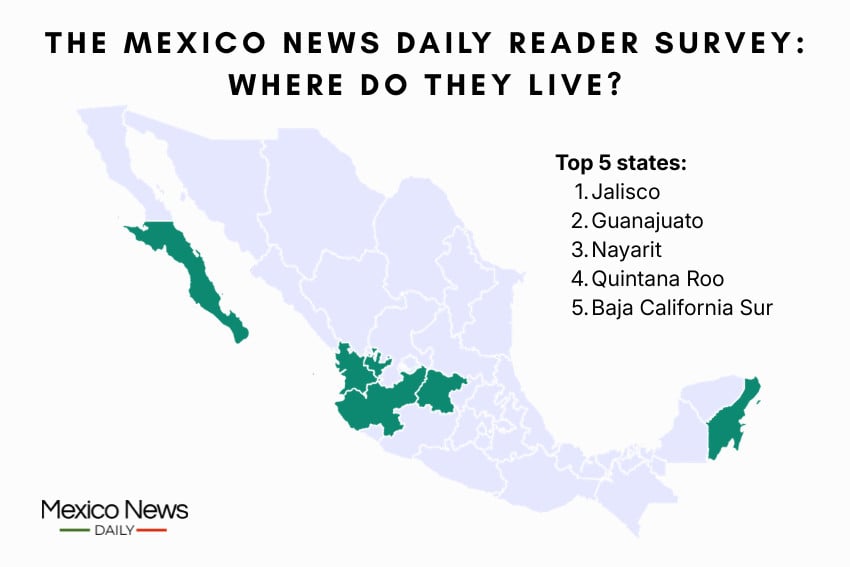
- The top 10 states where respondents live are Jalisco, Guanajuato, Nayarit, Quintana Roo, Baja California Sur, Mexico City, Yucatán, Oaxaca, Baja California and Sinaloa.
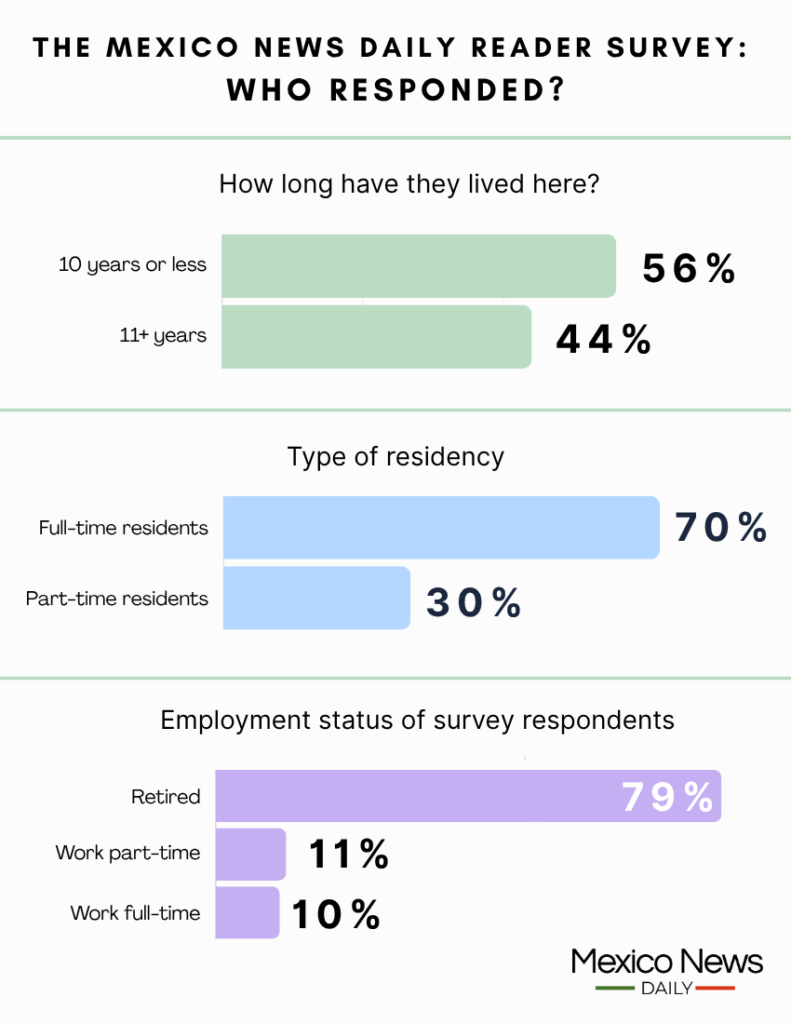
- Around 44% of respondents have lived in Mexico for 11 years or longer, while the remaining 56% have lived here for 10 years or less.
- The respondents are both full-time (70%) and part-time (30%) residents of Mexico.
- Almost eight in ten respondents (79%) are retired, while the remainder work either part-time (11%) or full-time (10%).
- More than seven in 10 respondents (73%) own their primary home, while the remainder rent.
10 Key Takeaways
7 in 10 respondents think their money is safe or very safe in banks in Mexico
More than four in 10 respondents (44%) think their money is “safe” in a bank in Mexico while an additional 28% believe their money is “very safe” in a bank in Mexico.

Almost one-quarter of respondents (23.5%) chose the “neutral” option in response to the question about the safety of their deposits in banks in Mexico.
Only 5% of respondents think their money is “unsafe” (4.5%) or “very unsafe” (less than 0.5%) in a bank in Mexico.
One factor that may have influenced people’s perceptions about the safety of their money in banks in Mexico is that federal Finance Minister Édgar Amador Zamora promptly reassured CIBanco and Intercam account holders that their money was “absolutely” safe after the U.S. Department of the Treasury last year accused the banks of laundering millions of dollars for drug cartels, prompting the government to take control of them. For the vast majority of CIBanco and Intercam customers that proved to be the case, although account holders who responded to a previous Mexico News Daily survey did face a range of inconveniences linked to the U.S. accusations.
8 in 10 respondents don’t have a Mexican credit card
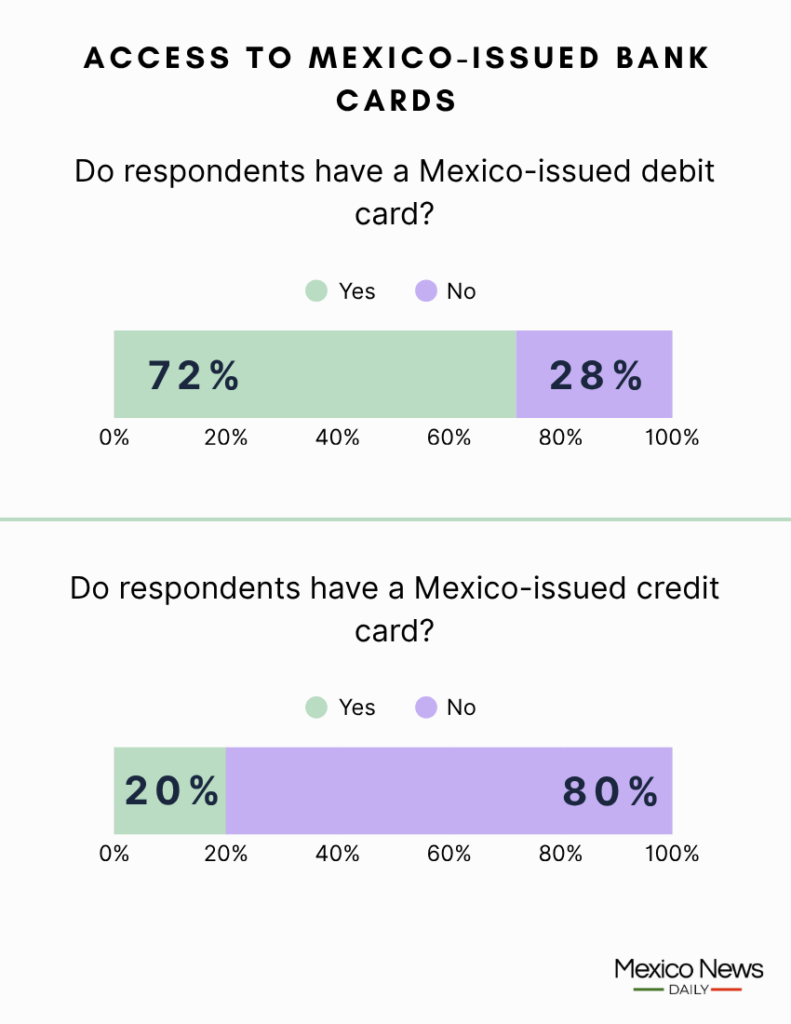
Almost 37% of respondents don’t have a checking account based in Mexico, 58% don’t have a savings account with a bank in Mexico and a striking 79% don’t have a credit card issued by a Mexico-based bank.
A strong majority of respondents (72%) do, however, have a debit card issued by a Mexico-based bank.
The results suggest that many foreigners in Mexico use credit cards issued by banks in their countries of origin.
One possible reason why many foreigners opt not to get a credit card from a bank in Mexico is that credit card interest rates are typically very high.
8 of 10 respondents have made some kind of investment in Mexico
Only 21% of respondents have not invested in at least one of real estate, stocks, bonds or a business in Mexico. The remaining 79% of surveyed foreigners have invested in at least one of those assets.
The purchase of a home in Mexico was easily the most popular investment. Seven in 10 respondents (71%) own a home in Mexico, while 14% have a property in which they don’t currently live. Just over 12% of respondents receive rental income from a property they own in Mexico.
One in 10 respondents (10%) has invested in a business in Mexico, while 8% of surveyed foreigners have bought stocks and 9% have purchased bonds.
A strong majority of respondents have not had ‘money issues’ with contractors or other service providers in Mexico
Over eight in ten respondents (83%) of respondents have not had “money issues” with contractors in Mexico.
Almost nine in 10 surveyed foreigners (87%) have not had “money issues” with people who provide regular services to them in Mexico, such as landlords, cleaners or gardeners.
* Read about some of the money issues respondents have experienced with contractors and other service providers in the final section of this article.
Most respondents have not been a victim of a financial crime in Mexico
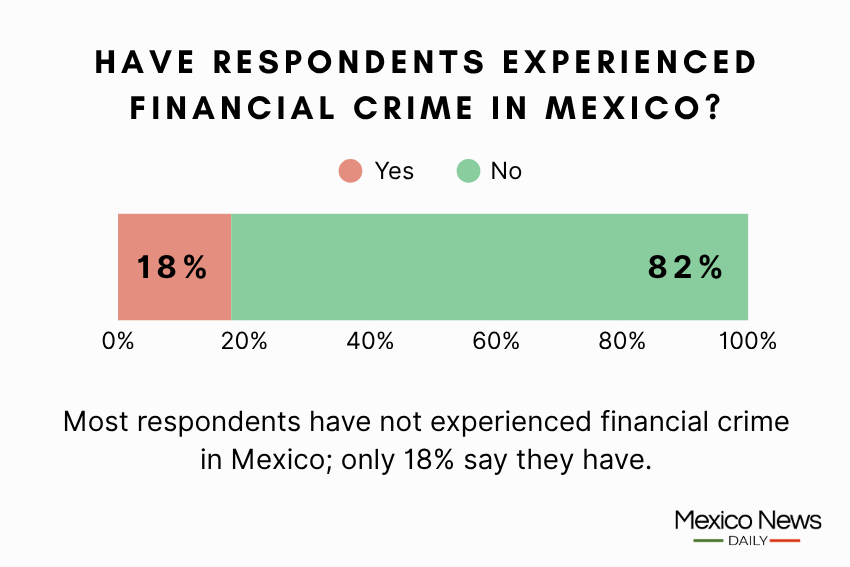
Over eight in ten respondents (82%) have not been a victim of a financial crime in Mexico, whereas 18% of survey respondents have been a victim of such an offense.
* Read about some of the financial crimes respondents have suffered in the final section of this article.
The vast majority of respondents have not borrowed money from a financial institution in Mexico
Almost 97% of respondents have not borrowed money from a financial institution in Mexico. Just over 3% of surveyed foreigners have borrowed money in Mexico.
This result suggests that the vast majority of respondents purchased real estate, vehicles and other assets in Mexico with their own funds or took out loans abroad.
As is the case with credit cards, the high cost of credit in Mexico is a deterrent to taking out loans in Mexico for many foreigners.
Rising prices in Mexico have negatively affected the lifestyles of 4 in 10 respondents
The increase in prices in Mexico in recent years has negatively affected the lifestyles of around four in ten (38%) respondents.
The lifestyles of the remaining 62% of surveyed foreigners have not been adversely affected by rising prices.
Mexico’s annual headline inflation rate fell to 3.12% in July, the lowest level in more than six years. However, inflation in Mexico was much higher in earlier years of this decade, peaking at an annual headline rate of 8.7% August and September of 2022.
Inflation, combined with other factors such as the strength of the peso, has made life in Mexico considerably more expensive in recent years.
Respondents are, on average, ‘somewhat concerned’ about fluctuations in the USD:MXN exchange rate
MND asked survey respondents to rate their concern over fluctuations in the value of the Mexican peso or the US dollar on a scale of 0 to 100.
On the scale, 0 meant “unconcerned”; 50 signified “somewhat concerned”; and 100 denoted “always concerned.”
The average response among respondents was 53, indicating that the surveyed foreigners are, collectively speaking, “somewhat concerned” about fluctuations in the USD:MXN exchange rate.
In general, fluctuations in the exchange rate are more of a concern now for foreigners in Mexico than in years gone by because, over a period spanning decades, the value of the peso against the US dollar trended down. However, in recent years the peso has bucked that trend, appreciating more than 10% against the greenback between 2021 and 2025, and continuing to strengthen this year.
A majority of respondents have loaned money in Mexico
Over half of the survey respondents have loaned money locally while living in Mexico.
Around 22% of respondents have loaned an amount under US $500, while 20% have lent between $500 and $3,000. About 11.5% of respondents have lent over $3,000 to someone in Mexico. Those three percentages add up to about 53.5%.
The remaining 46.5% of surveyed foreigners haven’t lent money to anyone while living in Mexico.
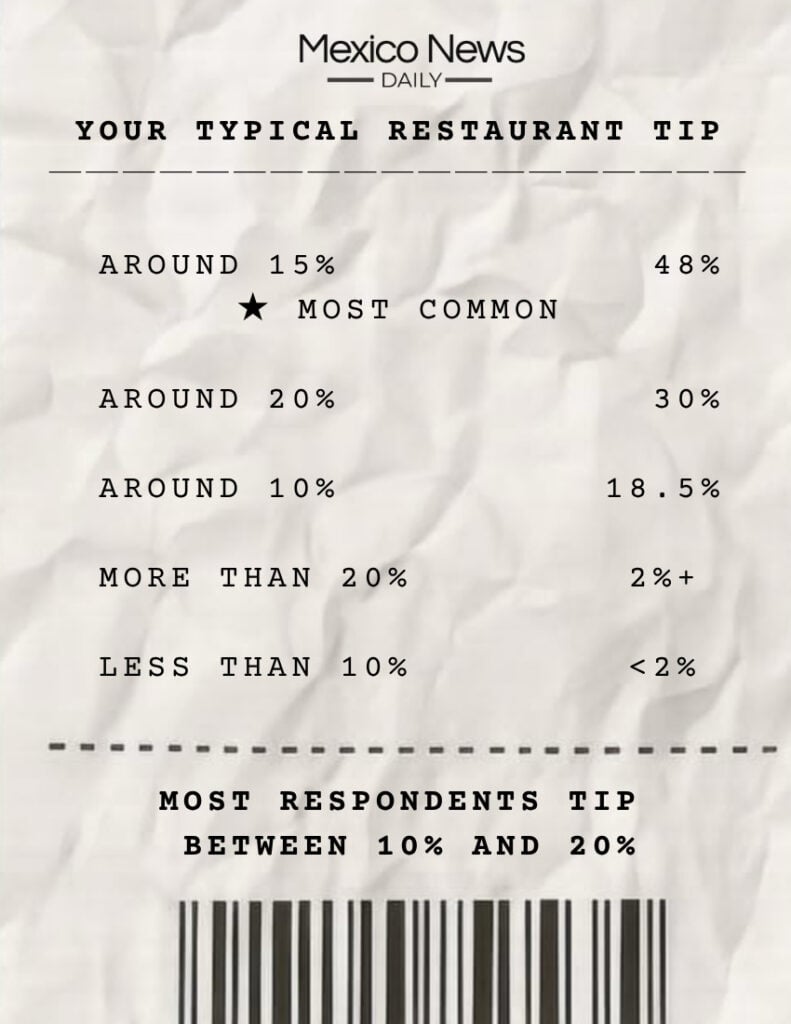
15% is the most common restaurant tip rate among respondents
Almost 48% of respondents typically tip “roughly 15%” of their total bill at restaurants in Mexico.
Almost 30% of surveyed foreigners usually tip “roughly 20%” when eating out, while 18.5% typically leave gratuities of “roughly 10%” of their total bill.
Just over 2% of respondents typically tip more than 20% of their total restaurant bill, while just under 2% usually tip less than 10%.
Your say
We asked survey respondents to provide additional information if they have experienced money issues with contractors and/or service providers in Mexico or if they have been a victim of a financial crime here. Many of the survey respondents who said they have been a victim of a financial crime recounted stories of being mugged, pickpocketed or having money stolen from their homes.
Below is a (lightly edited) selection of the comments we received.
Money issues with contractors
- I paid for materials I didn’t get.
- The price changed during the project due to the number of man-hours worked.
- I had disagreements over what was included with certain construction costs. The disagreements arose from familiarity with what is typical in the U.S. versus what is typical in Mexico.
- I paid for products and services I never received.
- I didn’t receive reimbursement for a shoddy job.
- I paid upfront for work that never happened or was executed poorly.
- The contractor demanded more money than we agreed on.
- The contractor failed to complete work and stole building materials.
Money issues with contractors and providers of regular services
- A cleaning lady we had for eight years was stealing money from our purse and wallets during the whole time she was working for us.
- A landlord kept my 20,000-peso security deposit without cause.
- In order to continue having hot water in the apartment, I had to purchase equipment and pay for the installation because the landlord would not.
- My rent increased above the agreed-upon rate. The increase was much higher than the standard rate increase in San Miguel de Allende.
- The gardener wanted more money and simply stopped working until he got his raise.
- I’m a former timeshare owner and the maintenance fee was immediately doubled after I was informed it was being adjusted because it was unfair. This was almost 20 years ago. It was extremely intimidating and I was threatened. Now that we know about cartel involvement in timeshares, I am so glad we got out even though we had to pay US $10,000.
- My landlord insisted on me paying rent in US dollars, then stopped when the dollar weakened. The landlord greatly increased my rent, specifically saying, “My expenses have gone up because of inflation and the dollar isn’t worth as much.” She then converted the rent from dollars into pesos, increasing it by 20%.
- I have had minor issues but have always been able to work them out. That’s life anywhere.
Financial crimes in Mexico
- I was a victim of fraud when purchasing a car.
- I was mugged. I lost my phone and wallet.
- I was robbed of money, jewelry and a tablet by a “nurse” taking care of me.
- Someone hacked my virtual HSBC card and ran up unauthorized charges.
- I was the victim of the fraudulent sale of a timeshare.
- An employee of a Mexican bank was siphoning funds and using new deposits to cover withdrawals. She was caught. I had to testify against her in exchange for the bank honoring my account balance.
- I was coerced into a timeshare purchase.
- A vacation rental that I paid for in advance was not owned or managed by the guy who rented it to me.
- I was a victim of a credit card scam in a taxi.
- A fruit vendor gave me counterfeit money.
KioskNews shows a cleaned-up reading view extracted from the publisher’s page — the original always lives on their site, not ours.