Finance, fossil fuels and the ‘overshoot’: six key takeaways from Cop31

As the planet faces the devastating impacts of unprecedented human-caused global heating, close to 200 countries have been meeting in Antalya, Turkey, for the annual UN climate summit. Here are six key takeaways from Cop31.
1. Fossil fuels cannot be ignored
These talks fell apart over the refusal by some countries to allow mention of fossil fuels in the final “cover decision” text – the “Antalya pact” – and the refusal of others to agree an outcome without it.
Yet for most people watching, it will seem absurd for a climate conference not to address the actual cause of global heating.
The EU, the UK, a handful of other rich nations and scores of developing countries, including the most vulnerable small islands and the least developed countries, joined in a loose coalition of about 130 parties on Saturday night to demand recognition of the need to “transition away from fossil fuels” in the final outcome of Cop31.
Their demands failed but the issue will not go away. All countries agreed to “transition away from fossil fuels” at Cop28 in Dubai in 2023. That original promise still stands and has not been repudiated, but refusing to talk about fossil fuels seems no longer a tenable position for the only global climate forum.
2. Finance matters
Although developing nations made up most of the 130 countries banded together in a “progressive coalition”, many of those countries did not object in the final session of Cop31 to the “Antalya pact”. For many, that was because finance was a much more salient issue for them than fossil fuels.
An increasing number of poor countries are in a debt crisis driven by the Covid pandemic, inflation which has eroded their capital and increased the interest payments on their debt, and the failure of rich countries to acknowledge the problem. This is compounded by the impacts of extreme weather, which are taking an increasing toll in this year of a supercharged El Niño.
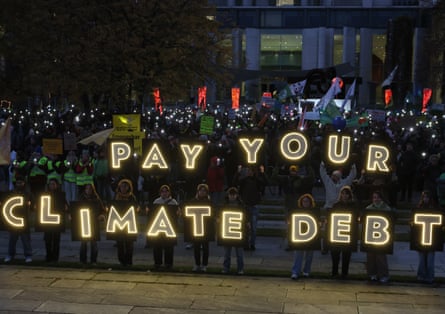
Activists at a Fridays for Future protest in Berlin, Germany earlier this month accuse their government of failing to meet its climate finance commitments. Photograph: Hannibal Hanschke/EPA Many are spending more on coping with the impacts of global heating on crop yields, infrastructure and disasters than they are on core budgets such as health and education. Rich countries have promised them money to help them adapt to such impacts, and to shift to low-carbon economies.
At Cop29 in Baku in 2024, rich countries pledged $300bn (£229bn) a year to the poor world by 2035 from publicly funded sources, and to facilitate $1tn in additional funding from private sector sources. But that money has been slow to reach the countries that need it most.
Key demands from poor countries, particularly in Africa, were to make good on the promise made last year of tripling finance for adaptation. Yet they felt unheard in these demands, and were angry. “We did not come here to beg,” African ministers told the Cop.
Australia also made a strategic error by failing to engage parties with finance at an early stage. As a developed country, Australia faces obligations under the Paris agreement to provide climate finance to the poor world. Repeatedly, Australia batted away questions of finance by saying “this is not a finance Cop” – this was true, but did not go down well with developing countries where finance is literally a matter of life and death.
3. We need to talk about the overshoot
Global temperatures have now risen higher than 1.5C above preindustrial levels, and within a few years this is likely to be judged a permanent state, unless strong action is taken. Yet it has been difficult to discuss this at Cops, because the Paris agreement stipulates holding temperatures “well below 2C” while “pursuing efforts” to limit them to 1.5C above preindustrial levels.
The difference may not seem significant, but it is crucial: above 1.5C, low-lying countries and islands face inundation, coral reefs die off and irreversible tipping points will start to be triggered.
For the first time, this Cop recognised and began to discuss the “overshoot” of the 1.5C target. There was no agreement on what to do about it, but at least a start has been made.
4. The presidency holds the key
Cop stands for “conference of the parties”, and at every summit, the president of proceedings will insist that it is a “party-driven process” and that their role is merely to facilitate. This is a polite fiction: in reality, the presidency can make or break a Cop.
For the first time, this Cop had two presidencies. Both insisted throughout that the arrangement was working well – Chris Bowen, the Australian president of negotiations, even said he could not understand how single country presidencies of the past had coped.
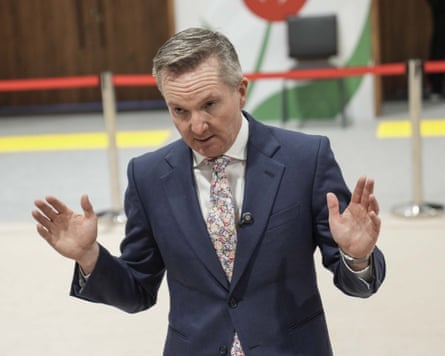
Australia’s Chris Bowen was the president of negotiations during Cop31. Photograph: Osmancan Gurdogan/Anadolu/Getty Images But when it comes to crunch negotiations with 195 countries, time matters, and consulting two presidencies takes twice as long. The gaps between the first draft of the cover decision on Monday, the second draft on Thursday, and the third draft in the early hours of Sunday morning – followed by a fourth and final draft on Sunday afternoon – showed how difficult it was for the joint presidencies to coordinate at speed when needed.
5. Electrification is vital
Pushing for renewable energy to replace fossil fuel power generation has been the work of decades, but it is finally an “unstoppable” process, helped by the dramatic falls in price of wind, solar panels and batteries, and also by the fossil fuel shocks of the last few years, which have demonstrated how susceptible oil and gas are to supply crunches and inflation.
But power generation makes up a minority of fossil fuel use – the rest is transport, heating and industrial uses. Unless these can also be decarbonised, the world will fail to meet its net zero greenhouse gas emissions goal.
That is where electrification comes in. Electric vehicles are now nearly as cheap as internal combustion engine cars, while heat pumps – some of which can also be used for cooling – have been widely adopted in some countries, and electrified industrial processes are now coming on stream. Electrification is also far more efficient than fossil fuels, meaning that our energy needs could be halved by switching from fossil fuel to clean electricity.
Cop31 failed to agree the goal that the presidencies pushed, of deriving 35% of energy from electricity by 2035, but it did succeed in putting electrification firmly on the map.
6. ‘Unbridgeable’ divides remain
Cops work by consensus; it must be clear that nearly all if not all countries are satisfied with a deal before it can pass. This is not quite the same as unanimity – previous Cop presidents have gavelled through deals despite a small number of objections. But it means presidencies must put in a lot of hard work to ensure that all countries are happy before they can expect a text to pass.
Consensus can also be a deadening force, producing “lowest common denominator” agreements. In the past, Cops have often passed weak agreements rather than allow the talks to break down.
Some countries have called for reform of the Cop process and the UN is slowly working on proposals. But consensus has advantages, in that an outcome produced by such painful methods is hard to repudiate – for instance, 1.5C is now a key climate goal, despite opposition to its adoption at the Paris summit in 2015.
Bowen told reporters at the end of Cop31 that “unbridgeable divides” among countries had made agreement impossible. This poses a serious question for Cop32, next year in Ethiopia. If the process is to keep going – and most progressive nations want it to, because it is the only global forum dedicated to the climate – these divides must be recognised and countries must work to find common ground, long before the next Cop even begins.
KioskNews shows a cleaned-up reading view extracted from the publisher’s page — the original always lives on their site, not ours.