Japan eyes defense spending at 3.5% of GDP, sources say
Japan is considering a new midterm defense spending target of 3.5 percent of GDP in line with NATO and other US allies, a move that could send a shock wave through financial markets concerned about Japanese Prime Minister Sanae Takaichi’s spending plans.
Japanese defense officials have already signaled a willingness to sharply increase defense spending in meetings with their US counterparts, people familiar with the matter said.
One scenario under consideration is to match a commitment made by South Korea to increase defense spending to 3.5 percent of GDP over 10 years, they said.
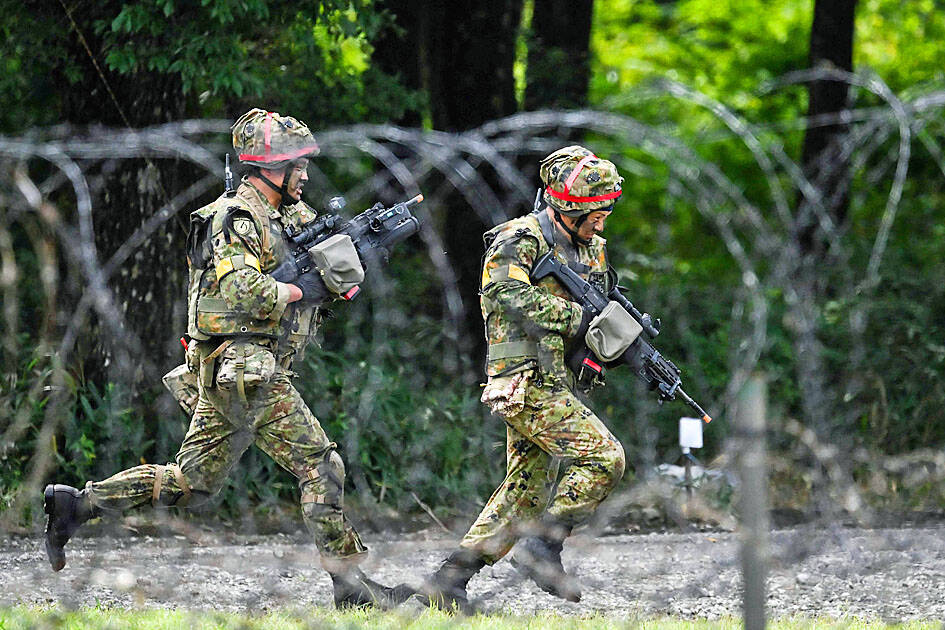
Members of the Japan Ground Self-Defense Force 6th Division acting as attackers assaulting a compound during an exercise covering drone and suppression operations at the Ojoji-ga-hara training area near Osaki, Japan, on Sept. 2.
Photo: AFP
A lower target, such as 3 percent, is also possible, one of the people said.
Like other US allies, Tokyo has been under pressure from US President Donald Trump’s administration to boost its defensive strength and reduce its reliance on the US military. Takaichi has already accelerated defense spending to almost 2 percent of GDP in the financial year ended in March, two years ahead of schedule.
Until 2022, Japan had an informal cap on defense spending at about 1 percent of GDP, an indication of how quickly thinking on defense has changed in the past few years. A new five-year defense spending plan is expected at the end of this year.
Committing to 3.5 percent could unsettle market players wary of large debt issuance, even though Takaichi has pledged to follow a “responsible, proactive fiscal policy.”
US defense officials have largely avoided public pressure on Japan to commit to a 3.5 percent defense spending goal, but they have made clear that they expect significantly more investment.
“We are anxiously looking for Japan to step up,” US Undersecretary of Defense for Policy Elbridge Colby said last month of Tokyo’s defense spending.
In meetings between defense officials from both nations, Japan has indicated it would most likely align with other US allies, but it has avoided discussing details, according to the people, who requested anonymity because of the sensitivity of the matter.
Some Japanese officials have said they are not ready to make a formal pledge and would deny the existence of such a goal if it was made public, the people said.
In public, Japanese Minister of Defense Shinjiro Koizumi has said spending would be determined by military needs rather than monetary targets.
The ministry did not immediately provide a response to a request for comment. The Pentagon declined to comment.
Koizumi in April said that defense spending and related expenditures for this fiscal year of ¥10.6 trillion (US$68.48 billion) were equivalent to 1.9 percent of nominal GDP in 2022.
Measured against the Cabinet Office’s nominal GDP forecast for this fiscal year, spending would come to 1.5 percent, he said.
A budget of 3.5 percent using that forecast would amount to ¥24 trillion, more than double the current amount.
International Institute for Strategic Studies Japan chair Robert Ward said the groundwork had been laid among policymakers and bureaucrats in Japan for a big jump in defense spending.
It is now mostly a matter of timing of when Japan goes to 3.5 percent, he said.
“Whether it’s over five years or 10 years, I don’t see any alternative given how important the US alliance is,” Ward said.
KioskNews shows a cleaned-up reading view extracted from the publisher’s page — the original always lives on their site, not ours.